Only the hardest of hearts could remain unmoved by the visceral power of John Cranko’s 1962 Romeo and Juliet.

The finest ballet set to Prokofiev’s monumental score, exquisitely performed here by the Opera Australia Orchestra under Nigel Gaynor with the brass expertly negotiating its exacting articulation and dynamic extremes, it is quite simply the perfect blend of music, choreography and design.
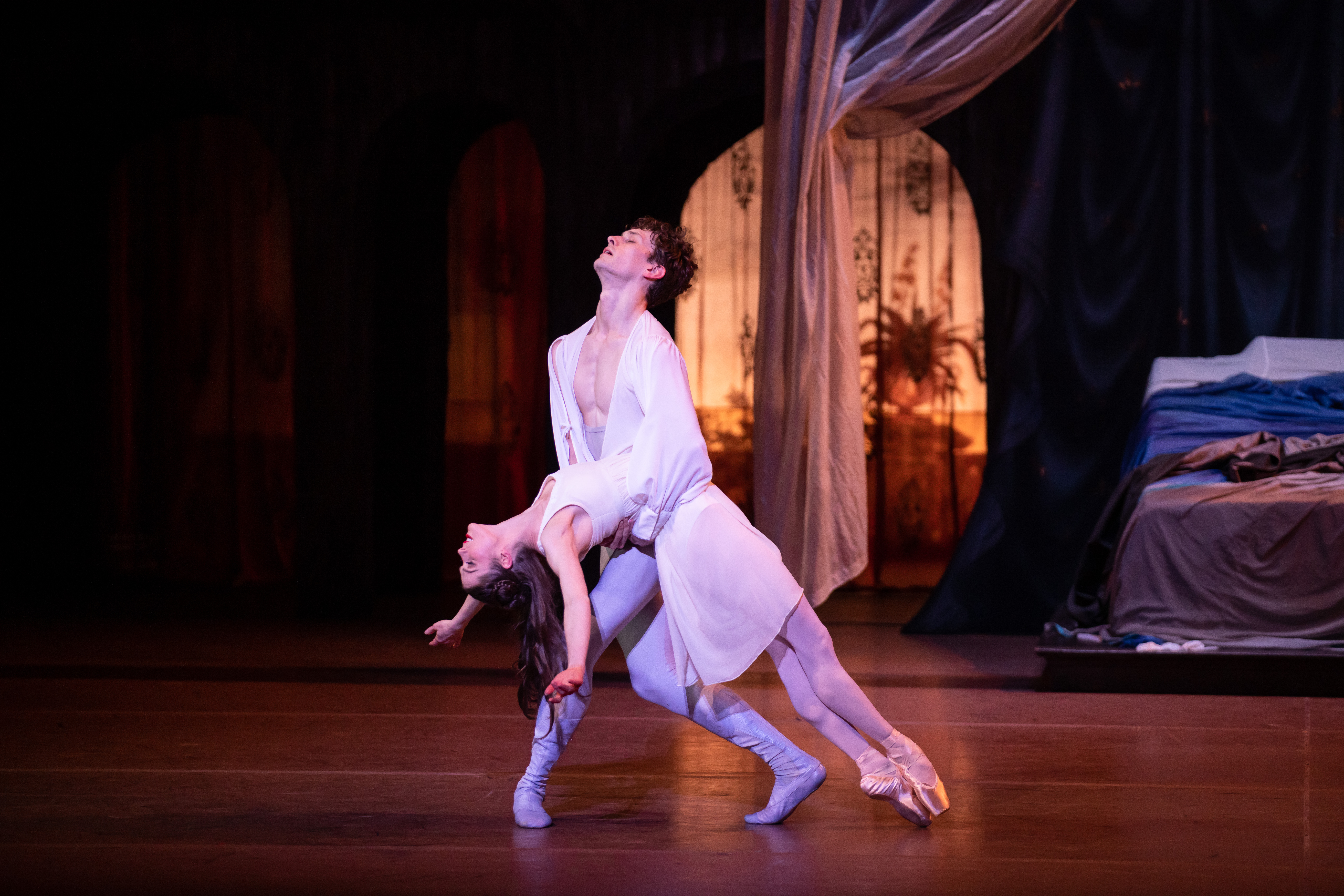
Sharni Spencer and Callum Linnane in The Australian Ballet’s 2022 season of Romeo and Juliet. Photo © Daniel Boud

Jürgen Rose’s backcloths are among the finest designed for a ballet and beautifully relit here by Jason Morphett after Jon Buswell – their forced perspective making it difficult to determine where their 3D renderings end and the physical set begins.

Rose’s depiction of the natural world is wonderfully naïve, like something out of a Rousseau painting, topped off by his signature crooked lines that Cranko insisted on retaining when Rose’s original sketches made their way to the stage.

Yet Cranko’s Romeo and Juliet is more than a beautifully crafted ballet. It is, frankly, one of the finest adaptations of Shakespeare’s tragedy, making it even harder to believe that Prokofiev originally conceived a happy ending for the ballet.

Fortunately, the composer saw reason for its first revival and, as we watch the dying Juliet (Sharni Spencer) embrace the lifeless body of Romeo (Callum Linnane), you could cut the air with a knife.

That can also be said of the entire evening, with the dancers of The Australian Ballet firing on all pistons.

Despite retaining Shakespeare’s period Veronese setting for his treatment of Prokofiev’s score, Cranko was inspired by the fate of those separated by the Berlin Wall, and in this latest revival by the national company, the political tension simmers.

Every member of the company adds fuel to the fire, whether in the street, where horseplay quickly turns into swordplay, or at the Capulet’s ball, where a graceful gavotte is punctuated by mercurial sideways glances – a flirt here, a hateful sneer there.

The Australian Ballet’s 2026 season of Romeo and Juliet. Photo © Daniel Boud

While still perfectly coordinated, the coryphées and corps de ballet honour Cranko’s intentions to forgo uniformity in favour of individually honed personas.

The dancers’ commitment to character is impressive, from the townsfolk and revellers at the carnival to the Romani dance girls and tumblers in the town square.

Among those excelling in their multiple roles are Adam Elmes as both a put-upon Capulet in the opening scene and a carnival clown in Act II, and Timothy Coleman whose rickety Duke of Verona is sharply contrasted with the avuncular solemnity of Friar Laurence.

Juliet’s friends deliver lilies to the drugged heroine in a delightful dance that belies its intricacy, Adam Bull reveals the duplicity behind Lord Capulet’s apparent peacekeeping, Larissa Kiyoto-Ward and Gillian Revie bring dignity to an otherwise bellicose environment as Rosina and the Nurse, and Jarryd Madden earns our sympathy as the hapless Paris.

Marko Juusela and Elijah Trevitt couple technical prowess and charm as Romeo’s raffish friends Mercutio and Benvolio. In the opening scene, they elicit laughs as they richochet off Romeo and another Montague kinsman (Drew Hedditch) in sideways shoulder bumps, later impressing us once more alongside Linnane in the pas de trois outside the Capulet’s mansion – double tours en l’air all delivered in perfect unison.

During Mercutio’s death scene, Juusela goes in for some expert dial-turning, making us laugh and cry simultaneously with his feigned bravado as he slips away from us – our horror reflected in the eyes of the dancers around him.

Callum Linnane and Sharni Spencer in Romeo and Juliet. Photo © Daniel Boud

It is juxtapositions like this that underpin the potency of Cranko’s ballet.

Mercutio’s ceaseless charm contrasts sharply with the baleful defiance of Tybalt’s final moments, brilliantly danced here by a smouldering Jeremy Hargreaves.

Lady Capulet’s hysteria at her brother Tybalt’s death couldn’t be more at odds with her restrained sorrow as she holds her seemingly lifeless daughter in her arms – the patrician Katherine Sonnekus delivering a nuanced portrayal in this most enigmatic of roles.

And then there is the extraordinary change the titular lovers undergo between the balcony scene and their second ravishing pas de deux in the bedroom – the virginal Juliet becoming a woman before our eyes as Romeo is thrust into manhood, his hands already bloodied.

It would be easy to paint this in broad brushstrokes, but Spencer and Linnane are so at one with these characters, their virtuosic dancing is matched by their acting prowess – their sexual awakening and loss of innocence now tinged with a dawning disillusionment.

Compared to their already brilliant performances in 2022, Linnane and Spencer have truly made the roles of Romeo and Juliet their own, and as they mature as dancers, their youthful intensity seems even more intense when considered alongside the melancholy and sorrowful self-sacrifice they convey later on – their experience dancing Ashton’s Margerite and Armand in 2023 clearly paying off.

Callum Linnane and Sharni Spencer in Romeo and Juliet. Photo © Daniel Boud

As for their handling of the choreography, this really is as good as it gets, Linnane effortlessy sweeping Spencer up in Cranko’s trademark “Stuttgart lifts” – a breathtaking marriage of acrobatic skill and fluidity.

In a 2019 interview with The Daily Telegraph, Spencer said, “A dancer is doing well if they can dance into their forties.” Given each time she performs Juliet, she seems daintier and exudes more youthful charm, she may want to reconsider her position. A long career seems certain, followed perhaps by an “Indian Summer” like Margot Fonteyn.

Linnane is the full package, and his emotional intensity never wanes, not even while completing a perfectly anchored series of pirouettes à la seconde. It is wonderful to see his technical prowess remains as polished and refined in the classical repertoire as it is in his signature contemporary roles in Johan Inger’s I New Then and Carmen, where he dazzled audiences as Don José, or his star turn as Nijinsky in John Neumeier’s eponymous ballet.

It is no surprise Linnane is joining Neumeier’s former company, the Hamburg Ballet, at the end of this season of Romeo and Juliet. They are a perfect fit.

He will be sorely missed at The Australian Ballet, but while his star continues to ascend, his extraordinary talent deserves to be seen by as wide an audience as possible.

Until then, Australian fans can still catch him in his final season with TAB, Cranko’s evergreen masterpiece proving the perfect vehicle for his farewell.


The Australian Ballet presents Romeo and Juliet at the Joan Sutherland Theatre, Sydney Opera House until 13 May; Regent Theatre, Melbourne, 6–16 June; Lyric Theatre, QPAC, Brisbane, 15–22 June.

Contribute to Limelight and support independent arts journalism.