




A passion project of baritone Leon Vitogiannis, the idea of presenting this truncated version of Debussy’s Pelléas et Mélisande crystallised through his work with Étienne Dupuis while participating in the Opera Australia Young Artist Program.
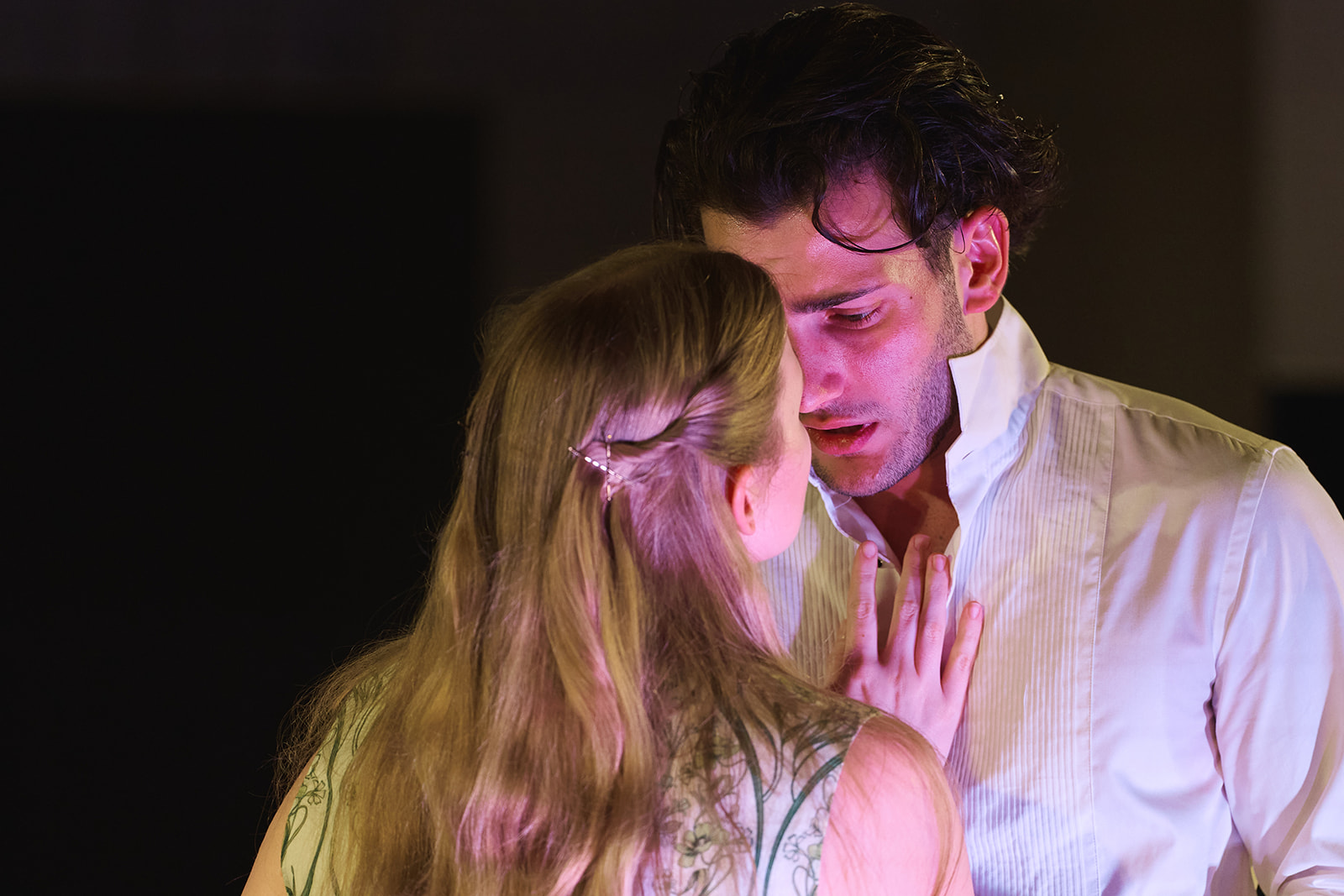
Lana Kains and Leon Vitogiannis in OA’s Scenes from Pelléas et Mélisande. Photo © Justin McLean
It is easy to see why Dupuis would have thought Pelléas a good fit for Vitogiannis. The role demands vocal youthfulness paired with the technical prowess and endurance that usually come with experience.
Vitogiannis has both in spades, conquering the nuanced, speech-inflected vocal line that was written for a Baryton-Martin and sits in the passagio. Vitogiannis rises to the unique challenges this presents with an equally singular approach that avoids obvious use of falsetto, instead applying a burgeoning heroism to his upper register that suggests Pelléas’s emotional and sexual awakening.
This is coupled with an acting performance that successfully conveys the character’s transition from timidity and childlike innocence to a more adult fixation the longer he spends with Mélisande, performed here by soprano Lana Kains.
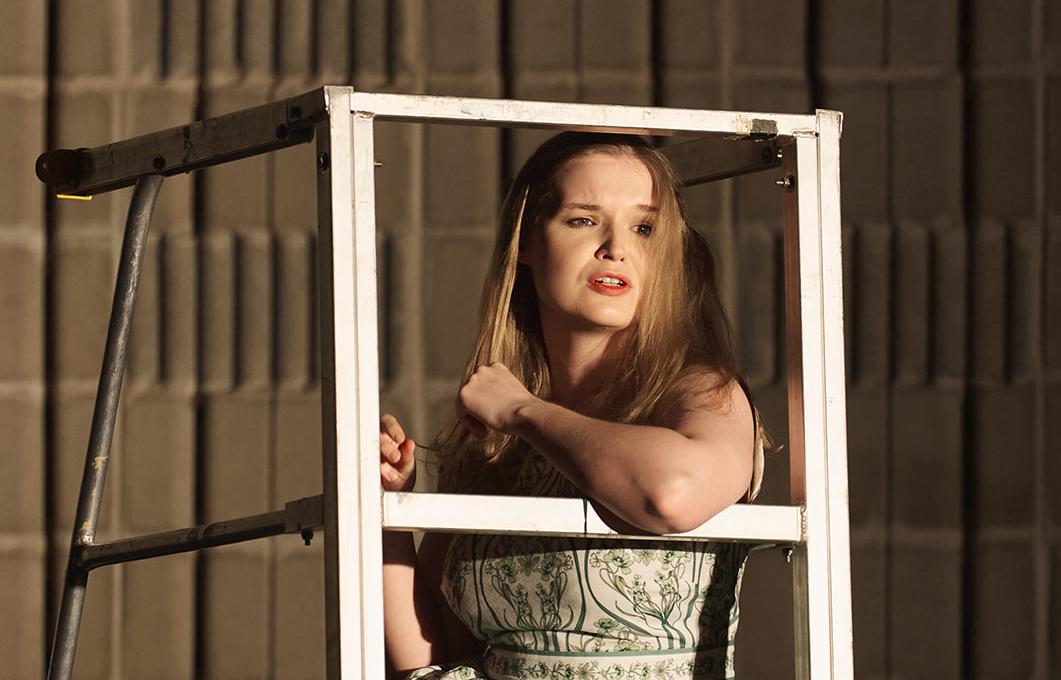
Lana Kains in OA’s Scenes from Pelléas et Mélisande. Photo © Justin McLean
Whereas Pelléas’s part sits higher than usual, Mélisande occupies a soprano’s middle range and requires a well-developed chest voice to work. Like Vitogiannis, Kains comes out with flying colours, putting her impeccable intonation and even tone to good use.
Having impressed us at this year’s Young Artists in Concert with a scene from Carlisle Floyd’s Susannah, here she thrills again, her radiant solo Mes longs cheveux descendent tout le long de la tour (My long hair descends all the way down the tower) matching Vitogiannis’s vocal prowess and emotional honesty.
Together they are irresistible and, despite the opera’s symbolist roots in Maeterlinck’s play of the same name, they bring an authenticity to the eroticism that simmers beneath the surface.
Full marks to director Edwina Strobl (also a member of this year’s OA Young Artist cohort) and intimacy coordinator Chloë Dallimore for successfully capturing the trajectory of Pelléas and Mélisande’s forbidden love, which is clearly signposted across three intimate scenes: The Fountain of the Blind, where Mélisande drops her wedding ring into the water and draws Pelléas toward her; the Rapunzel-like tower, where the symbolism of Pelléas’s fixation on Mélisande’s flowing locks needs no explanation; and the eve of Pelléas’s departure, when the two finally embrace.
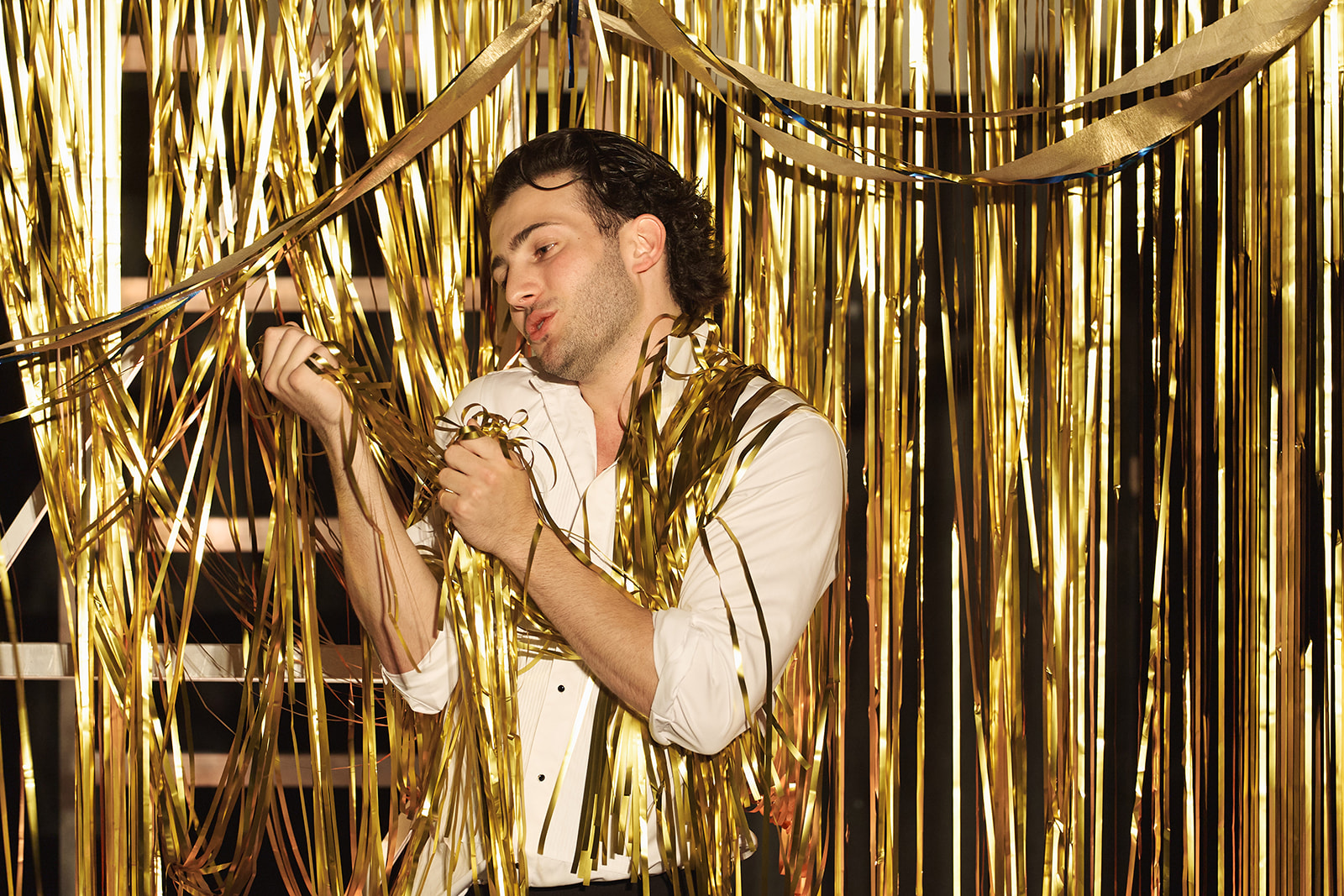
Leon Vitogiannis in OA’s Scenes from Pelléas et Mélisande. Photo © Justin McLean
Strobl’s directorial sleight of hand is impressive, and with only a handful of props cobbled together from a French Opera Scenes presentation earlier in the week, she delivers a potent drama that has the audience gripped. Two foil curtains (their blue and gold reflecting the opposing forces at play: light and dark, life and death), a platform ladder, a few chairs and a table are all it takes to convey Maeterlinck’s romanticised setting of Allemonde.
Strobl animates it all through beautiful use of ‘poor theatre’: the gold foil curtain becomes Mélisande’s cascading hair as it envelops Pelléas; the table becomes the fountain’s edge, where Kains and Vitogiannis sit, while mezzo-soprano Sidra Nissen and bass Daniel Kramer lie beneath them, deflecting light from silver serving platters to create the shimmer of water.
Nissen, Kramer and fellow OA Young Artists – tenor Chris Whalley and baritone Jake Lyle – take on chorus duties, supplementing Debussy’s evocative soundscape and using hand shadows to create flying birds on the back wall of the Warwick Fairfax Studio.
Nissen also makes light work of the role of Mélisande’s mother Geneviève, while Lyle is Golaud – Mélisande’s husband and Pelléas’s half-brother.

Jake Lyle in OA’s Scenes from Pelléas et Mélisande. Photo © Justin McLean
Golaud is the most conventionally operatic of the roles in the opera, with a more jagged and dynamically varied vocal style than the fluid lines of the title characters. Fresh from his triumph as the Phantom earlier this year, Lyle is a dab hand at conveying jealousy, using his imposing voice to foreshadow Golaud’s heartbreak and murderous rage when he scolds Pelléas and Mélisande.
At the piano, Head of Young Artists Francis Greep works a small miracle, singlehandedly navigating Debussy’s hypnotic score, shaped around the natural cadence of French speech. OA’s Young Artists have clearly benefited from their workshops with pianist, conductor and vocal coach Marie-France Lefebvre, successfully conveying the opera’s condensed narrative under Strobl’s ingenious direction.
It leaves us wanting more, and with OA’s new Director of Opera Amy Lane in the audience, we hopefully won’t have to wait too long for it to resurface. One can only hope it’s with this cast.
More information on the Opera Australia Young Artist Program is available here.





Comments
Log in to start the conversation.