


Constantine Costi’s gorgeous new production of La bohème is Opera Australia’s final major outing in its temporary Melbourne home, the Regent Theatre. This 1929 picture palace turned musical theatre venue is also gorgeous, but decidedly not built for opera.
Led by British conductor Finnegan Downie Dear, Orchestra Victoria sound splendid out in the open where the front rows of stalls seating usually are, but the cast are at a disadvantage.
Led by Russian Galina Cheplakova and Chinese-Australian Kang Wang, they must sing across this vast band to an audience that’s unusually distant even in the best seats, in a space with unhelpful acoustics.
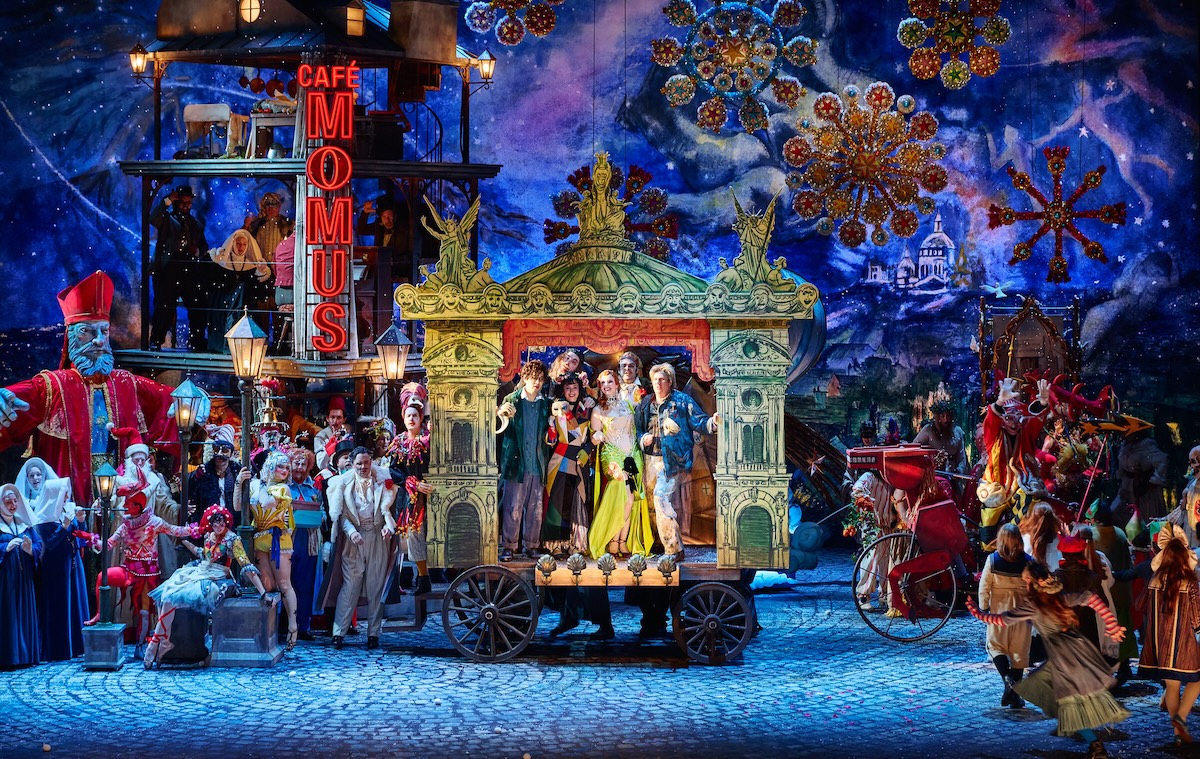
The Cast of Opera Australia’s La Bohème 2026. Photo © Peter Foster
Premiering in Turin in 1896, Puccini’s La bohème sees impoverished creatives wrestling with the problem that love and art is not necessarily enough for happiness let alone survival.
Poet Rodolfo falls for seamstress Mimi, while his painter friend Marcello has a tempestuous relationship with singer Musetta. As disagreements mask devotion, the increasingly ill Mimi leaves penniless Rodolfo, but her fate is already sealed.
Wang (Rodolfo) and Cheplakova (Mimi) sang with insufficient power for the theatre during opening night’s first half, though the lyricism and beauty of their voices was still apparent in Act I’s biographical arias and love duet – which is literally elevated by a Costi coup de théâtre that seamlessly merges the first two acts.

Galina Cheplakova as Mimì and Kang Wang as Rodolfo in Opera Australia’s La Bohème 2026. Photo © Peter Foster
Cheplakova in particular returned in stronger voice after interval, showing off her soprano’s silvery top notes, lovely phrasing and dynamic mastery – she’s clear and affecting even in deathbed pianissimo. Dramatically her Mimi is a consistently appealing mix of sweet and sad.
There’s good chemistry between Cheplakova and Wang, who brings a slightly nerdy charm to Rodolfo (indeed his glasses and scruffy dark hairdo are reminiscent of Harry Potter). The tenor’s legato is silky smooth including in the upper register, and his phrasing is also delightfully expressive.
Soprano Alexandra Flood is an irresistible package of sexiness and vocal pyrotechnics for Musetta’s showstopping aria, Quando me’n vo’, while her subtlety speaks volumes in the final, poignant act.

Alexandra Flood as Musetta in Opera Australia’s La Bohème 2026. Photo © Peter Foster
Rodolfo’s bohemian pals are all in fine voice. Company veteran Luke Gabbedy makes the most of a supporting role with meat on it: as Marcello the baritone is by turns playful, jealous and sympathetic.
Bass David Parkin is gruff then touchingly sombre as philosopher Colline, while bass-baritone Shane Lowrencev is at ease playing flamboyant musician Schaunard – despite only being announced as Stephen Marsh’s replacement moments before curtain-up.
Among the minor roles, accomplished baritone Simon Meadows is luxuriously cast as Musetta’s sugar daddy Alcindoro, while the Opera Australia Chorus and Opera Australia Children’s Chorus also make fleeting but effective appearances in Act II.
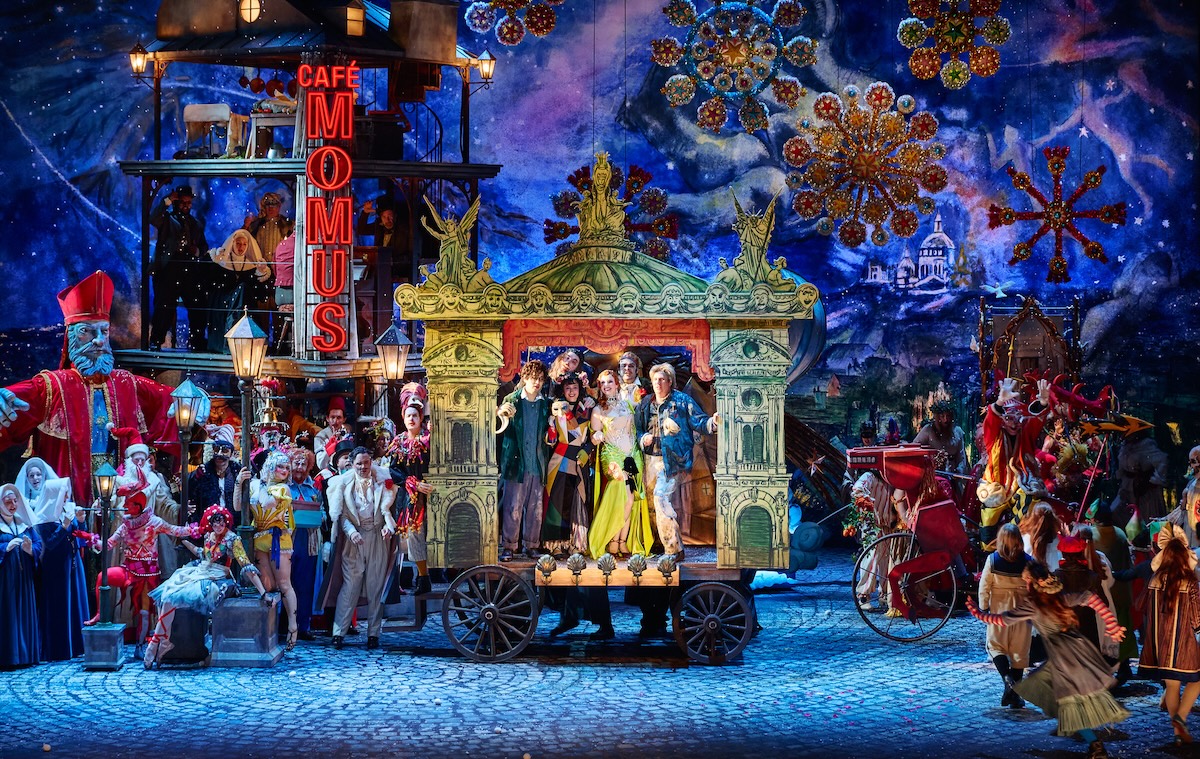
The Cast of Opera Australia’s La Bohème 2026. Photo © Peter Foster
Set among the bustling nightlife of Cafe Momus and the street beyond, this is always La bohème’s most lively act. Together with set designer Dann Barber and costume designer Sabina Myers, Costi goes all out here with carnivalesque colour and movement that conjures early 20th century bohemian Paris.
It’s a lavish, vintage spectacle of extraordinary creativity, beauty and detail, but there’s so much going on I couldn’t take it all in let alone the performances (beyond that Musetta showstopper). A small caravan-meets-stage’s malfunctioning curtain compounded the confusion.
Costi obviously has a flair for grand romanticism (also seen in last year’s The Abduction for Victorian Opera), yet he handles the opera’s three more modest acts well.
In the four bohemian mates’ garret – which is confined to a small space by black curtains – their knockabout scenes as well as Rodolfo and Mimi’s contrived problems with a key and candles are effective because of the direction’s naturalistic restraint. Just as those curtains close for the final time, we glimpse the heartbreaking gesture of Rodolfo taking up Mimi’s famously frozen little hand.
While Barber and Myers astonish with Act II’s maximalism – or minimalism in the case of Musetta’s slinky green dress – they also convey mood and character more sombrely in a patchwork coat, for example, and Act III’s painterly snow-swept darkness. Morgan Moroney’s lighting enhances each scene handsomely.
I sometimes wished I were experiencing this new bohème in the just-refurbished State Theatre, where this cast’s voices would surely sound sublime.
Chances are we will see Costi’s production in Opera Australia’s usual Melbourne home eventually (perhaps with a little less excess in Act II?). It transports audiences not just to old timey Paris, but also to states of intense love and grief, so should be in the repertoire for years to come.
Opera Australia’s La bohème is at the Regent Theatre, Melbourne, until 18 November, then plays the Sydney Opera House with a different cast 31 December 2026 – 17 March 2027.






Comments
Log in to start the conversation.