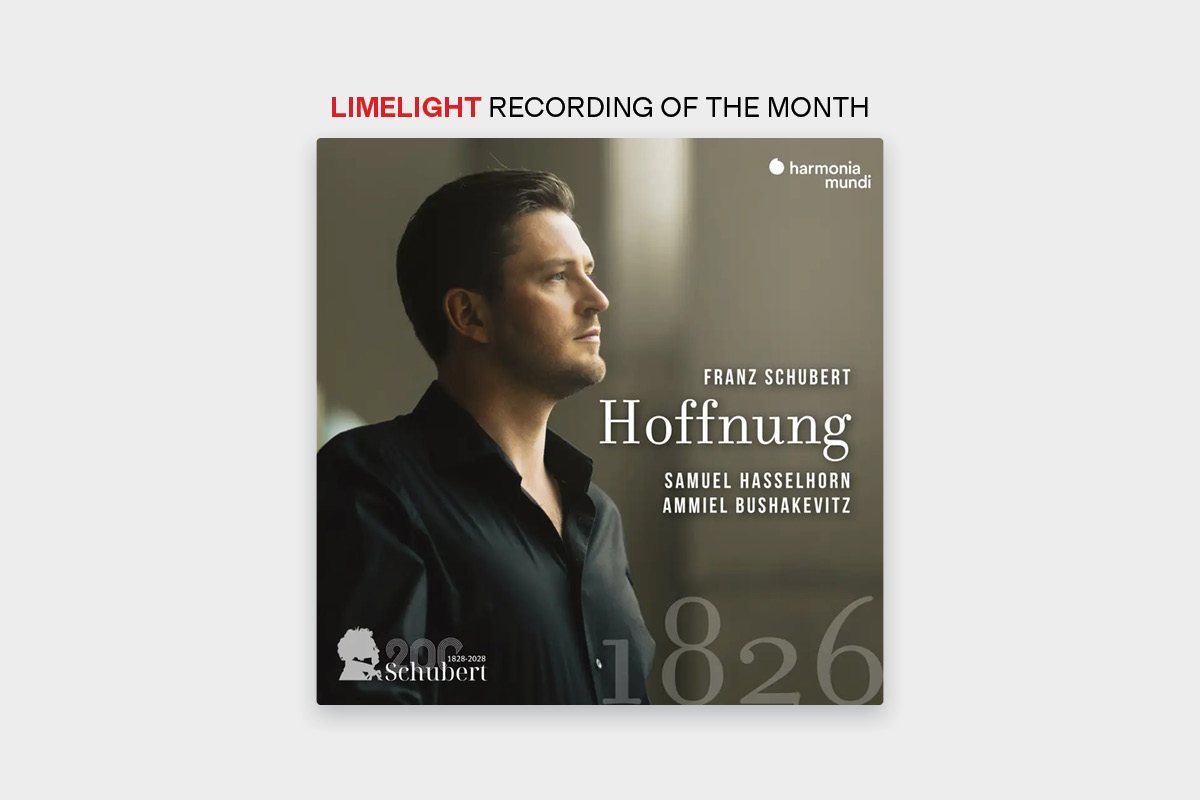
“We find ourselves in a time when hope in a better future is indispensable throughout the world,” write Samuel Hasselhorn and Ammiel Bushakevitz. Here, as part of Hasselhorn’s ongoing Schubert 200 project, these distinguished performers explore hope (“Hoffnung” in German) through 20 of Schubert’s sunnier Lieder, mainly written in one of the happier chapters of Schubert’s life, from 1825-26.
In their perceptive introduction to this wonderfully absorbing album, they also point to a Schubertian paradox. Happiness for this ultimately hapless composer is either in the past or in the future. A “subtle melancholy, a bittersweet yearning” pervades even his more irenic songs, while “we hear glimpses of positivity, a little smile full of hope in his ‘sad’ songs”.
This ambiguity informs these superb, finely calibrated performances that span many of Schubert’s classic subjects: the close connection between the realm of nature and human emotions; the remembrance of things past; then various poetic inspirations, including that of Shakespeare.
From the very first song, Im Freiem (In the Open Air), the striking synergy between Hassselhorn and Bushakevitz is immediately apparent. There is a captivating pliability in the pulsing accompaniment matched by the mellifluous expressivity of the voice. Such expressivity brings hopeful expectancy to Alinde, while the clouds that overshadow the happy recollection of Im Frühling demonstrate the dramatic versatility of Hasselhorn’s baritone. As Schulze’s poem puts it, joy alternates with strife. Bushakevitz comes into his own in An die Laute; the piano becoming a strummed lute to whom the young lover whispers secrets as he softly serenades his beloved.
Three Shakespeare settings contain plenty of contrast. The most famous, An Sylvia bounces with joyful confidence, while Staändchen sparkles with a subtle teasing quality. The Trinklied “Bacchus! Feister Fürst des Weins” based on lines from Antony and Cleopatra, is suitably Bacchanalian, complete with a comically tipsy postlude.
For this recording, Bushakevitz has also completed Schubert’s draft of Die Blume und der Quell, a charming dialogue between a flower and a spring. Remaining in nature, Der Wanderer an den Mond (The Wanderer to the Moon), a journeyman’s song has a rare, light optimism, contrasting with Das Zügenglöcken (The Passing Bell) and Totengräberweise (Gravedigger’s Song) in which Schubert’s classic major-minor duality evokes death and the hope of redemption.
Hasselhorn and Bushakevitz are sure guides through the labyrinth of Schubert’s conflicted emotions about life, love, desolation and the hereafter. In this brace of songs where the composer’s moods are predominantly buoyant, they are right to point to the hope they offer.
One of the other great lieder singers of our age, Christian Gerhaher has recently published Lyrical Diary: Lieder from Franz Schubert to Wolfgang Rihm. In Nicholas Spice’s thoughtful appreciation of this diary in the London Review of Books, he suggests that some Schubert Lieder, transposed from their original domestic context to a professional arena, lose their unknowingness, their naivete.
It is to the great credit of Hasselhorn and Bushakevitz that the final trio of touching, intimate songs: Wiegenlied (Cradle Song), Um Mitternacht (At Midnight) and finally Der Vater mit dem Kind (The Father with the Child) lose nothing of these qualities. Indeed, the simplicity and lack of artifice is exactly the element that offers the listener hope. As children know, there is nothing quite like being sung to by a parent. Here, we adults are offered the same profound consolation.
Composer: Schubert
Work: Hoffnung
Performers: Samuel Hasselhorn bar, Ammiel Bushakevitz p
Label: Harmonia Mundi HMM902779

Comments
Log in to start the conversation.