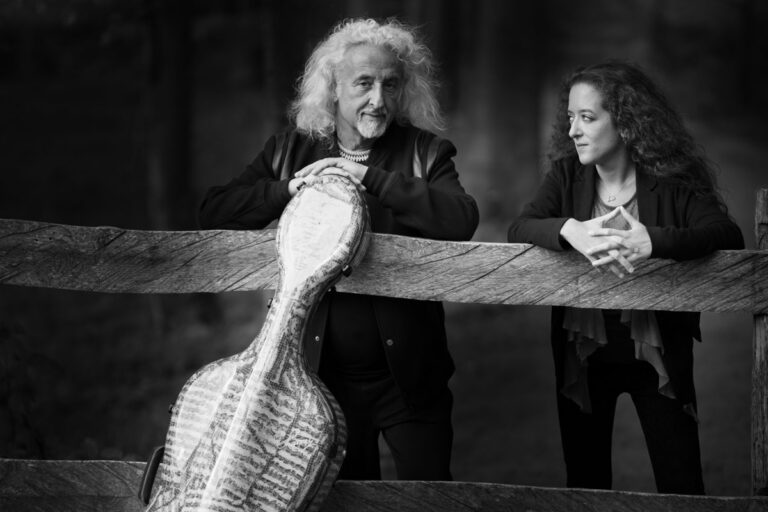
The year 2026 is the centenary of the birth of three significant figures in post-World World War II western culture — composers Morton Feldman (d. 1987) and György Kurtág (still composing), and poet and critic Frank O’Hara (d. 1966).

To celebrate the occasion, acclaimed Adelaide pianist, composer, academic and critic, Stephen Whittington, gives a thoroughly researched and highly entertaining recital that opens a window onto these and other important writers and composers with links to Feldman. In so doing, he characterises some of the revolutionary developments in music that emerged in the latter half of the 20th century.
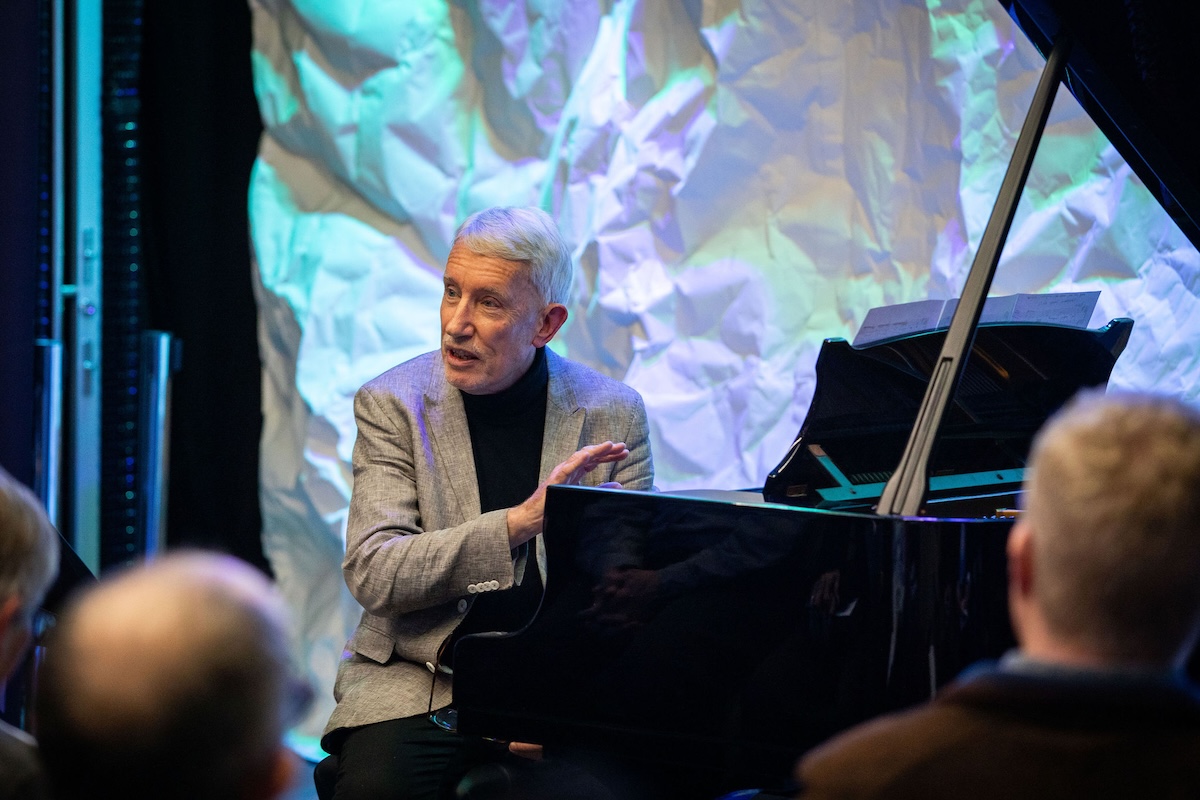
Stephen Whittington: Softly, Softly at MoD Adelaide. Photo © Dylan Henderson

The central figure is Morton Feldman and Whittington is an acknowledged expert on his sublime music. As well as Feldman and Kurtág, the program includes piano works by John Cage, Tom Johnson and Philip Corner, and Whittington performs one of his own works and reads poems by O’Hara and Samuel Beckett (1906-1989).

Whittington begins the recital with Feldman’s short Extensions 3, a sparsely scored and typically meditative work that proceeds slowly and quietly until near the end, when the peace is abruptly broken by chords played “as loud as possible”.

O’Hara, himself a fine pianist, worshipped Sergei Rachmaninoff and wrote seven different versions of On Rachmaninoff’s Birthday. The one Whittington reads begins: 

Blue windows, blue rooftops
and the blue light of the rain,
these contiguous phrases of
Rachmaninoff
pouring into my enormous ears
and the tears falling into my blindness

O’Hara was also a fan of Alexander Scriabin and Whittington includes a selection of Scriabin’s Poèmes, offering a compositional and pianistic contrast to the music of the other composers on the program. Feldman’s piano teacher was evidently a fellow pupil of Scriabin and passed on Scriabin’s delicacy of touch.

Stephen Whittington: Softly, Softly at MoD Adelaide. Photo © Dylan Henderson

This is followed by three very brief and characteristic pieces from Hungarian composer Kurtág’s Játétok (Games), including the quietest piece on the program, marked ppppp.

O’Hara and Feldman were close friends and collaborators, and the first stanza of O’Hara’s tribute poem Wind (for Morton Feldman) reads:

Who’d have thought
that snow falls
it always circled whirling
like a thought
in the glass ball
around me and my bear

Two short pieces by John Cage follow: the mechanical sounding A Room for prepared piano, and Piano Piece (3-5-2), both written before Cage and Feldman met. These pieces seem to prefigure Feldman’s music, and Cage and Feldman became close, but in his informative program notes, Whittington points out that the two were quite different artistically and temperamentally. He quotes Feldman: “I’m a European intellectual, not an American iconoclast.”

Tom Johnson’s Euler’s Harmonies is based on 18th-century Swiss mathematician Leonhard Euler’s theory of musical intervals. Johnson (1939-2024), who took a mathematical approach to his own music, was a student of Feldman’s, a music journalist and composer, and the first to apply the term “minimalism” to music.

Pianist and composer Philip Corner (b. 1933), a member of the Fluxus Group, once participated with other artists in a performance involving the brutal destruction of a piano. The shortest work on the program is Corner’s One Note Once.

Whittington’s own work, the slow, quiet A Forgotten Dream, is monophonic – one note is played at a time and it’s to be played by the left hand. This work, together with those of Cage and Johnson, illustrates the idea of composing to a restrictive formula, a popular approach in Feldman’s era, and the works of Cage, Johnson and Corner reflect on the very idea of what constitutes music.

Whittington then reads Samuel Beckett’s poem Neither, which Feldman used as the libretto for his opera of the same name, though the ‘opera’ is really a setting of the poem for soprano and orchestra. Beckett and Feldman were collaborators, and Kurtág also set Beckett’s texts.

Stephen Whittington: Softly, Softly at MoD Adelaide. Photo © Dylan Henderson

The evening concludes with the feature work, Feldman’s Palais de Mari, one of his last works, which was inspired by the uneven ruins of the Babylonian Palace of Mari. It’s slow and gentle and, as with his most famous piano works, Triadic Memories and For Bunita Marcus, it places the listener into a restful but attentive state. Whittington is the finest of pianists and his renditions are definitive.

Feldman was a collector of central Asian rugs and his concept of “crippled symmetry”, which is reflected in his late compositions, was inspired by slight variations in the rugs’ colouring and designs. One listens to the attack and decay of each note, and the notes then seem to assemble themselves into interesting patterns that evolve in unpredictable yet appealing ways.

Stephen Whittington is well known for his entertaining and thought-provoking performances that are quasi-lectures on particular composers and their music. This wondrous recital seems like a gently unfolding composite artistic work, and it exemplified the endless webs of influence that inform artistic creation.


Softly, Softly was presented as part of the MOD. x Elder Conservatorium: Sounding the Future series co-presented with the J. M. Coetzee Centre for Creative Practice.

Contribute to Limelight and support independent arts journalism.