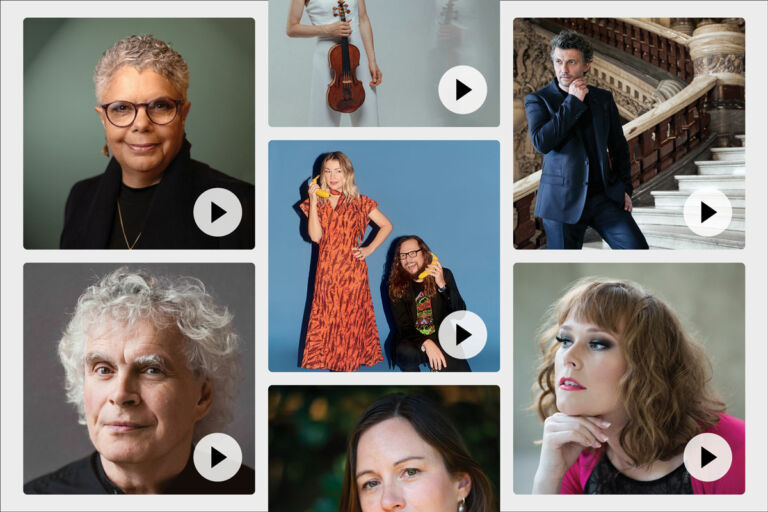
Since the Blackheath Chamber Music Festival’s inception in 2021, composer Ross Edwards has featured prominently, with his works included in the 2022 and 2024 programs, and a personal appearance last year in conversation with Diana Doherty, who also performed Edwards’ Oboe Concerto Bird Spirit Dreaming, commissioned for her and the Sydney Symphony Orchestra in 2002 by Andrew and Renata Kaldor.
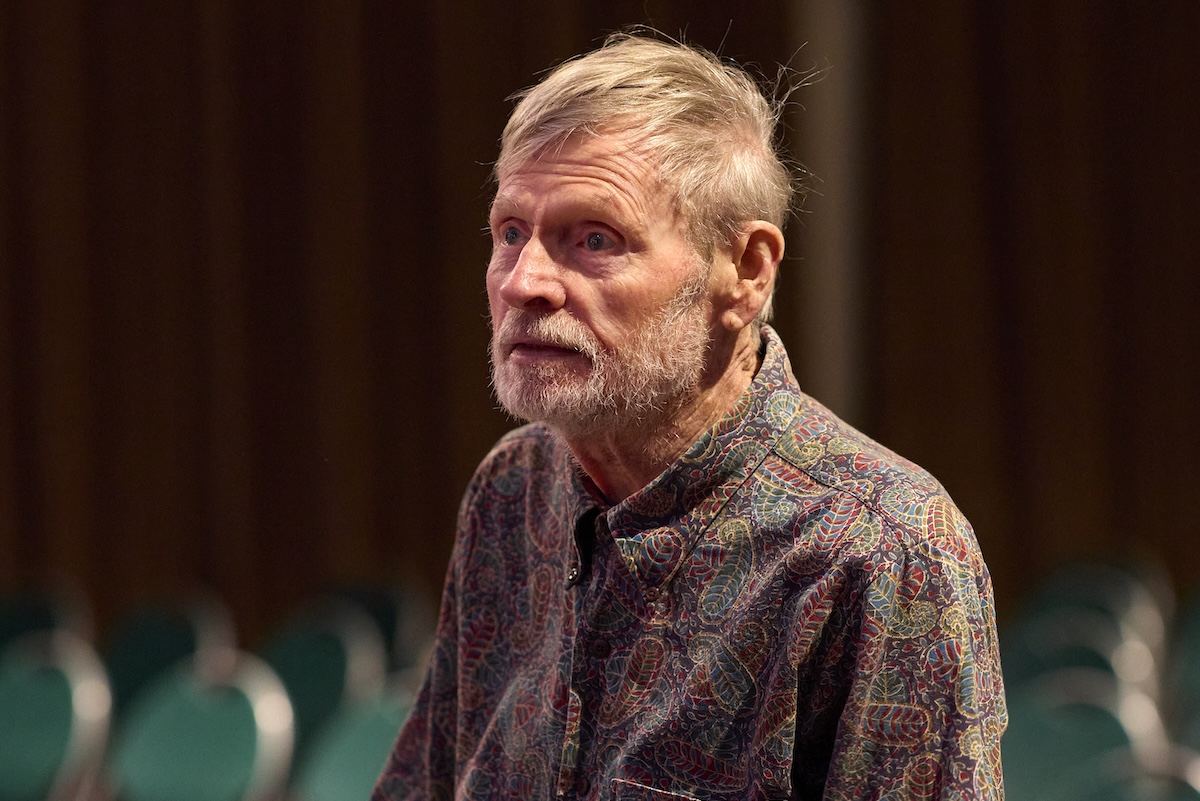
It seems only fitting, then, that Edwards should return to co-curate the closing program in what will be the final festival under founding President and Director Catherine Harker.
In fact, it is very much Edwards’ day, with the festival’s penultimate concert Danses de jeunesse also featuring his five-movement work for wind quintet, The Laughing Moon, written in 2012.
Alongside music by Piazolla, Ravel and Janáček, it is given a glorious reading by Sydney Symphony Orchestra’s Principal Wind Soloists – Emma Sholl (flute), Shefali Pryor (oboe), Matthew Wilkie (bassoon), Samuel Jacobs (horn) and Olli Leppäniemi (clarinet).
Described by Edwards as “light but not trite”, The Laughing Moon is a fine example of his “Maninyas” dance-chant style and sets the tone for an afternoon dedicated to the composer’s passion for the natural environment, First Nations’ cultures, dance and ritual.

Blackheath Chamber Music Festival’s The Laughing Moon. Photo © Keith Saunders
Based on his earlier work Djanaba – the Eora word for ‘laughter’ – it pairs buoyant rhythms with moments of introspection, such as the fourth movement, Moon Song. During the Interlude with Imaginary Birds, Edwards’ trademark onomatopoeic birdcalls are beautifully rendered by Sholl, transporting the audience to the rainforest, while Jacobs does the honours on Aboriginal rhythm sticks in the final Clapping Dance.
This is followed by the festival’s closing concert, Terra mater aestiva, a bespoke program devised by Edwards and including a specially arranged suite based upon his Vespers for Mother Earth – a response to Monteverdi’s Vespro della Beata Vergine (Vespers for the Blessed Virgin) that celebrates and mourns the natural world in the face of today’s ecological crises, as well as expressing hope for a restored sense of community and renewal.
The assembled forces include several members of The Song Company who premiered the original version in 2024, and the complete lineup comprises sopranos Susannah Lawergren and Susie Bishop, mezzo-soprano Jessica O’Donoghue, tenor Geoffrey Webb, bass-baritone Andrew O’Connor and bass Philip Murray, with a reduced musical ensemble including Riley Lee on shakuhachi, Louise Johnson on harp, Julian Smiles on cello and Timothy Constable percussion.
The performance is conducted by Nicholas Routley, who also commissioned the opening five Latin songs, Ab Estatis Foribus (At the Gates of Summer) for the Sydney Chamber Choir in 1979.

Susannah Lawergren and Louise Johnson in the 2026 Blackheath Chamber Music Festival’s Mater Aestiva. Photo © Keith Saunders
If the previous day’s program, The Passionate Pilgrim, had a hint of ritual about it, this presentation of Terra mater aestiva is the real thing, with theatrical lighting judiciously pin-pointing the singers and musicians who enter in ceremonial procession.
We are greeted by the intentionally archaic Ab Estatis Foribus sung a capella, the five songs evoking medieval lyricism rather than Edwards’ usual engagement with the natural world or local and Asian-Pacific musical traditions.
A choral invocation of summer, it sets four 13th-century poems about seasonal transition and the vicissitudes of love taken from the Benediktbeuern manuscript, alongside one 5th-century poem written by Aurelius Prudentius Clemens about the restorative nature of sleep.
The second song about unrequited love, Dum estas inchoatur, sung with a lilting melancholy by Lawergren and O’Donoghue, stands out as one of the many highlights in this ultimately transcendent performance.
Edwards’ reduced Suite from Vespers for Mother Earth follows. With the audience in semi-darkness and sounds of a purifying stream filling the hall, Lee appears like a shaman to “breathe life” into the darkness. Inspired by the meditational music of Zen monks (hokyoku), his shakuhachi solo serves as an invocation of dawn.
With a sweeping wire scrape on her harp, Johnson appears in a pool of light shared by Lawergren, and together they perform the poignant aria Flame of the Sun. With text by Hildegard von Bingen, sunlight grants spiritual illumination as Lawergren’s ecstatic interval leaps recall the chirping of birds at first light.
As the sun rises, Smiles appears seated near Lawergren, and her aria segues seamlessly into his extended, meditative cello solo, Orison. At times unsettled, it expresses a yearning to transcend the “fragmented, temporal world” before the Vespers come to a close with the sublime o magnum mysterium, the six unaccompanied singers looking skyward as night falls once more.
Contemplating our place in the universe, the male voices ask, “What is it all for?” and the female voices reply, “The answer is love.”

Julian Smiles in the 2026 Blackheath Chamber Music Festival’s Mater Aestiva. Photo © Keith Saunders
Rounding out the proceedings, Edwards repurposes his 1992 Dance Mantra, with Constable beating a hand drum as he makes his way down the centre aisle to join his colleagues on stage, his rhythmic invocation inducing an almost trance-like state, fuelled by the collective energy of the musicians and their rapport with the audience.
For those present, it is a defining moment: a testament to the genius of Ross Edwards and the apotheosis of Catherine Harker’s vision for a festival that could provide solace at a time of suffering.
In 2021, it was the pandemic. And today?
Thank goodness for the healing power of music.
For more information on Blackheath Chamber Music Festival, visit this link.

Comments
Log in to start the conversation.