For three decades Genevieve Lacey has been acknowledged as Australia’s “queen of the recorder”,  but despite playing for Queen Elizabeth at Westminster Abbey, featuring in a London Prom concert and collaborating with multiple orchestras and ensembles at home and abroad, she has only now made her debut with the Sydney Symphony Orchestra in an intriguing recital at Sydney’s City Recital Hall.
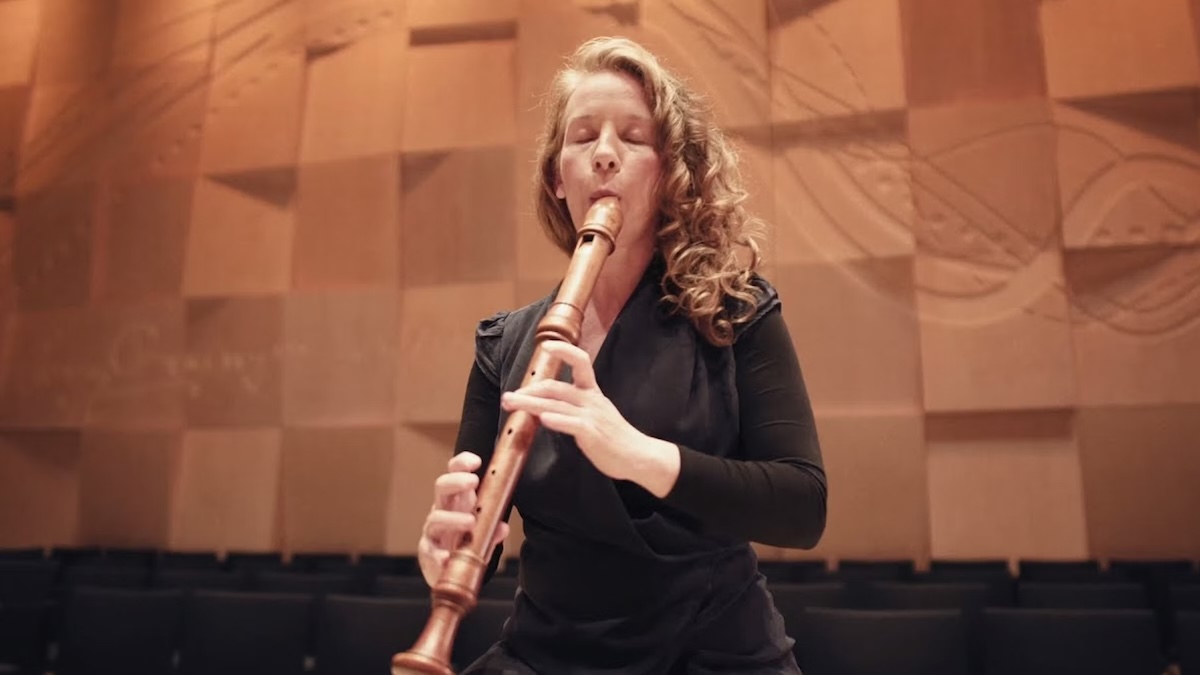
Genevieve Lacey

Curated by the Melbourne-based musician and led by SSO Concertmaster Andrew Haveron, the one-hour program featured six contemporary composers – three Australians, two Brits and an American – and their takes on the Baroque and the Renaissance alongside a scintillating performance of Giuseppe Sammartini’s Recorder Concerto in F, in what Lacey describes as “a labyrinth of contemplation on time’s infinitely beautiful haze”.

Several composers, most notably Benjamin Britten, have raided John Playford’s The Dancing Master, a 17th century collection of English country dances and folk tunes, and former ACO violinist Erkki Veltheim’s A Playford Maze is a montage of intercut tunes, featuring Lacey’s recorder and short orchestral links.

This 11-minute patchwork showed the small string ensemble in various combinations as the dances ranged from slow and courtly over a drone from Neil Peres Da Costa on chamber organ and Simon Martyn-Ellis on theorbo, to quick and lively with a hornpipe, piccolo recorder bird calls and laments from Catherine Hewgill’s cello and a double bass solo from Benjamin Ward.

UK-based Australian Lisa Illean time-travelled six centuries back to the court of the Duke of Burgundy for her instrumental arrangement of two songs by Gilles Binchois, Amours merchi and Adieu, adieu, with the 12 musicians split into three complementary string quartets.

The effect was beautiful, the superbly controlled pianissimo playing sounding as if it came from a distance.

The mellow combination of two violas, two cellos and bass was used by Englishman Tom Coult for his Prelude which evokes the little known world of 17th century bass viol player and composer Monsieur de Sainte-Colombe, teacher to Marin Marais.

American composer Caroline Shaw took Joseph Haydn’s second Lobkowitz quartet, Op. 77 No. 2, as inspiration for Entr’acte. More specifically she “riffs” on the shift to the D-flat major trio in the Minuet second movement.

Hints of the original would intrude and Shaw’s use of pauses, shifts from bowing to pizzicato and delayed timing all added to a sense of Haydn’s wit, ending with groans and sighs from the fiddles.

Lacey returned to the stage for the world premiere of Illean’s Swellsong, featuring the melancholic plainchant voice of the bass recorder. Behind the 11 musicians on stage pre-recorded strings provide an overlay as the musicians play unhurriedly “as if suspended in waves”.

There was also a maritime feel to Thomas Adés’s Shanty – Over the Sea with a rocking rhythm set up by bass harmonics and plucked violins in a slurred chord sequence in which it was difficult to focus on the horizon. Anyone with Ménière’s disease will identify with this!

The evening ended, as all good evenings should, in a ceilidh with an infectious jigging duet between Lacey and Haveron in Sydney composer Alice Chance’s Nose-scrunch Reel, originally composed for the Australian String Quartet.


Contribute to Limelight and support independent arts journalism.