


The Cooperative always seems to have a surprise up its moth-eaten sleeve. When I reviewed its production of Nabucco last year, I noted that Artistic Director Menila Moineaux was moving in the direction of the pop-up productions associated with Birmingham Opera Company under the late Graham Vick.
I’m pleased to report that this year’s double bill, presented as part of The Cooperative’s inaugural Freedom Festival of independent music and theatre, reinforces that.
Like a modern-day Joan Littlewood, Moineaux wholly embraces her company’s genuine poverty. This isn’t a case of Grotowski’s ‘poor theatre’ as an aesthetic choice, but genuine makeshift theatremaking that doesn’t just blur the lines between the audience and the stage; it eliminates them altogether.
This mightn’t suit every opera in the repertoire, but Moineaux is a dab hand at programming, and this year she has outdone herself with her staging of Viktor Ullmann and Peter Kien’s Der Kaiser von Atlantis oder Die Tod-Verweigerung (The Emperor of Atlantis or The Disobedience of Death), written and rehearsed between 1943 and 1944 at the Nazi concentration camp in Terezín (Theresienstadt) near the Czech city of Ústí nad Labem.
A darkly satirical allegory in which Death goes on strike and leaves the haplessly bureaucratic Emperor Overall grappling with the consequences, its premiere was prevented by the SS, who recognised the political jabs aimed at Hitler. Instead, both composer and librettist were deported to Auschwitz and murdered before the work could be premiered.
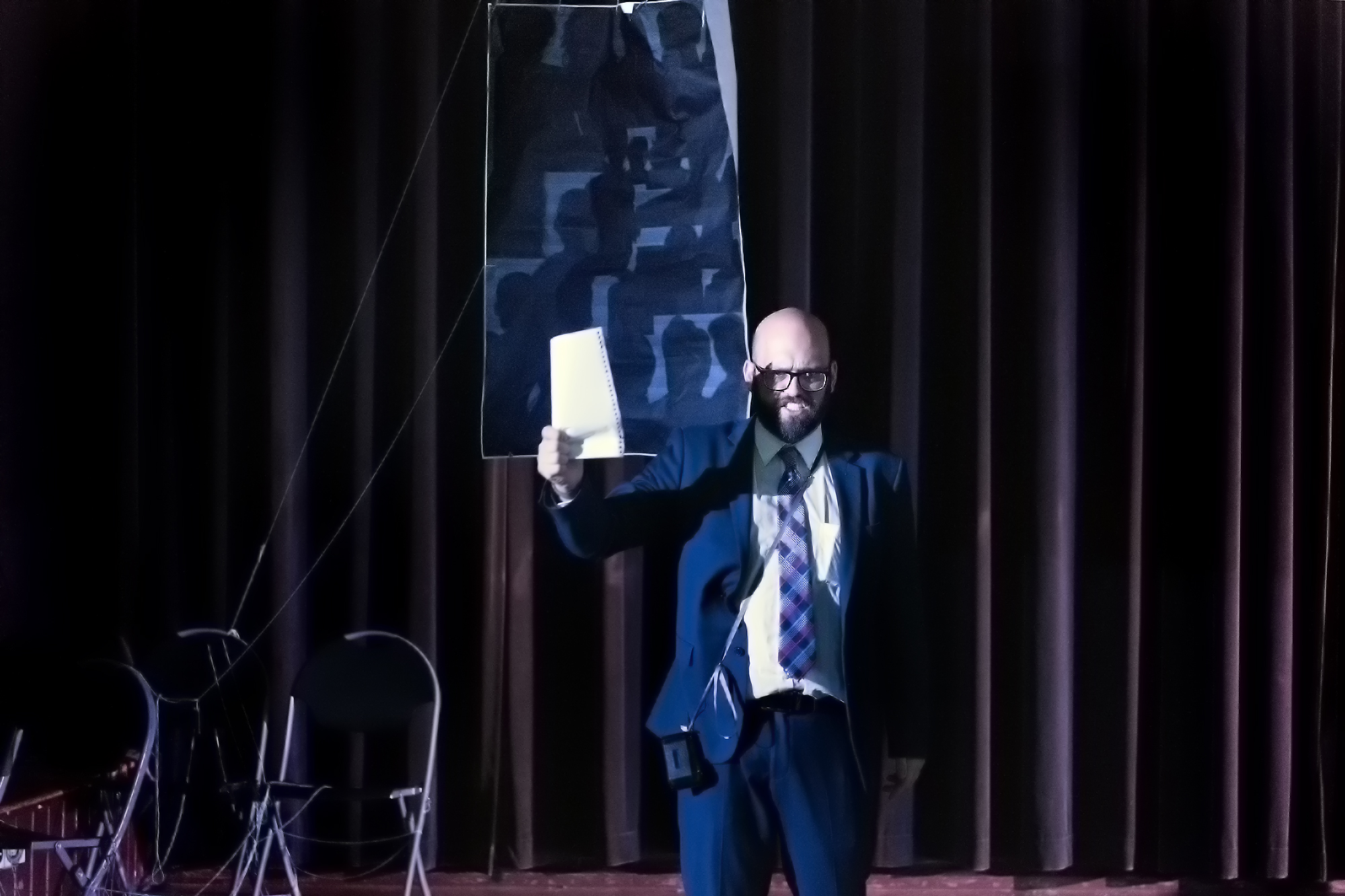
Michael Lampard in The Cooperative’s The Emperor of Atlantis. Photo supplied
I remember visiting Terezín with the late Sam Neill in 2002. I mention this because he was deeply concerned with history and human injustice, and it was fascinating to compare my very visceral response with his.
We were both immediately struck by the resilience of the Jewish artists, who persevered and continued creating entertainments for their fellow prisoners in the ghetto.
And we were equally appalled not only by the horror of the Holocaust as it had unfolded but by the perversion of the Nazis, who not only passed this hellhole off as a Jewish idyll when it was inspected by the International Committee of the Red Cross under Swiss physician Maurice Rossel, but also were able to pursue their own idyllic lives living alongside the Jewish inmates.
Where they didn’t derive sadistic pleasure from the suffering before their eyes, bureaucratic compliance offered an excuse to ignore and become oblivious to the gunshots of the firing squad in the so-called Small Fortress across the road.
Philosopher Hannah Arendt called this the “banality of evil”, and it has rarely been as well captured as it was in Jonathan Glazer’s 2023 film The Zone of Interest.
But here, Moineaux succeeds in evoking that same corruption of normality, adopting the same metatheatricality Ullmann and Kien had aspired to by casting us, the audience, as the Red Cross inspectors.
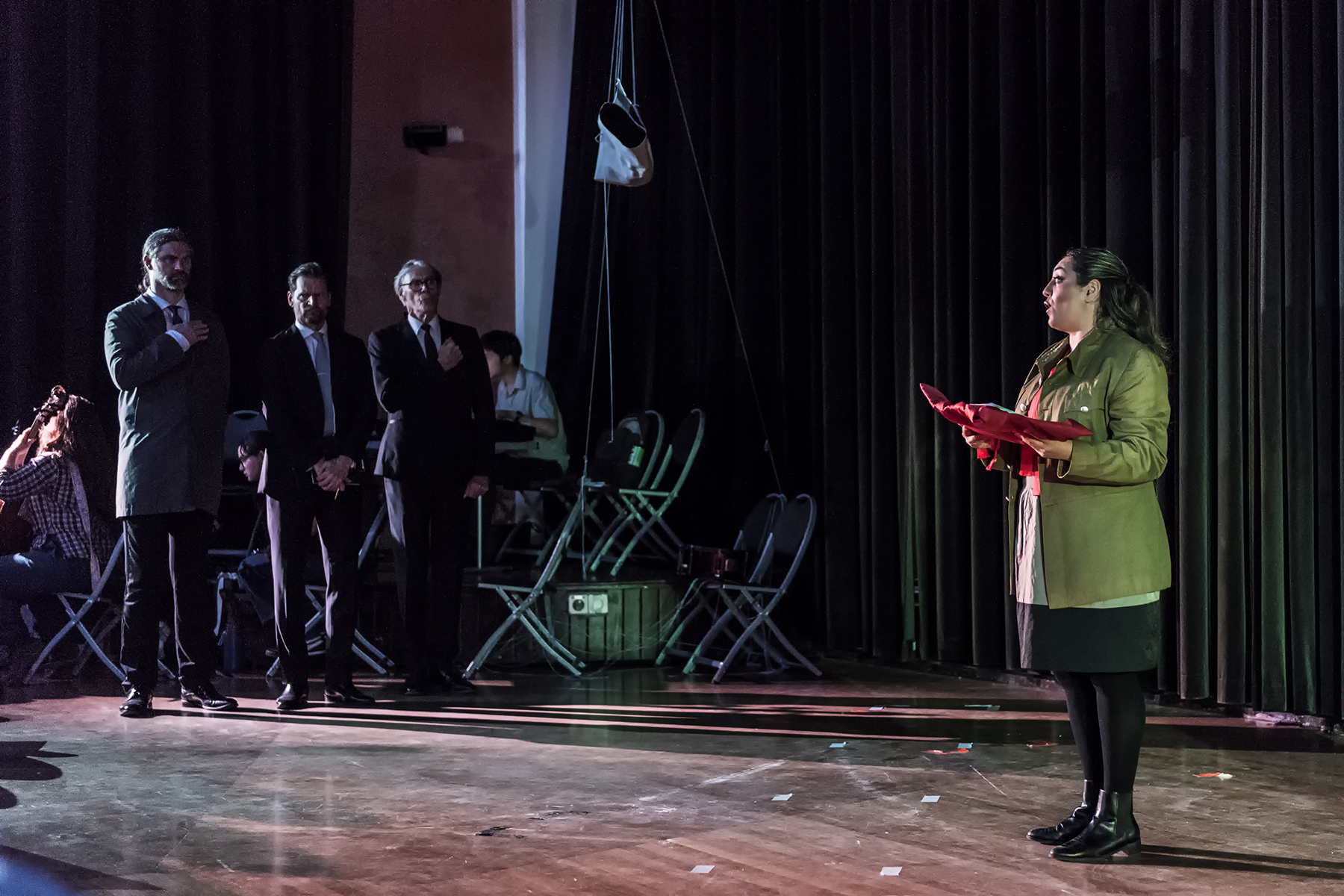
Matt Gaskin, Andrew Pennycuick, Andrew Paul Barbary and Angelique Tot in The Cooperative’s The Emperor of Atlantis. Photo supplied
The performance begins with baritone Dale Schilling as the officious Loudspeaker, who opens the doors to the hall and addresses us in the foyer. He is flanked by four faceless bureaucrats in suits (vocal ensemble members Andrew Paul Barbary, Tristan Entwistle, Matt Gaskin and Andrew Pennycuick) who usher us inside.
Unlike the elaborate stagings at opera houses around the world, Moineaux creates an immersive environment with little more than a couple of chairs borrowed from the audience, a few bits of string, gaffer tape and the black curtains that line Glebe Town Hall.
The result works a treat and is far more in line with a surviving sketch of what Ullmann and Kien conceived in Terezín.
Conductor Toby Wong works wonders with his reading of Ullmann’s Weill-esque score, drawing out its cabaret and dissonant jazz influences, the ‘shimmy’, blues inflections and post-Romantic operatic writing.
The chamber ensemble plays to perfection, and special mention has to go to Tristan Sumarna, who delivers Ullmann’s potent harmonium motifs on keyboard, and bassoonist Lyndon Coward who successfully navigates the work’s complex rhythmic shifts. Likewise, Lena Morris meets Ullmann’s expansive demands on the trumpet, achieving extraordinary leaps and uniquely atonal textures throughout.
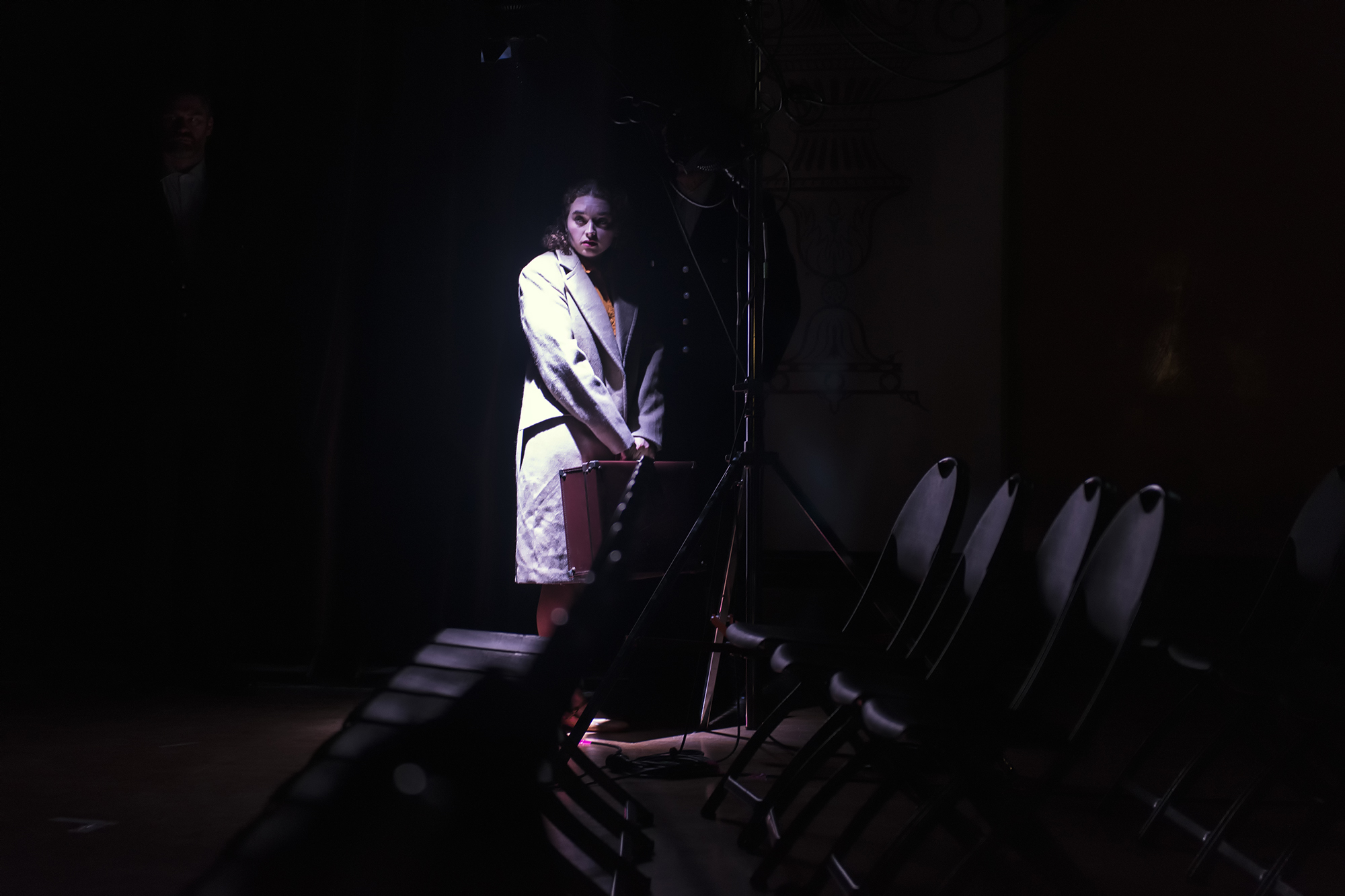
Elizabeth Harper in The Cooperative’s The Emperor of Atlantis. Photo supplied
The singers are all first-rate, and they would have to be. Some of the finest opera singers were sent to Terezín, and Ullmann wrote the pivotal role of Death for the celebrated Czech bass Karel Berman.
Here, Bernard Leong-Lokman more than rises to the occasion, the grotesquerie of his physical performance matching his stentorian vocal prowess. It’s a fine performance matched by baritone Michael Lampard as Emperor Overall, who brings the requisite Wagnerian heft and pathos to the role, while mezzo-soprano Angelique Tot seems to go from strength to strength, here performing The Drummer and dazzling us with Ullmann’s subverted quotation of the German national anthem, Haydn’s famous melody rendered here in a minor key.
As the Harlequin and Bubikopf, tenor Sam Elmi and soprano Elizabeth Harper add their lyrical warmth and crystalline high notes to the delicate vocal blend, the final Bach-style chorale all the more sublime for their contributions, as well as those of Sheri Anne Alterejos, Avalon Gatenby, Hannah Greenshields and Natalia Nour – all of whom are positioned around the hall so we hear it in surround sound.
Of course, the loudest round of applause goes to six-year-old Atticus Olds as The Child, whose apparent joy at playing ball belies the real horrors of Terezín.

Atticus Olds and Michael Lampard in The Cooperative’s The Emperor of Atlantis. Photo supplied
The Emperor of Atlantis is preceded by Luigi Dallapiccola’s 1949 The Prisoner.
Originally set during the Spanish Inquisition, it tells the story of a prisoner whose mother is haunted by dreams in which Philip II has been transformed into Death. A seemingly compassionate Jailer offers the prisoner hope of freedom and leaves his cell unlocked. However, when the Prisoner escapes, he discovers that the Jailer and the Grand Inquisitor are one and the same.
For the second time in as many weeks, I find myself thinking of Pasolini’s Salò, and with its use of Schoenberg’s 12-tone system, Dallapiccola’s harrowing score is perhaps as potent a critique of fascism as Pasolini’s film. Wong and his musical ensemble again do justice to the music, and although it boasts some glorious choral moments, much of it is intentionally tortuous.
In the title role, baritone Tristan Entwistle dives headlong into this atonal labyrinth and comes out with flying colours. Incredibly, he never succumbs to vocal fatigue, even though he sings almost non-stop for most of the opera’s 45 minutes. He is rewarded for his efforts with glorious pianissimo passages which he executes beautifully.
Mezzo-soprano Katrina Waters makes light work of The Mother’s jagged vocal lines. Despite constant leaps into her upper register, she succeeds in establishing more of an underlying sense of dread than the hysteria often associated with the part.
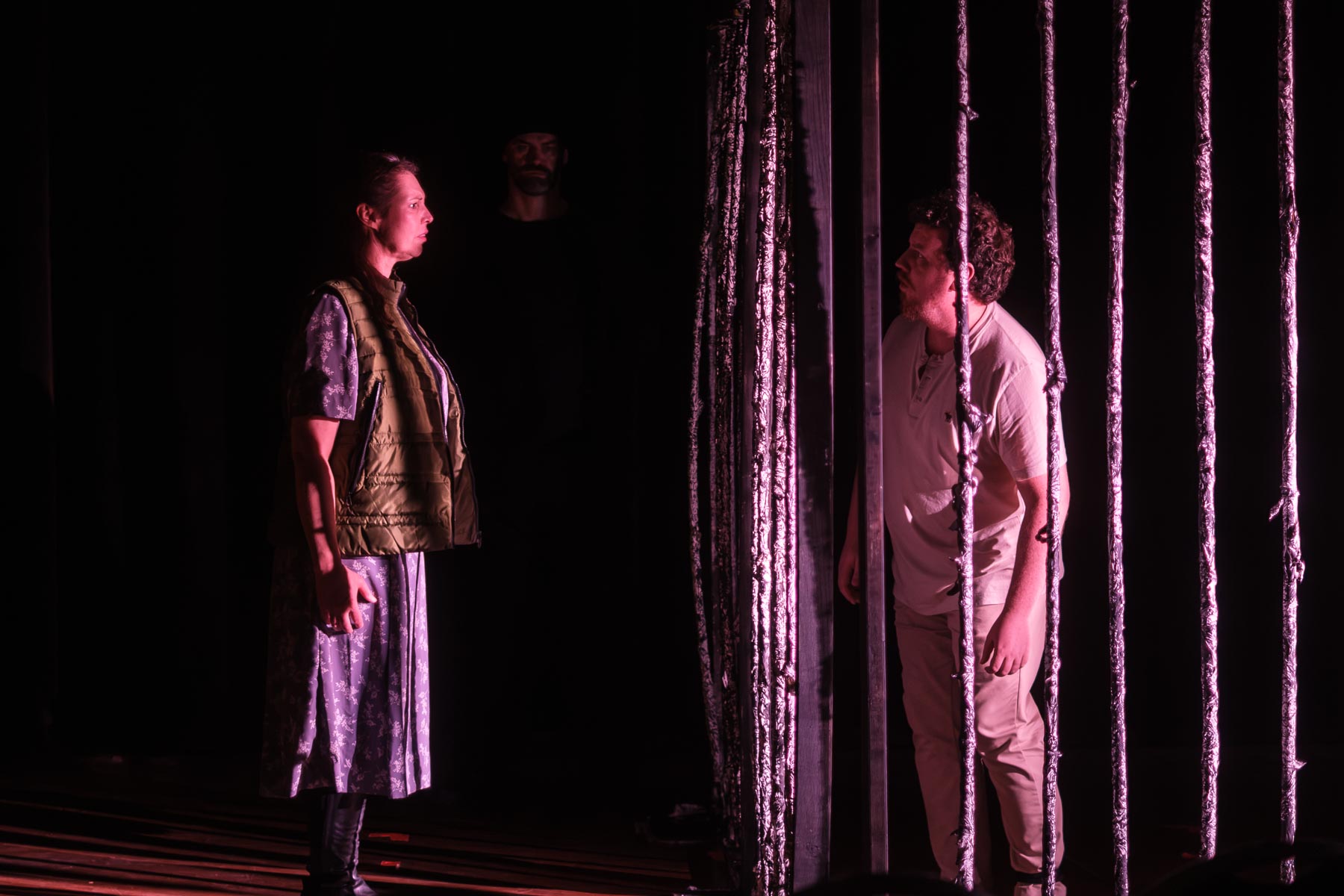
Katrina Waters and Tristan Entwistle in The Cooperative’s The Prisoner. Photo supplied
This performance of The Prisoner is directed by celebrated baritone Michael Honeyman, who is undertaking postgraduate studies at VCA as he transitions into direction and dramaturgy.
Foreshadowing the Holocaust setting of The Emperor of Atlantis, he updates the setting with visual cues that suggest the Dutch resistance during WWII, and he delivers some finely honed characterisations.
Elmi is marvellously mercurial as both the Jailer and Grand Inquisitor, and Schilling and tenor Matt Gaskin bring authenticity to their performances as the baton-wielding prison guards who stare us down as soon as we enter the auditorium in another example of The Cooperative’s immersive approach.
Schilling and Gaskin also double as stagehands, moving four sets of freestanding prison bars into different positions as Entwistle makes his way through the prison’s tunnels, avoiding capture and torture at every turn.
For a company that prides itself on the economy of its staging, this is perhaps too cumbersome a design solution. Judicious lighting would achieve a more seamless result and better align with the ‘less is more’ approach’ of The Emperor of Atlantis that follows.
All up, however, this is a triumphant double bill that proves The Cooperative has truly found its niche.
The Cooperative presents The Emperor of Atlantis & The Prisoner at Glebe Town Hall, beginning at 7pm on Sunday 1 November. This double bill is part of the Freedom Festival which begins at 1pm.
Photos by David Geer, Eddy Furlong and Ron Bullions







Comments
Log in to start the conversation.