It’s time for a confession – I am a big nerd. I’ve been into games for pretty much my whole life, amassing what I would call a pretty solid collection, following all the latest news, importing hard-to-find titles from overseas, and so on.

So, QSO finally doing a concert of video game music was, well, music to my ears. That’s why I’m sorry to say that this concert was a mixed bag. The playing was generally excellent with Leonard Weiss conducting, but the arrangements QSO tackled here were absolutely not all up to the same standard.

Here, it’s important to note that there are really two strands of video game music. In the early days (let’s say perhaps the mid-’80s to circa the early 2000s), most of the music was synthesiser-based, to a greater or lesser extent. Sometimes that meant synthesisers cosplaying as orchestral instruments, and sometimes it meant synthesisers writing music more in line with rock, pop, metal, funk and so on. The latter creates a tricky time when adapting the music for a full orchestra. These days, though, plenty of games start with an orchestral score straight from the word go.
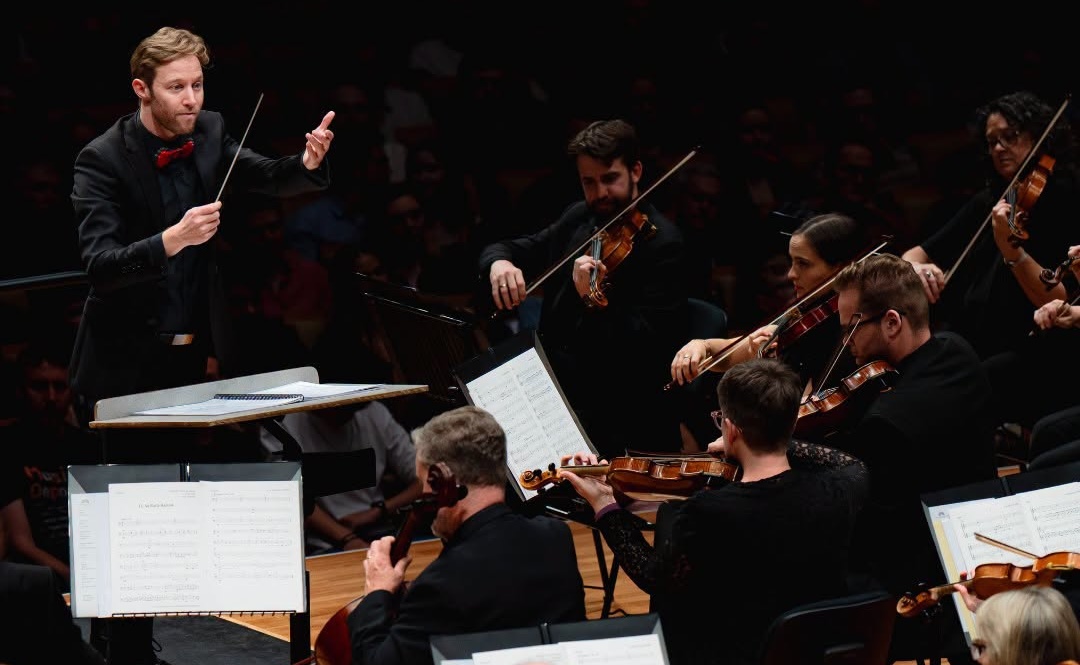
Leonard Weiss and the Queensland Symphony Orchestra. Photo © Sam Muller Media

The concert kicked off with some of Masato Nakamura’s music for Sonic the Hedgehog. This was a strange arrangement, partly because Sonic’s music is all high-octane rock and hooky synths, but also because, despite having played plenty of the games, there were only a handful of “big tunes” that I spotted. You get half a bar of a theme from the very first game, and then we’re into the Epic Orchestral vibe, which is absolutely not what I associate with the series. Where’s the charm and lightness of Green Hill Zone? Also, surely this isn’t arranged by Nakamura, J-pop bassist, so who’s the arranger of this one?

Next up was Harry Gregson-Williams’ music for Metal Gear Solid 2. If you imagine Tom Clancy mashed up with anime ridiculousness, that’s Metal Gear, complete with gigantic mechs and clones. Gregson-Williams is an incredibly experienced film composer (in fact, Metal Gear is the only game score he’s done), so this was beautifully orchestrated, of course, and the brass got plenty of very satisfying blasts here. Nicely played overall.

Andrew Hale’s music for the 1940s-set detective game L.A. Noire is a deliciously thick miasma of jazz flavours, and here trumpeter Tetsuya Lawson absolutely shone. The percussionists, too, laid down a tight bass for the rest of the players.

Next was Jessica Curry’s BAFTA-winning music for Everybody’s Gone to the Rapture, which gave harpist Emily Granger a star turn, with her gentle accompaniment a constant underneath a subtly disquieting string melody. Reminiscent of English folk music, it was performed beautifully.

Tetsuya Lawson and the QSO. Photo © Sam Muller Media

Somehow, though, one of the highlights of this first half was Ari Pulkkinen’s music for the goofy Angry Birds. The orchestration here was great, with offbeat honks from flutes and horns, the percussion leaping in – good stuff.

The one I was most looking forward to was Nobuo Uematsu’s music for Final Fantasy IX. If there’s one thing I love, it’s the Final Fantasy series, and if there’s one game I love, it’s IX: a medieval world with magic automatons, evil queens and airships. But I don’t think this arrangement captured the game’s flavour at all. Like the Sonic the Hedgehog arrangement, it comes awfully close to generic Epic Orchestral. I would argue that Final Fantasy IX, across a gigantic, varied score, tends towards lots of Renaissance flavours.

The opening music when you boot it up is for recorder consort, for instance, but I didn’t hear that theme at all, or several of the other big tunes. No battle music, no town music, only a brief snatch of the “you are exploring” music. Like I said, some of these pieces are odd arrangements, and not what I’d expect. Audience chatter during the interval suggested some people were similarly let down.

The second half, though, fared much better. Brian Tyler’s score for Assassin’s Creed IV: Black Flag is a swashbuckling piratey good time, but the real hit was Australian composer Christopher Larkin’s music for Hollow Knight. Hollow Knighthas been absolutely massive in the last few years (the sequel, Hollow Knight: Silksong, is so popular that it crashed several online platforms when it became available to buy), and it’s an Australian game to boot, so violist Imants Larsens’ gorgeously rich playing here was warmly received by the audience.

We returned to Jessica Curry with her scores for both Dear Esther and So Let Us Melt. I’ll admit that I generally don’t like either of these scores (I played Dear Esther and thought it reached ungodly heights of pretentiousness), and so “I Have Begun My Ascent” from Dear Esther was dull, dull, dull, slowly rocking between two uninteresting chords. Well, it was nicely played at least.

Austin Wintory’s score for Journey, on the other hand, is immediately memorable, with a cracking solo cello melody catching the ear right away (nicely played by Hyung Suk Bae). This genuinely soared – a highlight.

Next up was Koji Kondo’s wonderful score for The Legend of Zelda: Ocarina of Time. The game is still considered one of the greatest of all time, with its music an incredibly integral part of the experience (just look at the title), and here Kondo’s music has hit after hit.

Again, though, I’m not sure what arrangement is being used, given that the programme gave zero information. We had all the themes you’d want to hear (the Song of Storms for me always being a favourite, with QSO transforming into a giant hurdy-gurdy galumphing around), but Gerudo Valley was yet another odd one. There was the main theme (great work from the trumpets and brass), and a couple of variations (weird, not in the original). The variations REALLY fell apart, to the point where I genuinely couldn’t find the pulse. Could be an arrangement problem, could be a rehearsal problem, but not ideal.

Tetris got an outing with a neat arrangement of its theme, “Korobeiniki” (pinched from a Russian folk song), but the winner was the final piece, a mash-up of Kondo’s Mario music. We shifted from the original 1985 Super Mario Bros. music into the incredibly lush orchestral sounds of Super Mario Galaxy, which sounded terrific as a real showstopper. Again, though, no idea where these arrangements come from.

So, let’s recap. At least several of the big-name pieces here suffered from arrangement problems. Looking online, a similar BBC Proms concert from a couple of years ago lists exact pieces with arrangers; here we have QSO playing The Legend of Zelda – no subtitle to tell you which one out of the 40-year-old series you’ll be hearing, no movements indicated, and no arranger to tell you whether it’s the composer themselves doing the re-working, or a third party.

Also, please, QSO – you would get a much bigger audience if you outright mentioned Ocarina of Time or Super Mario Galaxy in the advertising, not just the series name.

There were also some big names missing that would have been easy wins, like The Last of Us (now several seasons into an HBO adaptation and winner of nine Emmys), or Undertale (with full orchestral performances coming up in several Australian cities this year).

On the one hand, I’m glad that QSO is giving this a whirl, but on the other, it was definitely not a complete success. Let’s chalk it up to teething pains.

Hopefully a second attempt will prove more successful.

Contribute to Limelight and support independent arts journalism.