At the Sydney Conservatorium of Music, the New Music Ensemble joined forces with Swiss contemporary group Ensemble Contrechamps for a compelling concert celebrating Australian and Swiss composition.

Curated by Damien Ricketson and conducted by Sam Weller, the collaboration between emerging and established voices was united by a shared commitment to adventurous contemporary music-making.
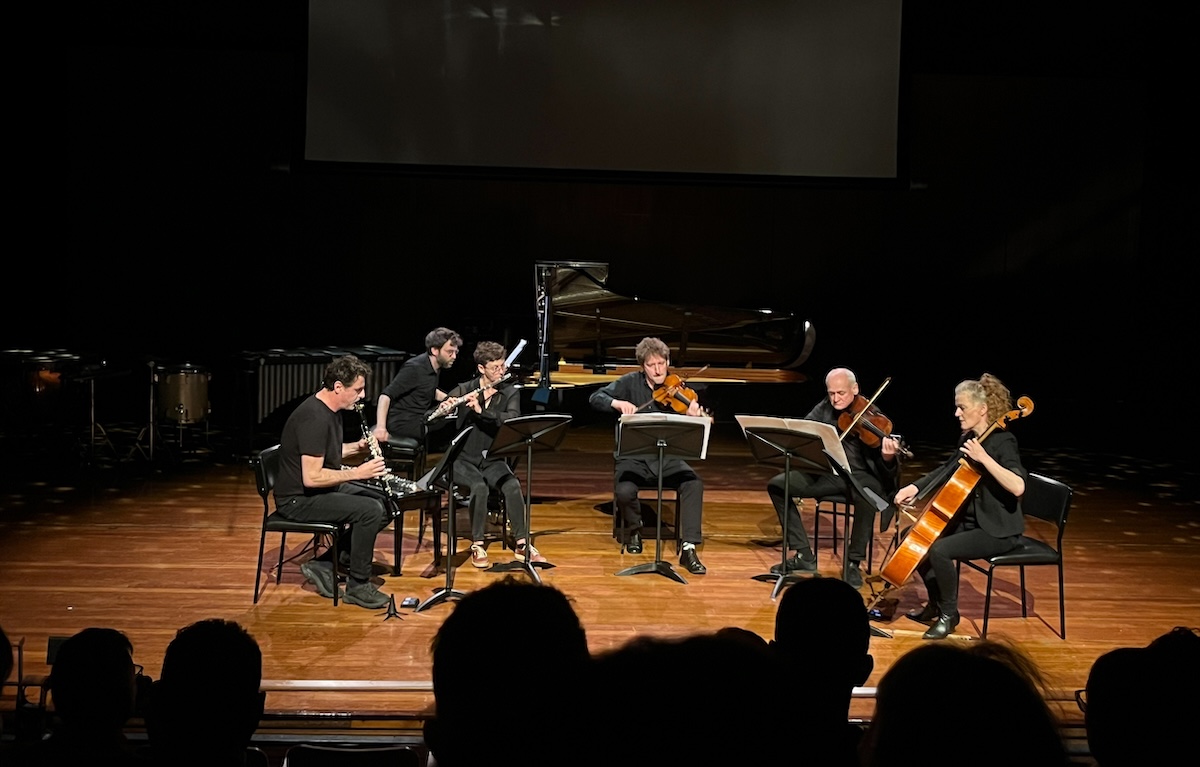
Ensemble Contrechamps. Photo © Charlotte Leamon

The evening opened with a striking work by Australian composer Katia Geha, whose and they leave me in the dark confronted the harrowing reality of violence against women.

Referencing cases in which women’s bodies have been discarded in garbage bags, the work unfolded through abrasive multiphonics, dense dissonances and chordal agitation that conveyed both horror and grief with unsettling immediacy.

Extending beyond sonic imagination, in the final moments of the work the performers tore their scores into 35 pieces and placed them into garbage bags, mirroring the dismemberment of victim Shraddha Walkar.

While all art is political, Geha’s compositional voice is rich with activism and protest. As Ricketson stated, she does not shy away from topics that are difficult to face. This work asks the age-old question political art confronts: whose stories are these to tell? Rather than offering resolution, and they leave me in the dark demanded reflection.

A contrasting sensibility emerged in Refraction, Reflection by Australian composer Beth Roche.

Inspired by the behaviour of light, the work unfolded in three vividly characterised movements. The opening created a lush harmonic landscape of shimmering textures and suspended colour, while the energetic second movement captured the splintering of light through driving rhythmic patterns and fractured ensemble gestures.

Anchored by an insistent piano bass line, the music gathered impressive momentum without sacrificing clarity of detail. The final movement offered a delicate and translucent conclusion. Weller’s direction maintained both structural clarity and dramatic tension, allowing each work’s distinct sound world to emerge vividly.

Ensemble Contrechamps performed movements one and two of the invigorating Vortex Temporum by Gérard Grisey.

Grisey’s spectral work explores the relationship between timbre, resonance and time, drawing on acoustic phenomena and waveforms as structural foundations. The interplay between the woodwinds and strings created both unity and contrast through shifting tonal colours, while the ensemble’s sharp attacks and physical commitment brought striking energy to the performance.

The musicians navigated Grisey’s intricate rhythmic and timbral demands with remarkable virtuosity, revealing both the mathematical rigour and visceral intensity embedded within the score.

The concert concluded with Enter the Impossible by Jessie Cox, performed collaboratively by both ensembles.

The musicians were dispersed throughout the hall and audience seating, transforming the performance space into an immersive sonic environment. Structured around an imagined journey through futuristic and otherworldly planets, the work invited listeners into shifting terrains.

SCM New Music Ensemble & Ensemble Contrechamps. Photo © Charlotte Leamon

Planets devoid of life were represented through extra-musical sounds, sparse textures and vast timbral expanses, while worlds populated by extraterrestrial beings became increasingly harmonic and animated. The ‘jungle’ planet introduced playful imitations of elephants, monkeys and birds, injecting theatricality into the work’s speculative universe.

Cox’s composition was an act of deep listening, exploring how we associate harmony, density and gesture with vitality, and silence or abstraction with emptiness. The result was imaginative and deeply engaging, balancing conceptual ambition with moments of genuine wonder.

More than a cultural exchange, this collaboration demonstrated the vitality of contemporary music when ensembles invest in dialogue, experimentation and emerging voices. The concert’s strongest moments came not simply from technical accomplishment, but from its willingness to confront urgent ideas while remaining musically imaginative.

Contribute to Limelight and support independent arts journalism.