


On a trip to the US a few years ago, I saw a performance in an art gallery. In the program was a pearl of a work for prepared piano and saxophone; I wandered over afterwards to chat to the performers and to ask who had composed it.
“That’s an Australian work!” the saxophonist told me. “Miriama Young, This Earthly Round.”
He explained he had found it on the Australian Music Centre; he’d loved how easy the site made it to find works for any instrumentation on hand. I was more than 15,000 km from home, and struck by the fact that Aussie art music had made its way there, too.

Catherine Haridy. Photo courtesy of the Australian Music Centre.
AMC’s CEO, Catherine Haridy, also got her own reminder of the organisation’s importance earlier this month: on invitation, she travelled to Chile to speak at the country’s first dedicated gathering for its art music community.
“It really brought home for me how special the AMC is,” she tells Limelight. “From holding a catalogue right through to professional development, advocacy, music education services, the incredible and very broad community of music lovers that we speak to. It’s a real honour.”
That’s the power of a centralised, accessible resource for Australian art music for both international and national audiences. With more than 30,000 items in its catalogue now, it’s what AMC has been doing since its inception 51 years ago, and it’s a mission now shared by Limelight’s Guide to Australian Art Music.
“And that’s what’s driven me in this role,” says Haridy. “The team, who are so dedicated to the community at large, realise how unique and privileged this position is to hold that information and to protect it, and to promote it. I hope that we have another 50 years of doing this and doing this with the community.”
“Very similarly to Limelight‘s Guide, it’s a beautiful, honoured and privileged, position to be in to hold information and legacy in one place.”
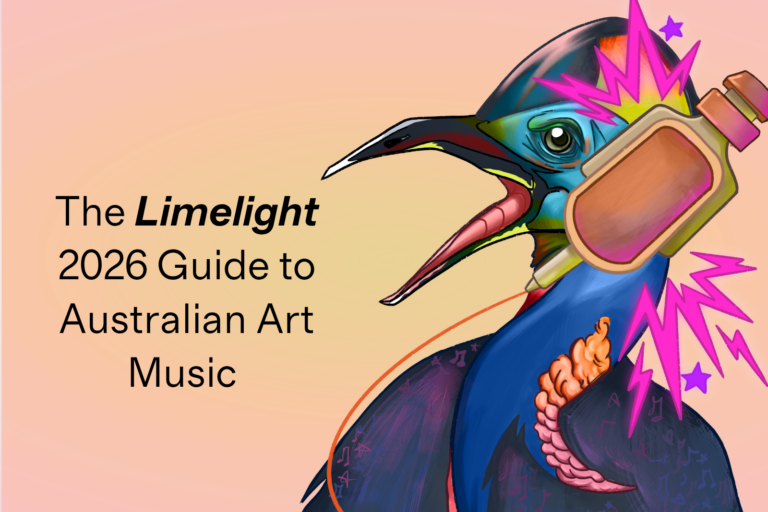
Created in partnership with composer-curator Cameron Lam, Limelight’s Guide to Australian Art Music is now in its second year. It presents one track from over 700 composers; the goal is to showcase the breadth and diversity of Australian art music – from classical contemporary music and jazz to sound art and improvised music.
“Australian art music is just the most innovative and progressive type of music-making. It’s so beautiful to see those forms coming together and create something new and different, something that pushes our intellectual and emotional boundaries, that makes us feel,” says Haridy.

Catherine Haridy at the 2025 Peggy Glanville-Hicks Address. Photo courtesy of the Australian Music Centre.
“Particularly, in the current times we’re experiencing, which are so challenging globally, Australian art music is so important. It’s important for people to connect and feel, that they’re not alone and that there is still beauty in creation.”
Earlier this week, APRA AMCOS noted in its Year in Review report that Aussie music’s foothold at home is shrinking – only 8.6 percent of music listened to this year by Australians was homegrown, a steep drop on the previous year. One reason for this is the decreasing visibility of Australian artists on platforms. As music streaming algorithms increasingly favour international artists, it’s vital to make Aussie music easy to find and access. Haridy agrees.
“Our mission is clear. We want to promote Australian art music. We want it to be heard, we want it to connect with audiences, and we want to help to show the value of that music. We believe that everybody around us should embrace it and love it as much as we do, ” said Haridy.
Earlier this month, Haridy visited Trackdown studios as AMC’s 2026 Momentum PLUS composers had their short orchestral works recorded (with the help of Jessica Wells and Joanna Drimatis, whom Haridy calls “powerhouses”).
“It was incredible! To give these composers the chance to actually record these works and own these works, to promote these works as their own… I feel like it’s the best kind of work. The energy in the studio at Trackdown Studios was so wonderful and warm and positive, and everybody was just having the best time of their lives.”
“Now, we’re in the process of mixing those 10 pieces down, and then they’ll go out into the world, and hopefully they will encourage multiple performances of that work, and they’ll get sync opportunities and licensing opportunities. Hopefully, so much will come from just that one project.”
To close, Haridy gets the tough question – out of the 700 works on the Guide, does she have any favourites?
“Every single one of those works is amazing. Comparing and contrasting in art music is extraordinarily difficult; becomes such a personal thing in terms of what we consider to be our favourites and what resonates with us, what speaks to us,” she says.
“All of it is brilliant, and the Guide is just a phenomenal amount of work in bringing it all together.”
See the 2026 Guide to Australian Art Music here. Vote for your top 10 works here.
More about the Australian Music Centre’s 2026 AusArt campaign can be found here.





Comments
Log in to start the conversation.