They’re now based in London, but oceans away, violist Ella Beard is still rhapsodising about Australian music. 

Having touched down in Adelaide yesterday, they’ve got a bunch of the stuff to showcase across the country over the next few weeks, including the Australian premiere of Kate Moore’s Storm Oratory with Ensemble Offspring on 3 June  – a “pretty good band”, Beard reckons.
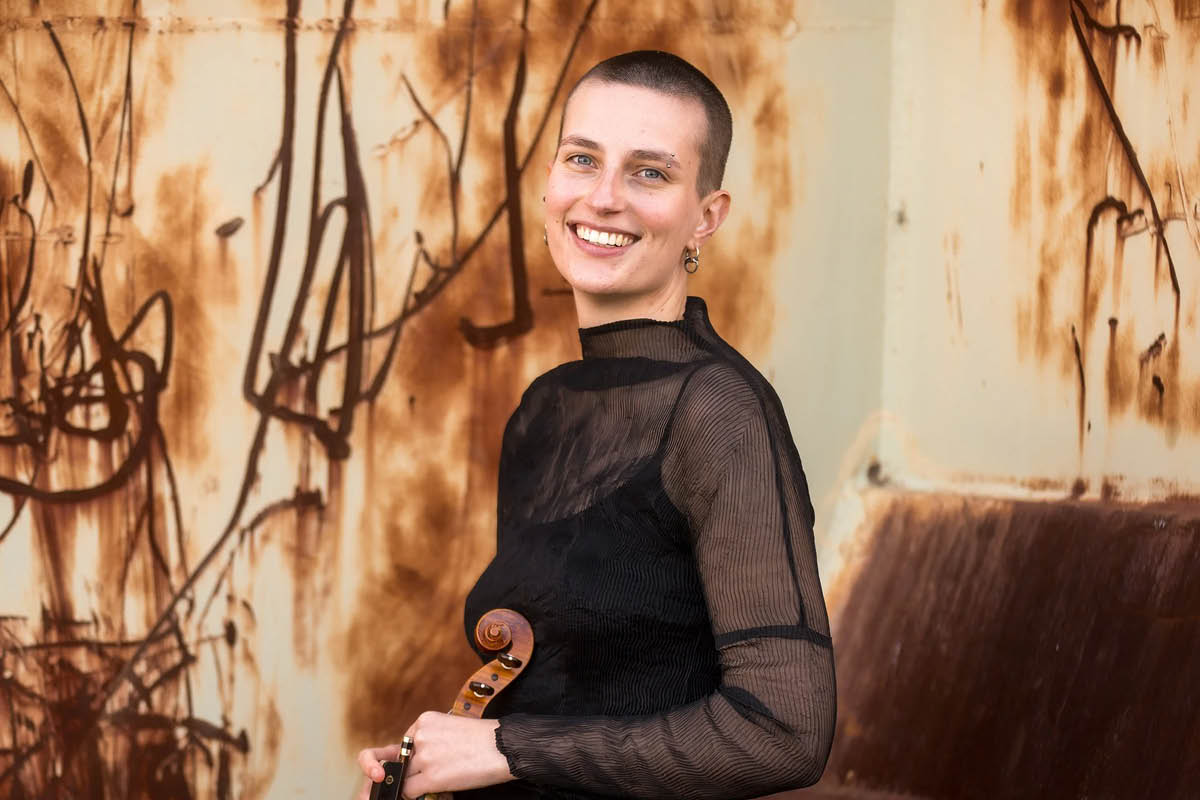
Ella Beard. Photo © Alastair Bett

“I love Kate’s music, and this piece is so distinctly her – these gorgeous, long lines. It’s so exciting. She has this tarantella for solo viola, which is one of those pieces that gets you thinking, “this is what music’s all about’. It’s so good,” Beard tells Limelight.

Before Moore, Beard will also deliver the premiere of three new solo viola works from Australian composers under their groundbreaking commissioning project, Hear Us Now, in Adelaide and Brisbane. Featuring compositions from Robert Davidson, Hilary Kleinig and Emily Sheppard, the project is an examination of child sexual abuse (CSA), informed by Beard’s lived experience. 

“I started looking for repertoire that publicly engaged with childhood sexual abuse in 2021. I had actually quit music; I thought that my relationship with music was properly irreparable,” Beard tells Limelight.

“I really had this ache for music that would reflect where I was at, that really looked it in the face and was unafraid to say, ‘this is what it is, and this is how it feels’, but I couldn’t find any recordings.”

Hear Us Now began to take more tangible shape once Beard found their way back into classical practice a few years later. It’s an endeavour that’s now taken them (and their pick of Australian works) around the world: Beard was the 24/2025 Trainee Music Leader at Wigmore Hall, with a focus on community music initiatives, and a 2024 Fellow with American new music group Bang on a Can. They’ve performed at the Royal Opera House and Wigmore in London, and with the Queensland Symphony Orchestra and Camerata – Queensland’s Chamber Orchestra.

“I was hearing in workplaces and in concerts this romanticisation of what I think in the present day we could really be calling abuse or coercion. Composers falling in love with their students and getting married, and that falls apart and then they marry the next student,” they explain.

“It felt like I was regularly being asked to sympathise with the actions of these composers whose actions more resembled the actions of the person who had abused me. It really set in motion for me the need to make it happen to really have something that was so publicly from the perspective of the victim-survivor.” 

Lora Kmieliauskaite and Ella Beard performing at Bang on a Can’s Summer Festival. Photo © Lora Kmieliauskaite

Compared to fields like contemporary music, theatre and visual art, classical music seems relatively hesitant to address abuse artistically, or scrutinise relationships with the works and composers within its canon. Beard pins that hesitancy to a kind of fear of “losing something so dear to us in classical practice”, in the face of the increasing effort it takes to maintain the genre in a modern context.

“I really understand the desire to maintain these works by great composers as a part of our cultural canon. They’re extraordinary. But when we’re working so hard to conserve something, it can be difficult to invite in the nuance of saying ‘This work is beautiful, but these elements make me really uncomfortable,’ they say. 

“I think we can have both, the canon and this conversation. We can have that nuance.”

All works in Hear Us Now are for solo viola. When Beard first began looking for works, they were hoping for something to play for themselves, from their room, rather than something to bring out on stage; it’s always made sense to have these works as a solo voice.

“I also really wanted these pieces to be playable, because I would love for others to play them if they want to – from a professional, to someone who learned music at school and hasn’t played for a while. I wanted accessibility to be at the heart of the design.”

Violinist-composer Emily Sheppard’s work for singing violist, May these sounds bring you home, uses a video score to teach performers the work. Inspired by her time in residency on Réunion Island and her work with musician and survivor Ann O’aro, Sheppard draws influence from maloya (one of Réunion’s major genres) and uses the video to break down rhythms more easily learned by ear than off the page.

“It’s been a really interesting process to learn a piece of music that way. It was great to play along and hear the viola and voice. That’s how we’ve learned music forever, and it felt really natural,” Beard explains.

As a starting point for each composer, Beard opened up a discussion where they talked through their Victim Impact Statement from the court process, and a list of “every single emotion [Beard] could think that I felt, during and after the abuse”.

Hilary Kleinig’s work, titled Hear Me Now, is similarly written for singing violist, and adapts and builds upon some of Beard’s words for its text. For Beard, it captures the experience of anger “in this beautiful, soft way”.

“I really appreciate it, because it took me so many years to feel angry. It’s an emotion that comes with so much baggage, but it’s such an important part of realising injustice, and expressing it outwardly instead of inwardly. It’s wonderful to have this piece which holds a space for that without judgement,” Beard says.

“The piece has this beautiful finish where it’s going up by a third, and I’m singing in thirds over this broken chord, ‘I am here, hear me now’. It’s lovely to have words of anger that can be met with a sound that’s unyielding, but gentle. It’s so powerful to actually ask to be heard.”

Robert Davidson

Robert Davidson. Photo supplied.

Robert Davidson’s piece, Isolation, is beautiful in its simplicity, says Beard. His work is based around recurring motifs that take on a “different emotional light” each time they emerge.

“It speaks to how you keep on passing over these moments – sometimes it’s so truly sad, sometimes you’ll feel connected and calm, and the next time you’re back and you’re just totally enraged,” says Beard.

“The emotions feel very intuitive, through Rob’s subtle harmonic shifts. Every time, I find myself wanting to say something different with each motif.”

Beard is also adding their own voice to the project with a work of their own, titled Here, Now. Using scordatura tuning, its tonality pulls between D major and B minor in a musical exploration of how grief can sit besides feelings of wonder and gratitude, inspired by the mix of feelings they’ve been experiencing working on their new base in London.

And now, on the precipice of premiering the works, Beard’s “feeling it all, at the moment.”

“I feel so grateful to get to play this music, because it’s a real privilege, I also feel pretty scared. It feels very vulnerable,” says Beard.

“For so long, I felt such an intense shame about the experience I had, you know? It’s common for people with experiences like mine to have these feelings of ‘it’s my fault, there’s something wrong with me. If I tell people this, they’ll stop loving me.”

“The work’s had direct community support through an ACF matched funding campaign, and to get this sense of community around it has done so much for me in feeling that this is important too. It’s really helping to take something that has been such a source of shame, and to frame it in this light of something I can be proud of. Yeah, it’s just feeling everything, at the moment.”


Ella Beard will perform Hear Us Now at Goodwood Books, Adelaide on 17 May and at The Raven Hotel, Brisbane on 25 May with Dots+Loops. They will also perform with Ensemble Offspring in The Oracle at The Neilson, Sydney on 3 June.

Contribute to Limelight and support independent arts journalism.