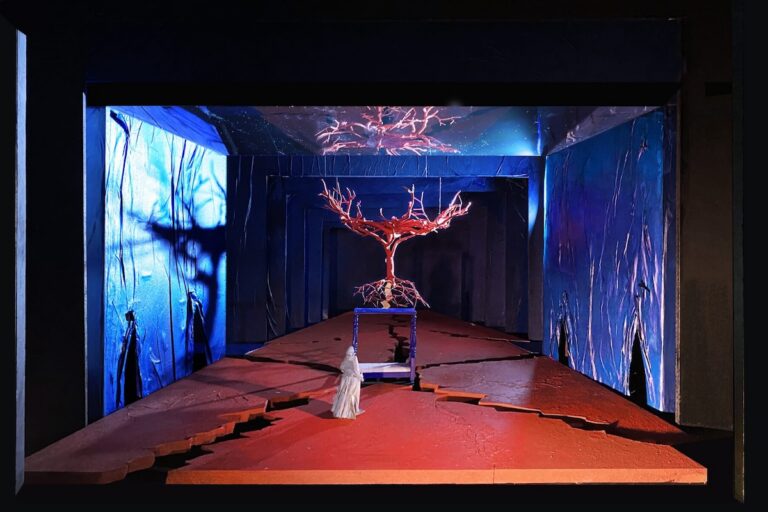
The ASQ opened this absorbing concert with a significant new work, composer Samuel Adams’s (b. 1985), String Quartet No. 3, Alma, of 2024.

Written for Amsterdam’s Alma Quartet, with whom he has previously collaborated, Adams says that the quartet’s title refers to that ensemble’s name, but that he was also drawn to the Spanish meaning of “alma”, which means “soul” or “spirit”.
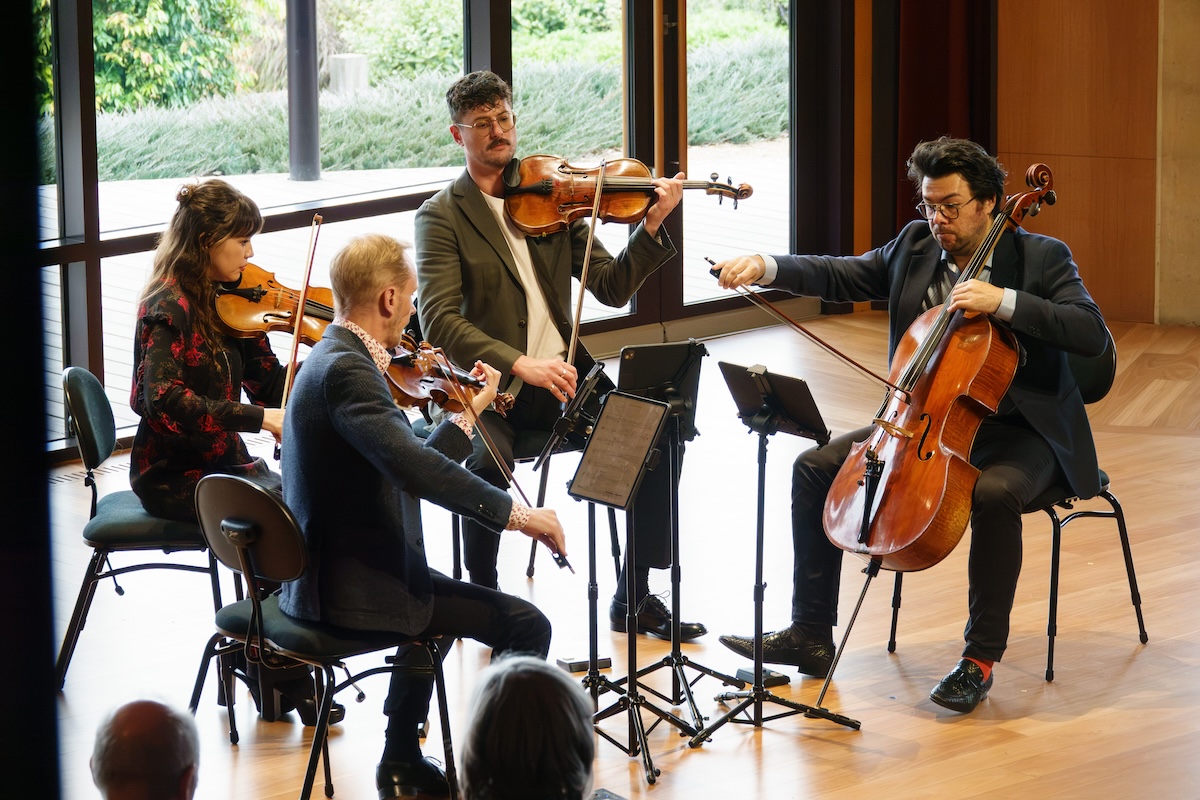
The Australian String Quartet at UKARIA Cultural Centre. Photo © Tony Lewis

The son of renowned US composer John Adams, Samuel Adams’s third string quartet carries hints of his father’s work, for example his Shaker Loops, and, as ASQ first violinist Dale Bartrop noted, there are also hints of the extraordinary music of Steve Reich.

Samuel Adams’s Alma is a substantial work of around 21 minutes, and while his background is in electroacoustic music and he flavours this piece with a distillation of the spirits of an earlier, revolutionary era of composition, Alma is uniquely his own.

The short first element of this four-movement work is entitled Simply, and it opens with a slow, hypnotically rhythmic passage featuring a complex interplay between the four instruments rather than a solo expository voice. It’s rhythmic, swirling character hints at minimalism, but it gains in complexity as it progresses.

The second movement, entitled Fast, bright, is as its title suggests, with edgy, off-beat gestures like an ecstatic dance. There is moment of quiet and then a return to the densely layered, rhythmic violin and viola voices of the opening, heard over a droning cello line.

The third and most compelling movement, Lontano, frozen, seems to suspend time. It opens quietly and arrhythmically, with very slow, dreamy passages initially pitched in upper registers, and soft, fluttering trills ornamenting the melodic lines. The movement gradually develops in dynamics and intensity, with a resonant cello line recurring, and the music evolves into a profound and passionate cry.

The final movement, just over one minute long and continuing attacca from the third, is also entitled Simply and it returns to the swirling, motoric character of the first movement. The abrupt ending suggests that the story is unfinished, as if the threads that the music embodies can be woven anew. The ASQ was at its best in this beguiling piece.

The Australian String Quartet and Julian Smiles at UKARIA Cultural Centre. Photo © Tony Lewis

Renowned former Goldner String Quartet cellist Julian Smiles than joined the ASQ as soloist in a performance of Tchaikovsky’s Andante Cantabile, arranged for cello and string quartet. This gracious work is the second movement of the composer’s String Quartet No. 1 in D, and it has become a favourite as a standalone performance piece.

The strings are muted and the voice of Smiles’s muted cello has a poignant tone in a piece of music that suggests a heartfelt song without words. Underpinned by the lilting rhythm of the accompanying strings, it recalls the rhythmic character of Adams’s Alma.

Smiles’s formidable presence enabled the ASQ to stage a superlative performance of Schubert’s Quintet in C, D. 956, one of the greatest works of chamber music. It was written in a flurry of composition just weeks before the composer’s early death, as if he knew his life would be short. A journey of nearly an hour in length, the quintet’s scale and complexity are remarkable, and the addition of a second cello adds density and gravitas to the music.

Smiles’s cello carries the pizzicato bass line in the opening Allegro ma non troppo movement and pizzicato bass is heard again in the early passages of the Adagio second movement, suggesting the relentless ticking of a clock or the footsteps of approaching death.

The Adagio begins slowly and sadly and, towards the end, the second cello and first violin establish an intimate and revealing conversation, with the other three instruments accompanying the speakers like a heavenly choir.

Schubert’s Adagio resonated with the third movement of Adams’s Alma quartet and Tchaikovsky’s Andante Cantabile – slow movements evoking the emotional inner voice of the composers.

The Australian String Quartet and Julian Smiles at UKARIA Cultural Centre. Photo © Tony Lewis

Schubert seems to acknowledge his mortality in his Adagio, but he then moves on to the third Scherzo movement which opens with an energetic and full-bodied exposition that’s followed by a wistfully slow, reflective passage, and it finally returns to the buoyant opening theme.

The Allegretto final movement of the Schubert quintet opens with a jaunty Hungarian-flavoured folk theme that signals a joyous new beginning. This exuberant finale exudes hearty optimism, as if the composer is wishing us ‘all the best’. Rather than a dying man’s evaluative reminiscence, Schubert’s quintet is a work that looks forward.

Julian Smiles combined wonderfully with the ASQ, and this rare gathering of musical forces made for a memorable concert.

Contribute to Limelight and support independent arts journalism.