




When the two Voyager probes left Earth in 1977, the last music on the golden records they carried was the Cavatina from Beethoven’s String Quartet in B-flat, Op. 130, in the Budapest Quartet’s recording: a song whose first violin, at the bars marked beklemmt, stammers into fragments, as though the breath behind it had briefly failed.
By calling this program Voyager, the Australian String Quartet promised a journey outward, and at Hackett Hall, on the opening night of their national tour, they kept that promise with a focus and intensity that held from the first bars of Garth Knox’s Satellites to the last of the Grosse Fuge.
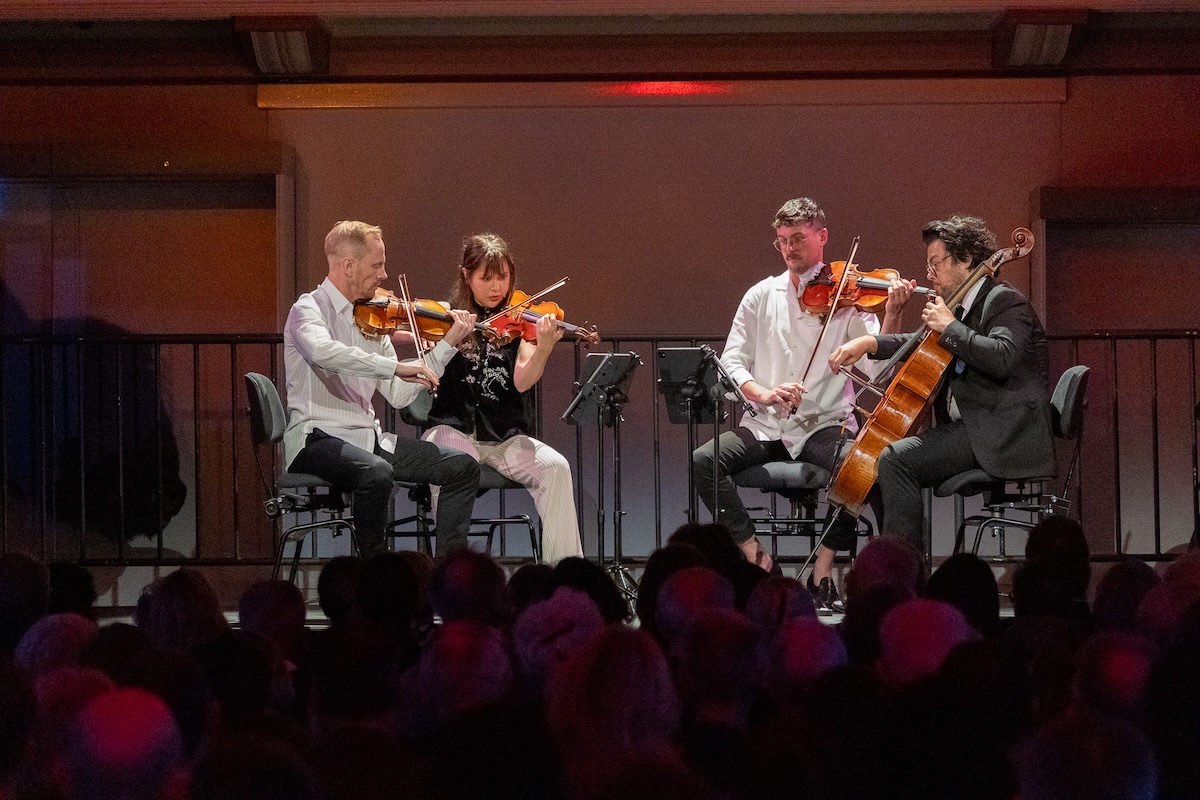
Australian String Quartet: Voyager (Hackett Hall, Perth). Photo © Kane Moroney
Knox, formerly violist of the Arditti Quartet, wrote Satellites in 2015 for the Kronos Quartet’s Fifty for the Future project, and its three movements turn the quartet into a laboratory of bowing in which the four players – in Knox’s own image – become astronauts adrift.
In Spectral Sunrise the bow may travel only along the length of the string, so that pitch thins into grain and air; Geostationary hovers, Dimensions scatters. Dale Barltrop, Francesca Hiew, Chris Cartlidge and Michael Dahlenburg, who brought the piece to UKARIA last year, played it with terrific authority, yes; but also a delectable balance of seriousness and fun.
The same discipline carried them through Bartók’s Fourth Quartet of 1928, whose five movements form an arch around the central Non troppo lento, where Dahlenburg’s cello spun its long, parlando line over a sustained and barely breathing chord.
The muted Prestissimo flickered past, the pizzicato Allegretto snapped against the fingerboard, and the finale’s driving ostinati gathered weight without coarsening, the intensity everywhere governed by a long view of the arch.

Australian String Quartet: Voyager (Hackett Hall, Perth). Photo © Kane Moroney
After the interval came Op. 130 as Beethoven first conceived it in 1825, with the Grosse Fuge as finale in place of the lighter movement his publisher Artaria coaxed from him the following year. Stravinsky called the fugue “an absolutely contemporary piece of music that will be contemporary forever”, and its self-multiplying architecture recalls Piranesi’s Carceri, where stairs and gantries proliferate beyond any frame that might contain them.
The ASQ’s fluency made that architecture legible, each entry of the subject placed so that the ear could follow it through its violent transformations, while the Cavatina before it, hushed and unhurried, made the case for its interstellar posting better than any argument could.
Few quartets would have made this voyage sound so inevitable.
Australian String Quartet presents Voyager on 19 October (The Neilson, ACO on the Pier, Sydney); 20 October (Utzon Room, Sydney Opera House); 22 October (UKARIA Cultural Centre, Mount Barker, South Australia; 23 October (Elder Hall, Adelaide); 25 October (Gandel Hall, National Gallery of Australia); 27 October (Queensland Conservatorium Theatre, Griffith University) and 29 October, Elisabeth Murdoch Hall, Melbourne Recital Centre.








Comments
Log in to start the conversation.