Brahms’ A German Requiem is a work I return to often, and it would seem I am not alone. Despite the disruptions caused by the pandemic, since 2019 it has been performed on at least nine different occasions by major ensembles around the country.
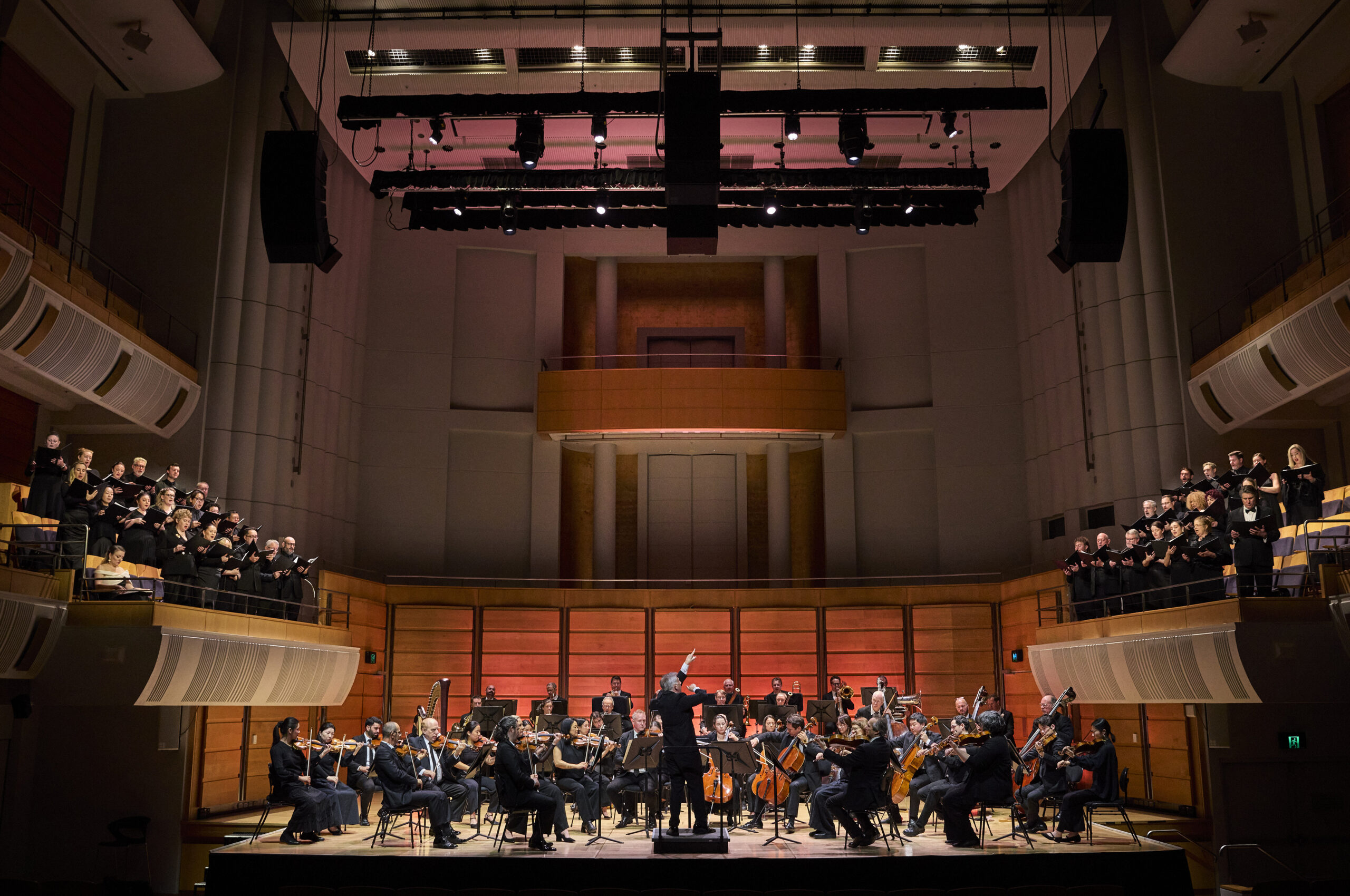
Opera Australia’s Brahms: A German Requiem. Photo © Keith Saunders
When I reviewed Simone Young’s reading in 2022, it marked the return of the Sydney Symphony Orchestra to the Sydney Opera House after the lockdowns, along with Sydney Philharmonia Choirs under Brett Weymark and Elizabeth Scott.
Licking our collective wounds, we were in desperate need of Brahms’ life-affirming music, which Young, Weymark and Scott delivered in spades, with Emma Matthews and Bo Skovhus as the two soloists.
However, just as we found comfort in a humanistic work that eschews references to damnation in favour of a gentler memento mori and solace in the face of grief, the world was being plunged into wars that would lead to the greatest humanitarian crisis since the Second World War – the effects of which are being felt the world over.
And so, four years later, we find ourselves in the hands of conductor Nicholas Milton as he leads the Opera Australia Orchestra and Chorus in a performance that pairs comfort for the living with a sense of resilience and even defiance in the face of death.

Opera Australia’s Brahms: A German Requiem. Photo © Keith Saunders
Indeed, there are times when Milton allows for moments of vehemence that, given the relatively intimate forces at his disposal, are surprisingly hair-raising – especially in the Third Movement when the Chorus asks, “Now, Lord, where shall I see consolation?” and the Sixth, when they sing, “Death, where is your sting! Hell, where is your victory!”
With just 36 singers in the OA Chorus positioned in the balconies on either side of the podium, the size of the choir is comparable to that of the recent recording by Pygmalion under Raphaël Pichon. OA’s singers ably match the elasticity of their French counterparts, achieving the sound of forces twice their size.
And while the OA Orchestra may not share the historically informed sound of Pichon’s ensemble, under Milton, it also achieves comparable dynamic range and transparency – something Milton’s recording of Brahms’ complete symphonies with the Göttinger Symphonieorchester also boasts.
So too, the OA Chorus pairs the intimacy of a chamber choir with the clarion heights one might expect in the climactic moments of Wagner’s Tannhäuser.

Opera Australia’s Brahms: A German Requiem. Photo © Keith Saunders
Full marks to Chorus Master Paul Fitzsimon on preparing the vocal forces with such precision and matching the transparency of the orchestra.
Just as we never lose sight of the strings under Concertmaster Matthieu Arama, the horns under Sydney Braunfeld, trumpets under Dominic Longhurst (how could we?) and the delicate harp of Natalie Wong, the textural clarity of the choir is exceptional, the voice parts conveying humankind’s diversity rather than a uniform mass.
That said, their blend and intonation are never in doubt, and the polyphonic fugues are expertly rendered.
The performances of the soloists, soprano Celeste Lazarenko and baritone Luke Gabbedy, are notable for their restraint as they step out of a sea of humanity, their virtuosity carefully reined in so as not to overshadow the chorus.
As such, they achieve a universality and sing for each and every one of us – not on the precipice between life and death but consoling and empowered to carry on with our earthly lives.
It’s a deft choice – and one of many made by Milton – that delivers precisely what Brahms wanted: a very “human” requiem. And in capturing humanity’s imperfections – including our frustration and anger – it is as fine a reading as any.
More information about Opera Australia’s 2026 season can be found here.

Comments
Log in to start the conversation.