The last outing of Graeme Murphy’s staging of The Merry Widow marked Opera Australia’s return to the Joan Sutherland Theatre after the Covid lockdowns. After the deprivations of the preceding 10 months, we were all in desperate need of a good laugh, and this decadent update of Lehár’s operetta delivered in spades.

Five years later, it’s back with Murphy and his Creative Associate Janet Vernon at the helm, but this time it comes with a healthy dose of humanity thrown in.

Of course, it’s as beautiful as ever, with set designer Michael Scott-Mitchell and costume designer Jennifer Irwin going to town on their updated 1920s setting, lit here by Damian Cooper.

The cast is resplendent in period fashions that perfectly complement the spectacular Art Deco scenery with its Lalique-style pressed glass panels and a mural based on Monet’s Water Lilies – its reveal eliciting applause as soon as the curtain goes up.
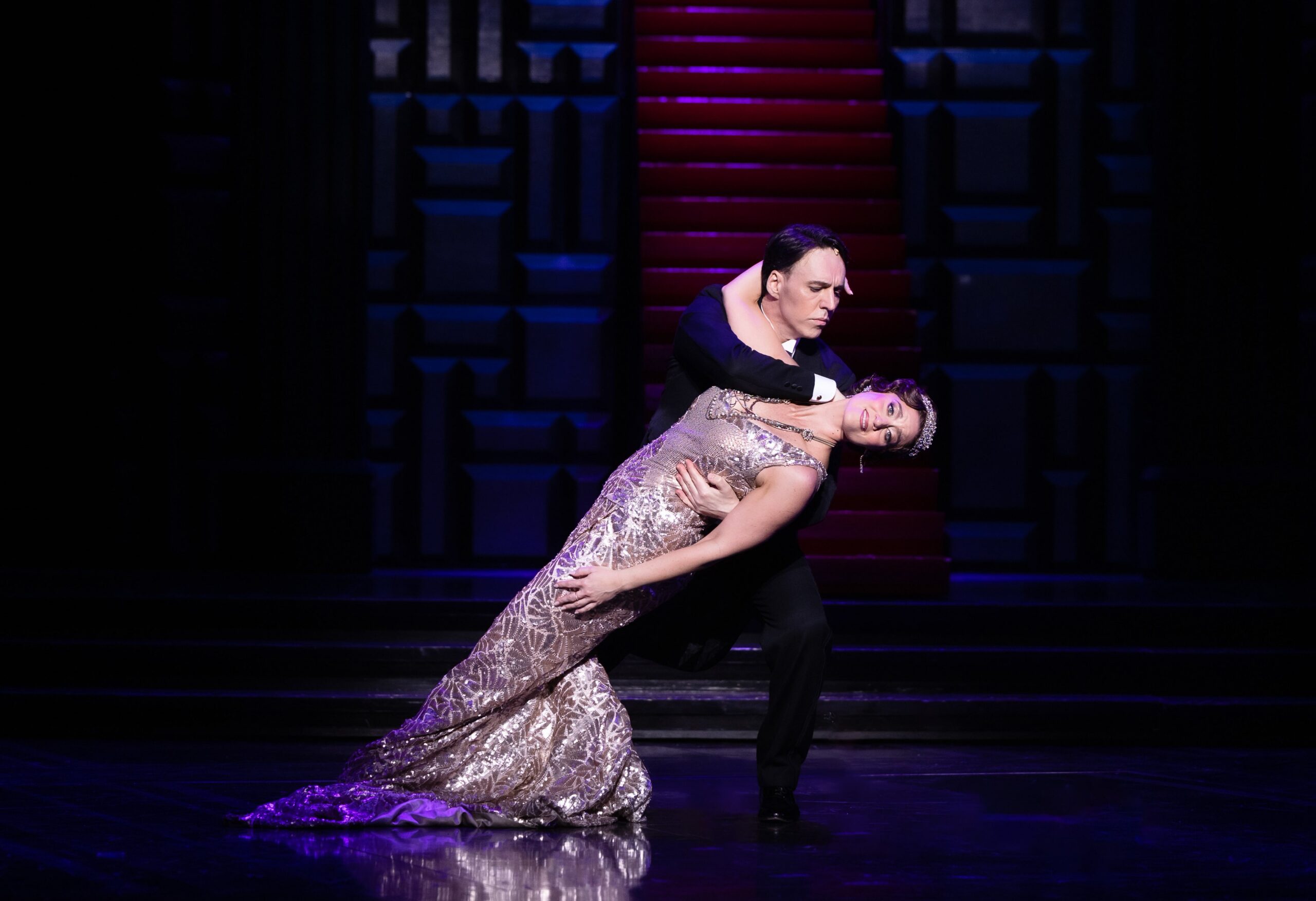
Alexander Lewis and Julie Lea Goodwin in Opera Australia’s The Merry Widow. Photo © Carlita Sari

Murphy’s choreography is as fresh as ever and beautifully executed by the Opera Australia Dancers who animate the stage in a variety of styles, from a traditional Slavic kolo to elaborate routines that recall the regimented choreography of Onna White and Gower Champion in Mame and Hello Dolly.

There are other references too, including a reverential nod to Fosse’s trademark “amoeba”, the tuxedoed male ensemble slinking about in an undulating mass and creating a shimmering halo with their white-gloved hands around Julie Lea Goodwin as Hanna Glavari.

If you know Murphy’s style, however, it bears all the hallmarks of his classic works – the lifts in Vilja and angular partnered arabesques harking back to his groundbreaking An Evening in 1981 – an earlier pairing of song and dance for Sydney Dance Company that featured Geraldine Turner alongside Vernon and Murphy.

Even the intricate way Hanna and Danilo’s arms entwine has its antecedent in routines like the Snow pas de deux from Murphy’s Nutcracker. It’s ravishing stuff, and the virtuosity and gracefulness of the dancers belies its complexity.

Once we arrive at Maxim’s, there’s plenty of bawdiness too, with a highly entertaining can-can performed by Hanna and the grisettes, Goodwin’s vampish turn culminating in a jaw-dropping kickline.

John Longmuir, Alexandra Flood, David Whitney and Richard Anderson inThe Merry Widow. Photo © Carlita Sari

If Goodwin’s dancing is a joy to behold, her singing is sublime. Her soprano is crystal clear and warm, her top notes stratospheric but never shrill. In a role that often sees singers opt out of its more extreme vocal demands, it’s thrilling to hear Goodwin do justice to the score. As do Alexander Lewis (Danilo), Alexandra Flood (Valencienne) and John Longmuir (Camille) – Lewis and Longmuir enjoying a long association with this production, as indeed does Goodwin.

And it is the onstage rapport developed by Goodwin and Lewis that allows them to bring such authenticity to their roles – their chemistry making it clear from the get-go that they were always meant to be together. As the evening progresses, we get equal bursts of sexual tension, genuine love, friendly rivalry and companionship, and even though we know a happy ending is inevitable, there are moments of deep regret and tenderness that are tear-jerking and elevate this paragon of Viennese operetta beyond the light-hearted froth one might expect.

There is a trade-off, however, and the emotional truth Murphy and his team of creatives and performers have mined from the material sits slightly at odds with the more absurd moments of comedy that typify traditional operetta – all charmingly delivered here by David Whitney as Baron Zeta, Iain Henderson as St. Brioche, Nathan Lay as Viscount Cascada and Benjamin Rasheed in a scene-stealing turn as Njegus.

As Opera Australia writes in the program: “Operettas don’t pretend at real life … They are created for diversion: to amuse and entertain.” Well, in its latest guise, Murphy’s production still amuses and entertains, but far more importantly, it has a genuine heart – one that beats as strongly as it does in Helpmann’s glorious ballet version, which Murphy danced in.

Benjamin Rasheed in Opera Australia’s The Merry Widow. Photo © Carlita Sari

Musically, this performance is a revelation too, with conductor Vanessa Scammell eliciting perfect Viennese phrasing from the Opera Australia Orchestra. Far from metronomic, her use of tempo rubato allows choice moments to linger, heightening the emotion, at times to the point of ecstasy.

This is accentuated by the masterful playing of Concertmaster Matthieu Arama, who makes the most of Lehár’s distinctive doubling, adding an exquisite third voice to Flood and Longmuir’s reading of Wie eine Rosenknospe. With Scammell’s direction, Arama’s playing and such superb voices, this is quintessential operetta – operatic in its colour and lyrical phrasing, but with diction that is crisp and clear.

There are some delightful cameos from Jane Ede, Dominica Matthews, Helen Sherman, Richard Anderson, Alexander Hargreaves and Tom Hamilton, and the Opera Australia Chorus is in fine form under Chorus Master Paul Fitzsimon, with Scammell keeping the forces in the pit and on stage in perfect sync.

What’s more, in this company’s hands, The Merry Widow remains surprisingly relevant. 121 years after its premiere, the world is once again politically and economically volatile. People still fall in love … or find reasons to resist temptation. Despite its underlying decadence, Murphy’s production reminds us how futile it is to deny true love, and only the coldest of hearts would be unmoved by that.


Opera Australia presents The Merry Widow at the Joan Sutherland Theatre, Sydney Opera House until 18 August. Emma Pearson will perform the role of Hanna Glavari, 22–26 July.

Contribute to Limelight and support independent arts journalism.