




Benjamin Britten’s music has long struck a chord in me.
I was first introduced to it in 1986, when I sang A Ceremony of Carols with my primary school choir under our music teacher, baritone Gregory Yurisich.
Three years later, director Derek Jarman filmed his adaptation of Britten’s War Requiem, featuring Laurence Olivier, Tilda Swinton, Owen Teale, Sean Bean and Nathaniel Parker (now starring as Henry Higgins in My Fair Lady next door) as Wilfred Owen.
It was an unforgettable experience for me as a teenage boy, having grown up in the shadow of the Cold War. The film’s limited release on VHS immediately followed the fall of the Iron Curtain, which in turn led to renewed hope of an end to the arms race.
One wonders what Britten would have made of world events at that time, given his fear of a nuclear war in the Sixties was as much a driving force behind the War Requiem as Owen’s poetry and the pacifism instilled in him by his mentor Frank Bridge.
Jarman’s film, however, was extraordinary for another reason. Amplifying the homoerotic subtext of Owen’s writing, it critiqued government apathy toward the AIDS crisis, which was just as prevalent as state-sanctioned militarism.
Fast-forward to 2026, and one must ask what both Britten and Jarman would make of our increasingly bellicose society now.
The world is once again fractured, the global fight against HIV has taken a step backward, and we have seen a worrying shift from commemoration toward the glorification of war. Indeed, only an eleventh-hour backflip by the US President has prevented the livestreaming of an execution that would otherwise have seen our civilisation regress to Salò-like levels of depravity.
In this context, reviewing a performance of Britten’s War Requiem becomes much more than an assessment of musical prowess; it is a question of the degree to which Britten’s intentions are honoured and resonate.
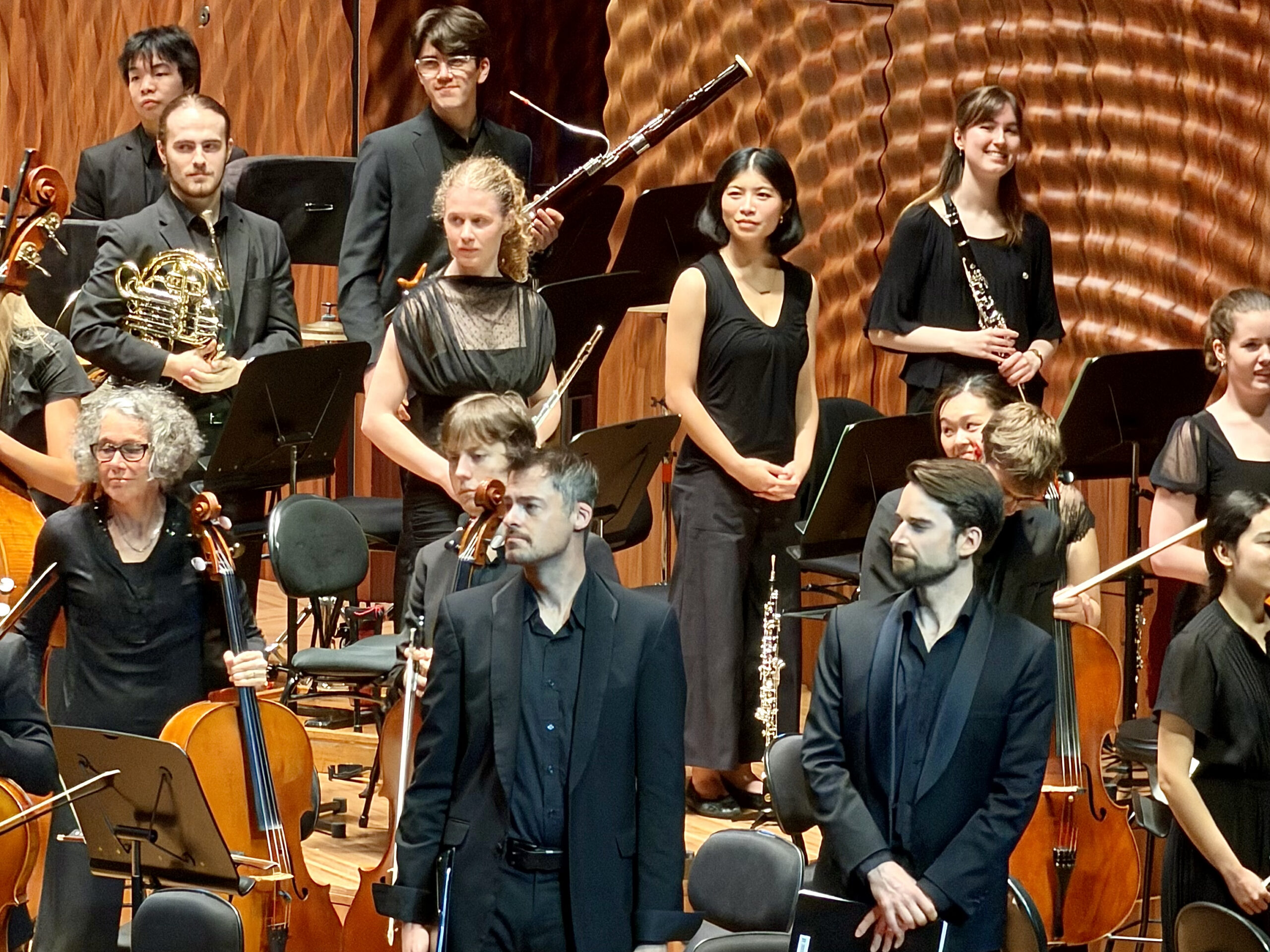
Kyle Stegall and Jeremy Kleeman in Britten’s War Requiem with Sydney Philharmonia Choirs. Photo © JJ Antmann
In his program welcome, Conductor Brett Weymark quotes Owen by referring to the War Requiem as a warning, and in his reading of the work, together with Elizabeth Scott who conducts the chamber orchestra and Michael Bradshaw who leads the children’s choir, that warning rings loud and clear.
It continues to do so a day later – a sound I cannot expunge, no matter how hard I try.
It’s not in the Dies irae – potent though it is with its unsettling asymmetrical metre, sudden rhythmic shifts and alarming fanfares – but rather in the explosive climax of the Libera me where panicked choral bursts are coupled with a convergence of musical forces, creating a wall of sound so dense as to elicit a visceral response in the listener.
At once suffocating and sublime, the screams of “calamity and misery” are coupled with the piercing cry of the soprano, Eva Kong, who trembles in fear of the “wrath to come”. It is as though Britten wanted this moment of “great and exceeding bitterness” to be utterly unbearable – sonically, physically and emotionally.
When Gavin Carr conducted the War Requiem in Hiroshima last year, marking the 80th anniversary of the city’s atomic bombing by the US, he said that “the sound should pass through our bodies like waves.”
In Waymark’s hands, it rips through us, leaving a lingering knot in the stomach that I still cannot shake.
Immediately after this shock, the music collapses in on itself, and we find ourselves in the trenches for Britten’s setting of Owen’s Strange Meeting.
Here, tenor Kyle Stegall and baritone Jeremy Kleeman capture the exact tenderness and intimacy found in Jarman’s film adaptation, recalling the bonds between Parker’s Owen, Teale’s Unknown Soldier, Bean’s slain German and their fellow war dead.
Britten remains unsurpassed in his gift for setting English text, and this is highlighted by the exceptional diction of Stegall and Kleeman, their even tone and fluid legato revealing the composer’s intricate phrasing.
Written for Britten’s partner, Peter Pears, the tenor part demands extended phrasing at which Kyle excels. Kleeman also makes light work of his long-breathed lines, but just as the tenor part floats, the baritone has more vocal shading, written to make the most of Dietrich Fischer-Dieskau’s Lieder skills. Kleeman rises to the challenge with flying colours.
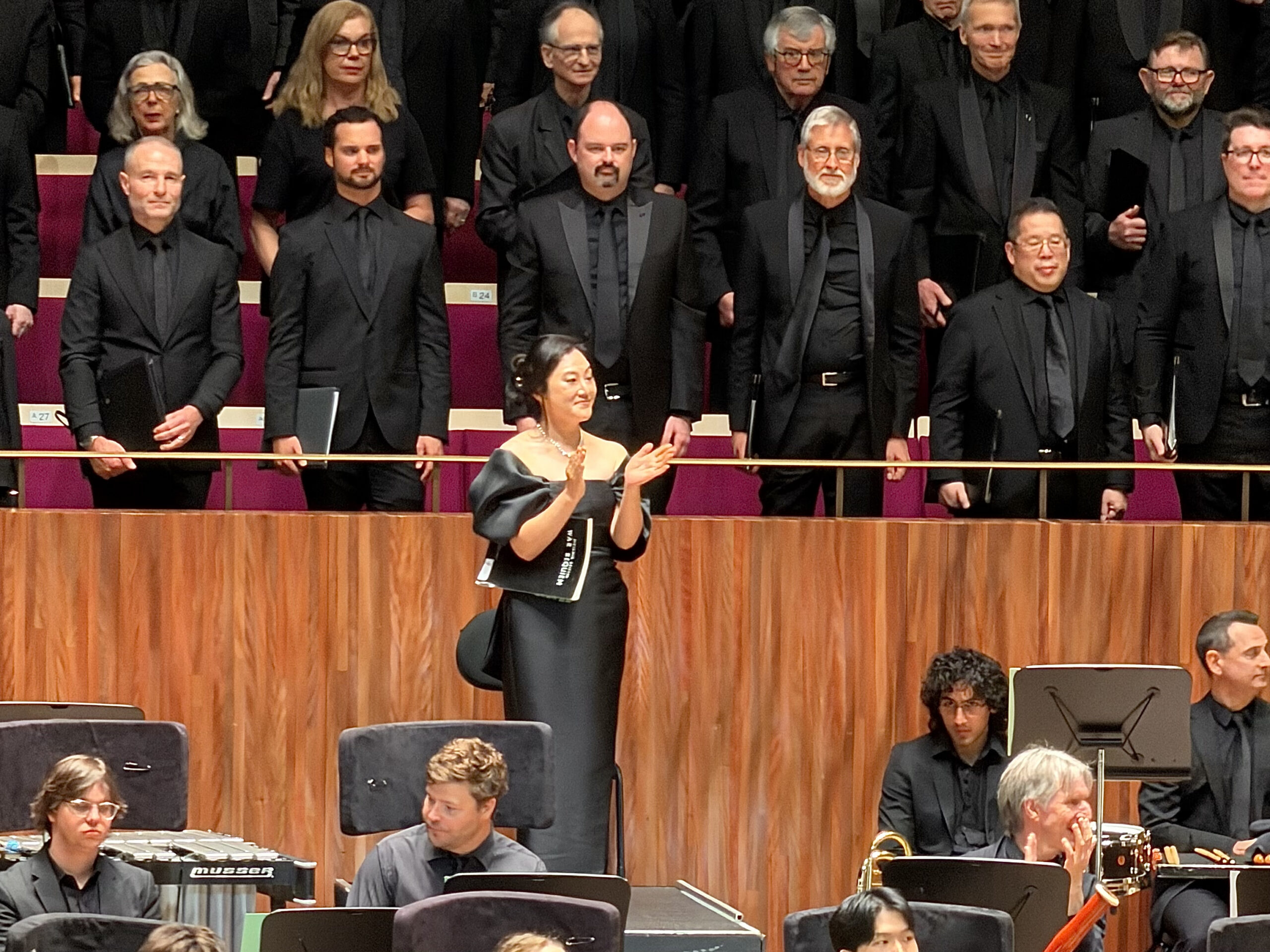
Eva Kong in Britten’s War Requiem with Sydney Philharmonia Choirs. Photo © JJ Antmann
Eva Kong is equally exceptional. Perched on a raised platform at the back of the stage, her clarion soprano succeeds in cutting through the vast orchestral forces beneath her, while her melismatic solo in the Sanctus captures the statuesque, incantatory quality Britten originally asked of Galina Vishnevskaya.
Weymark’s spatialisation honours Britten’s original intentions. The chamber orchestra that accompanies Stegall and Kleeman in the settings of Owen’s poems is positioned to the right of the orchestra (stage-left).
With their solo parts, the chamber musicians are as exposed as the singers, and special mention must go to the characterful bassoon playing of Lyndon Coward, notably in the Isaac and Abram section of the Offertorium, and Noam Zemack’s precision on timpani.
At the back of the Concert Hall, up in the gods, the Conservatorium High School Treble Voices bring an angelic quality to the immersive soundscape, with Tim Cunniffe adding the ethereal sound of a chamber organ, while at the front of the hall, David Drury plays the Concert Hall’s Grand Organ.
In this cathedral-like atmosphere, they join the exceptional Sydney Philharmonia Choirs and the musicians of the Sydney Youth and Sydney Philharmonia Orchestras to deliver a profound warning – one that resonates well beyond the Concert Hall, and one we ignore at our peril.







Comments
Log in to start the conversation.