An entire concert of motets for double choir by German early-Baroque composer Heinrich Schütz is a brave rarity in Australia, even if it mightn’t be quite so unusual for specialist vocal ensembles in Europe like The Tallis Scholars, The Sixteen or Dresdner Kammerchor.

Roland Peelman, among those who founded The Song Company in the mid-1980s, returned as Guest Director for this tour, bringing his precise, cat-like conducting energy to the cycle of songs written in 1671 at the very end of Schütz’s highly productive life (hence the title Schwanengesang: swansong).
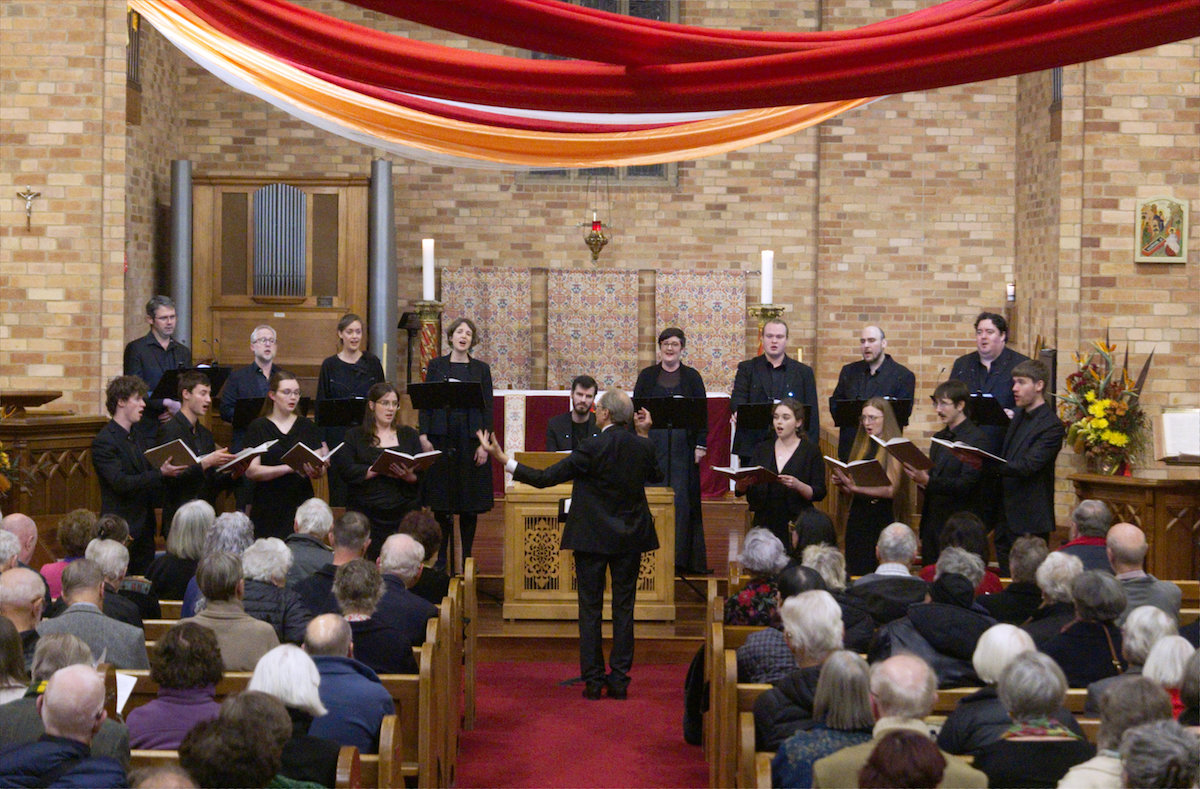
The Song Company: Der Schwanengesang (Roland Peelman, director). Photo © Peter Hislop

Schütz was unusual, not only for living to 87 when anyone who survived infancy in Germany was lucky to make it to 50. He bridged musical traditions in two ways: bringing the renaissance into the baroque, and melding German and Italian liturgical styles and forms. Schütz studied in Venice with Giovanni Gabrieli and closely observed Monteverdi at work.

It’s easy to hear the influences of Palestrina and Gabrieli, but Schütz’s melodies and harmony arrangements are less predictable, and at times more impressionistic, prioritising an ‘atmosphere’ and the human response to the German text above achieving conventional ‘resolutions’. Changing time signatures and tempo, and the scattering of parts, are used to mark out new lines, or subject matter, or moods from the text.

The Song Company is most commonly heard as a line-up of four to six voices, but for this performance the core group expanded to eight and was joined in alternate motets by eight more young singers comprising the Company’s Emerging Artists program. This added flexibility, colour and body to those motets (among 11 in all, with words from the epic on God’s word, Psalm 119) that called for a deeper texture than can be provided by using only one voice per part. This worked extremely well.

The Song Company: Der Schwanengesang (Roland Peelman, director). Photo © Peter Hislop

Tenor Timothy Reynolds intoned the introduction to each motet, his pure bell-like voice reflecting off the brickwork interior of St Paul’s, demonstrating a reverberation time of around half a second which well suited the music and an ensemble of this size. Standing beneath the chancel arch, sound reflected directly towards the audience. Singers, organist (Nathan Cox) and conductor were all easily visible.

Smoothness and uniformity of tone, which is critical for baroque choral music, was matched with generally precise and clear beginnings and endings of phrases. The singers’ articulation of the German text was excellent. The Henk Klop continuo organ was consistently sympathetic and accurate beneath Cox’s fingers, without any hint of chirpiness that some small organs are prone to.

This was not a concert to showcase individual voices. That said, it was possible to pick up tenor Perry Joyce’s Renaissance-faithful lack of vibrato, William Varga’s lovely counter-tenor, Anna Fraser’s mellow soprano, and young Baritone Liam Graham’s building vocal richness. The Emerging Artists were well-profiled as a distinct ensemble in the 7th motet Mem und Nun.

Finishing with a glorious, triumphal setting of Psalm 100 (‘Praise the Lord, all the world’), and a resounding full-voiced Amen, this concert was consummate, cerebral, and intriguingly satisfying.

Contribute to Limelight and support independent arts journalism.