Dance can be wonderfully malleable when it comes to meaning. In the program note for his new The Journey Itself is Home, Rafael Bonachela writes of longing, connection and tenacity seen under the light of “a setting (or rising) moon” .

He made the work. He knows what it means for him.

There are other possibilities, thoughts sparked by the knowledge that Bonachela is coming to the end of his exceptionally long artistic leadership of SDC (not far off 20 years when he finishes at the end of next year). For me this was a piece about separation.

What if the semi-circle of Kelsey Lee’s set was not the moon but Earth seen from space? It’s an irresistible notion, given the profusion of twinkling lights (Damien Cooper’s gorgeous design) and their changing texture. A huge city at night, lights blazing, sends out its message to the universe. We are here. Please look.
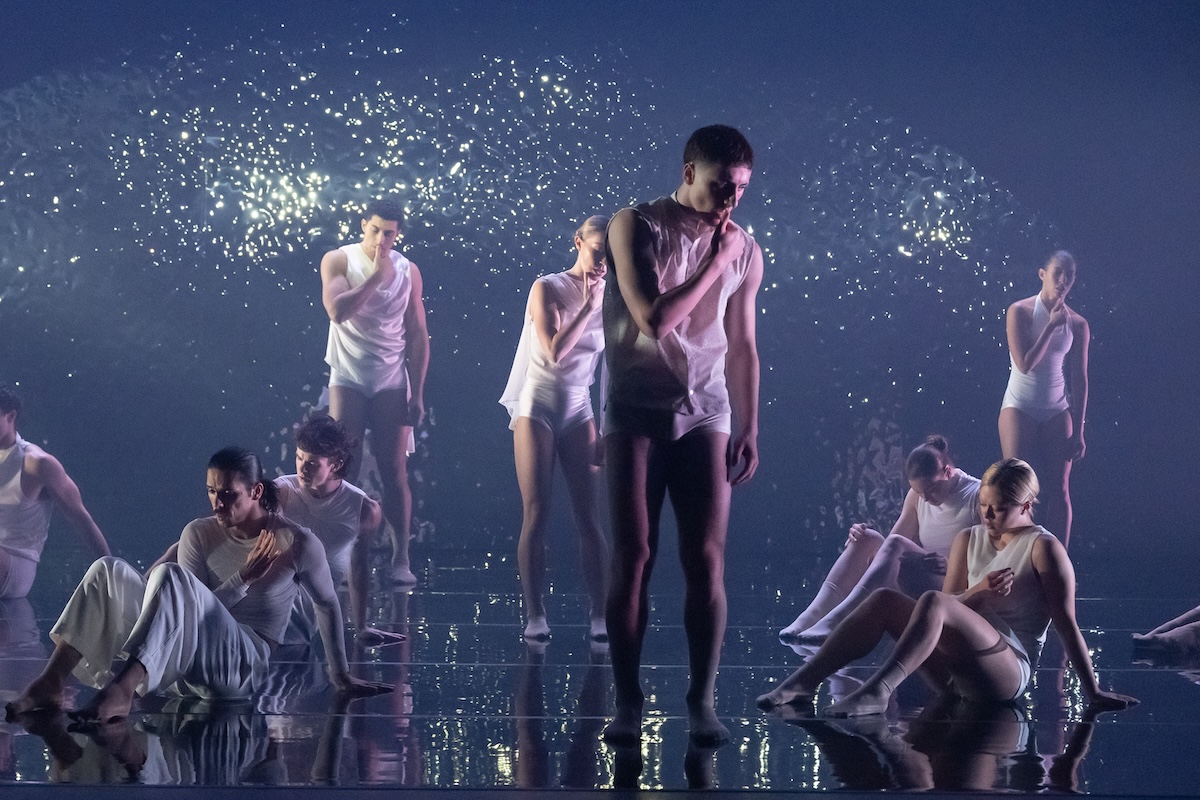
Rafael Bonachela’s The Journey Itself is Home. Photo © Wendell Teodoro

In such a context the dancers, all dressed in white, seem to embody the energy of swirling atoms. They are sometimes alone, as in a lovely solo for Jai Fauchon during which he tightly spins to the ground and then rises as if unaffected by gravity, or in exciting, tightly knit pairs in close orbit. There are larger sets of eight with interchanging members and there is satisfying order with the full group of 17.

The work has an aura of unknowability. There’s no sense of character and little of shared emotion but something in this distant realm catches the heart. Life goes on; it’s just somewhere else.

The close relationship between Bonachela and Bryce Dessner’s music continues extremely fruitfully. Dessner’s latest commissioned score is a piano concerto in four movements with layers of electronica, low and high, out of which the piano comes to take the lead. It is embracing as well as majestic.

Melanie Lane’s Love Lock. Photo © Wendell Teodoro

The Journey Itself is Home closes the triple bill, which opens with the return of Melanie Lane’s Love Lock. In between Bonachela introduces Australian audiences to Spanish choreographer Fran Diaz.

A pre-show glance at the program shows Diaz’s The Mass Movement lasts just 13 minutes. Hmmm, one thinks. That’s not long.

By the end of this incredibly powerful work you wonder how its 13 dancers manage to stay upright. Diaz delivers a punch to the gut as he surreally blends frenzied images of indoctrination and militarism alongside the benign cooperation needed to achieve something as exact as a showgirl line-up.

Fran Diaz’s Mass Movement. Photo © Wendell Teodoro

There’s not a sequin to be seen, mind you. Diaz costumes the group in military-style dark green which gives an idea of where his thinking is ultimately going.

At a few moments dancers shudder and fall as if shot. They are seen in tight formation as if soldiers at a drill session. The women are every bit as tough as the men. If you want to view this as an anti-war, anti-fascist piece, go right ahead. Also for consideration could be the view that conformism may not be ideal but it could mean you and your friends staying alive.

And then there are those shoulder-to-shoulder lines inspired, Diaz says, by the Tiller Girls, fabled exponents of late 19th and early 20th century synchronised dance. As I say, surreal, but incredibly affecting. A lot to think about in 13 minutes.

The pumped-up-to-15 score is based on music by Henryk Górecki, arranged to striking effect by composer and sound designer Tom Foskett-Barnes, who at one marvellous point gets a mad fairground sound going to match Diaz’s frantic mechanistic movement.

Love Lock was first seen in SDC’s 2024 Twofold program. It’s great to see it again.

Essentially this is folk dance-meets-rave party and very sexy with it. A second viewing brought certain details into sharper focus. Early on there’s an enigmatic solo in which Timmy Blankenship looks super shiny. Then everyone starts swaying slightly from side to side, after which they pick up the swing and bring even more hip and groin into the action. It looks fabulous, particularly when the movement propels the dancers into small discrete groups. Just lovely.

At this point everyone is wearing a little black something but as the work progresses and the folk dance elements accrue, designer Akira Isogawa (now there’s a name to crow about) adds bits of this and that to the basic outfit.

Colour arrives, as do texture and volume. The additions are weird and wonderful. They give personality to each dancer as Lane expertly mixes traditional dance shapes and forms with more out-there contemporary moves. It was a delight to see a touch of tango and hand-in-hand lines.

English composer Clark’s score is lush electronica out of which the cello emerges warmly and percussion gives bite. I thought last time and still think the addition of frequent vocalisations from the dancers is distracting, although acknowledge the wit of including some lyrics from the Bee Gees’ How Deep is Your Love and the sweetness of humming dying away at the end.

The three works that comprise Engine all speak to how communities behave. Lane’s is the one that offers the most comfort.


Engine is at the Drama Theatre, Sydney Opera House, until July 12.

Contribute to Limelight and support independent arts journalism.