


Released in 1922, Danish director Benjamin Christensen’s Häxan is a film of legendary status, albeit one that tends to lurk in the corners of cinema culture. Part essay, part historical fiction, part feverish occult fantasy, it draws a thematic line between a 15th-century witch brewing a love potion in her cellar, an outbreak of satanic madness in a convent and an unhappy early 20th-century woman caught shoplifting from a jeweller.
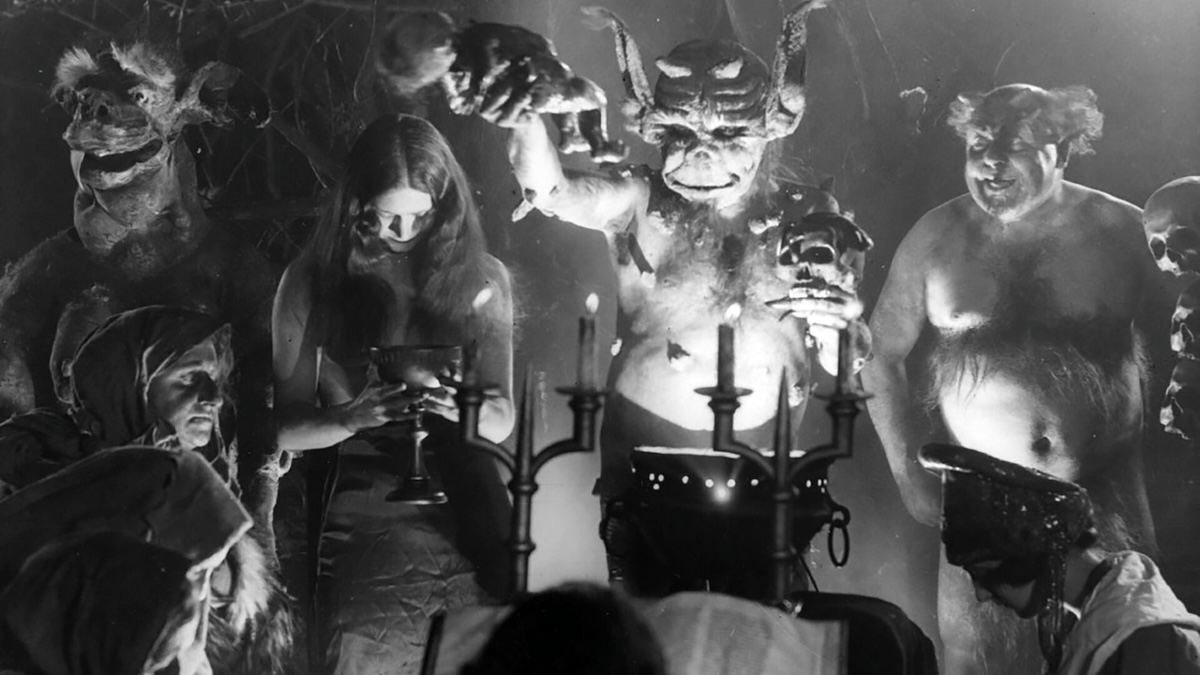
Benjamin Christensen’s Häxan
More than a century after its making, few would be persuaded by Christensen’s theory linking female ‘hysteria’ to the persecution of witches in earlier times. But the film remains an extraordinary piece of cinema: grotesquely comic, deeply disturbing and frequently hallucinatory. Its influence on subsequent filmmakers is unmistakable, from Carl Theodor Dreyer’s The Passion of Joan of Arc to Ken Russell’s The Devils and, more recently, the films of Robert Eggers.
No original score was composed for the film. At its premiere, the accompaniment was assembled from existing classical and traditional music, including excerpts from Bach, Beethoven and Mozart, although many of the original musical cues have since been lost.
All of which makes Häxan ripe for the kind of sonic reinvention offered here by Australian composer Madeleine Cocolas, whose live score was originally commissioned by Queensland Art Gallery | Gallery of Modern Art (QAGOMA) in 2024. This Halloween screening in the Sydney Opera House Playhouse marks its Sydney premiere.

Madeleine Cocolas. Portrait supplied
Performing alongside the screen with a digital keyboard and floor tom, Cocolas draws on a palette of ominous organ tones, electronic textures and sequencer patterns that might have come straight from a 1970s or 80s horror film.
Conceived as a response to the film rather than a blow-by-blow accompaniment, the score is atmospheric without being too illustrative. Its electronic sound world proves a striking match for Christensen’s richly textured monochrome images, amplifying their sense of the uncanny without dictating how we should respond to them.
Though Cocolas cuts an elegantly witchy figure at the keyboard, the music never competes for attention with the film. Instead, it settles into the images, finding new tensions and resonances in scenes that are already startling in their visual invention.
Häxan needs little help making an impression, but Cocolas’s score does more than provide contemporary gloss. Drawing out the film’s darker impulses, Cocolas makes its disturbing preoccupations feel immediate rather than merely historical.







Comments
Log in to start the conversation.