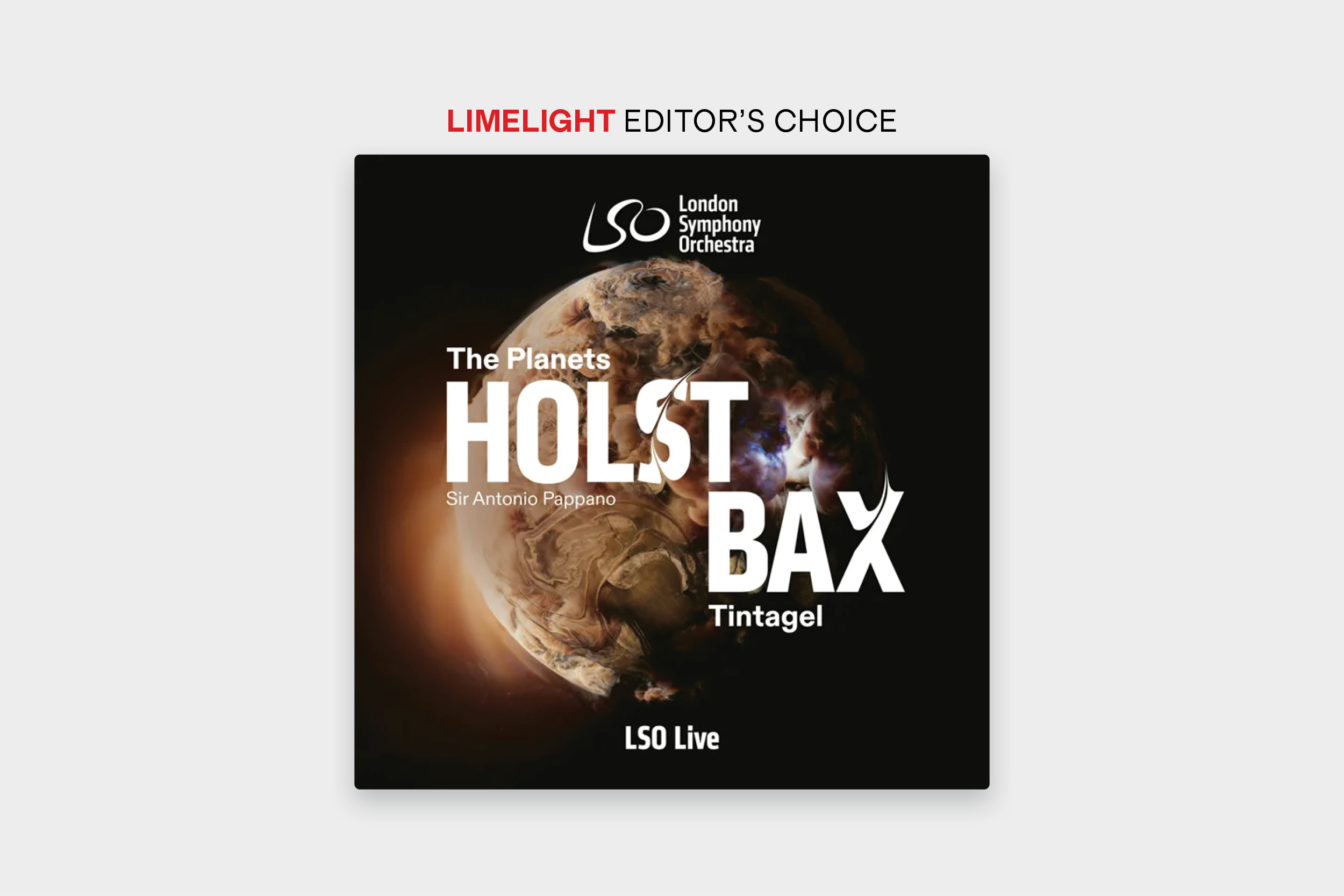
There are so many recordings, not to mention live performances of Gustav Holst’s The Planets that you wonder why an orchestra would bother to release a new version (the current catalogue contains well over 80!). And yet there’s something fresh and irresistible about this London Symphony Orchestra album, recorded live (with patches) in 2024 under Music Director Antonio Pappano. Not only that, it’s coupled with Arnold Bax’s swashbuckling Tintagel, a work fully deserving of British national treasure status and yet inexplicably a relative stranger to concert programs.
Holst couldn’t have chosen a less propitious time to compose The Planets, starting the work in 1914 as his country went to war and completing it in 1917 when there was little enthusiasm for new music. With a significant proportion of the population either recently dead or about to die, musicians for such an ambitious work were thin on the ground. His luck was in, however, for composer and promoter of contemporary music Balfour Gardiner leapt at the chance to put it on, arranging for the young Adrian Boult to premiere the work at London’s Queen’s Hall in 1918. It earned Holst immediate acclaim, catapulting him into the first rank of British composers alongside his friend and colleague Ralph Vaughan Williams (The latter at the time was serving in France while Holst had been rejected for active military service due to severe neuritis in his right arm and poor eyesight).
The work is cast in seven movements mirroring the seven then-known planets of the
solar system (minus Earth, of course). Holst was fascinated by astrology – he called it his “private vice” – but The Planets was more than that, reflecting, as he saw it, the cosmos as a “miracle” in which everything was interconnected. For that reason, he didn’t simply tie the planetary titles to the Roman gods for whom they were named but sought deeper connections to human thought and feelings. Mars may be “the bringer of war”, but Venus is linked to peace rather than love, Neptune to mysticism, rather than the sea etc. It works well, bringing a richness and an added palette of potential colours to the whole.
Pappano seizes on the prismatic and textural opportunities here, as of course do many of the most successful interpreters of the work (Boult, for example, also Dutoit, Rattle and Andrew Davis). What makes this performance so special is something that, I think, makes many of Pappano’s interpretations so fresh. There’s a real feeling here that the conductor has come upon the work with neither preconceptions nor reliance on tradition. Instead, he’s opened up the score and pondered deeply over each and every page, as if to say, “well, what have we here?”
There’s nothing eccentric. Tempi are well judged, sufficiently original to pique the listener’s interest without being confrontational. Textures are diaphanous – surely Venus has never sounded so ravishingly beautiful, Mercury never so, er, mercurial – with the work’s impressionist elements frequently to the fore. It’s also extraordinarily exciting. Mars is bone-crushingly fierce, the grinding dissonances over the inexorable crescendo raising hairs on the back of the neck. The fortissimos – especially in Mars and Uranus, but also in the chilly climax of Saturn – are thrilling. The LSO engineers have worked miracles in the challenging acoustics of London’s Barbican Hall.
There’s joy too, and fun. Mercury, for example, made me gasp with delight, while Jupiter will have you dancing around the room. Neptune, thanks to Pappano and the ethereal voices of Tenebrae, is an exceptional interpretation, the choir barely perceptible at times, the shifting harmonies here sounding like the harbinger of Ligeti.
As Holst drew a line under The Planets, Bax was picking up his pen to start work on Tintagel, completing the score in 1919 (it was the composer’s heart condition that spared him war duties). A 16-minute symphonic poem, it followed a visit to Cornwall and was inspired by views of the famous 13th-century Tintagel Castle perched on the rocky north coast. The work is certainly impressionistic. It’s equally uplifting, the composer creating the impression of the cliffs, castle and sea on a “sunny but not windless summer day”. The rolling waves, the glitter of sunlight, and especially the mounting fanfares and subsequent quotations from Tristan und Isolde (set of course in a legendary Cornwall), conjure a world of seafaring and chivalry with a long, sensual central section hinting at Wagner’s impassioned lovers.
Again, the performance feels fresh as a daisy, Pappano letting the music unfold in a way that is organic yet theatrically crafted. The LSO strings are gossamer light (as they are throughout The Planets), the brass superb in the slow opening build. The two works are perfectly complementary, Tintagel acting as a magnificently weighty encore to the Holst on this outstanding LSO Live album.\
Composers: Holst, Bax
Works: The Planets, Tintagel
Performer: London Symphony Orchestra/Antonio Pappano
Label: LSO Live LSO0904

Comments
Log in to start the conversation.