

Back in the days of analogue recordings and before there were playlists, friends and family would exchange music by compiling a cassette tape of favourite tracks and new “bangers”.
These mixtapes would often be loaded on to car stereos for the trip down to the family holiday.
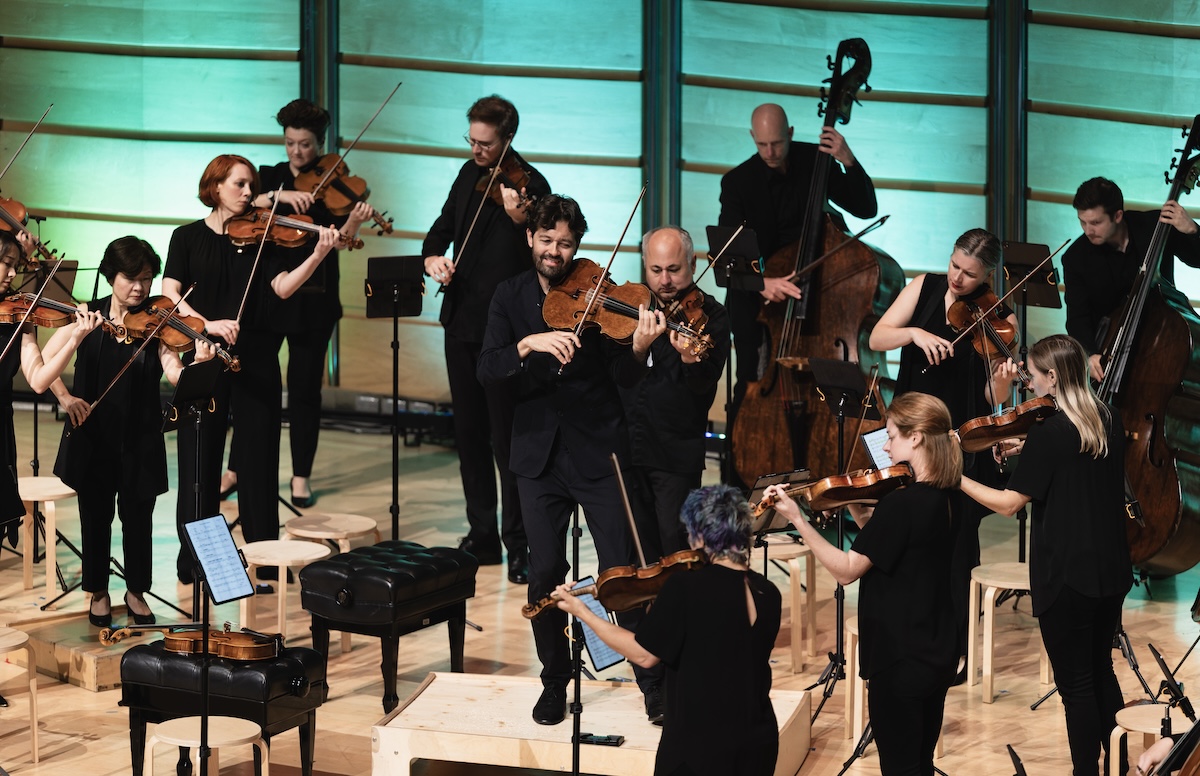
Childhood memories of staring through car windows while music competed with the drone of the engine inspired Radiohead guitarist and composer Jonny Greenwood’s orchestral work Popcorn Superhet Receiver – and an excerpt of the piece, with its motoric scratched and plucked rhythms and slap bass, opened English violist Lawrence Power’s Isles of Light concert with the Australian Chamber Orchestra.
It sat comfortably between a playful pizzicato rendering of a Henry Purcell ground bass number, literally a curtain-raiser to his opera Timon of Athens, and the ACO’s hummed chorus of Thomas Tallis’s beautiful hymn Why fum’th in fight. The significance of that choice would be revealed later.

Lawrence Power and the Australian Chamber Orchestra: Isles of Light. Photo © Nic Walker
London-born Power, making his ACO debut as both soloist and director, dubbed his tour a “mixtape” of English song from the Baroque period to the present day. As much a theatrical event as a concert, at its heart were two major works, both of which looked to the present as well as the past.
For lovers of English “pastoral” music, 6 September, 1910, is a highly significant date: the day Gloucester Cathedral hosted the premiere of Ralph Vaughan Williams’s Fantasia on a Theme by Thomas Tallis.
Sitting in the pews that day were two young composers, Herbert Howells and Ivor Gurney, and Howells was so transported by what he heard that he walked the city’s streets all night. Pieces by both men featured on the mixtape.

Lawrence Power and the Australian Chamber Orchestra: Isles of Light. Photo © Nic Walker
The other central work in this concert – co-commissioned by the ACO – was a new viola concerto for Power by his friend and fellow violist Garth Knox built around Samuel Coleridge’s poem The Ancient Mariner.
This was where the theatrical element came in. The stage was set with wooden stools in the shape of a boat facing sideways on to the audience, and as Power read selected lines from the poem punctuated by viola solos the 23-strong ensemble, led by Principal Violin Helena Rathbone, sat and swayed as if to the motion of the waves.
Sliding harmonics and dragged bowing created the effects of the wind through the sails and the cracking ice as the albatross led the lost ship away from the Arctic wastes. Throughout the seven sections of the concerto Power played, acted, sang and declaimed in what was a tour de force performance, culminating in the Mariner shooting the albatross with a crossbow – in this case a viola bow carried across stage to pierce the heart of Rathbone’s mewling 1732 “ex-Dollfus” Stradivarius.
Also part of the eclectic first half mix were Brett Dean’s arrangement of Kate Bush’s The Man with the Child in his Eyes, a viola solo of Gurney’s Sleep from Five Elizabethan Songs and Bernard Rofe’s adaptation of “GRS’s” irrepressible bulldog in Variation XI from Edward Elgar’s Enigma Variations.

Lawrence Power and the Australian Chamber Orchestra: Isles of Light. Photo © Nic Walker
The second half was more substantial and Power wisely changed the advertised running order so that the concert finished with the beautifully layered Fantasia, the main orchestra taking front of stage and a smaller ensemble lined along the back, creating an other-worldly sense of spaciousness.
Powell switched to violin to lead the opening work of the half, the much-neglected Irish composer Elizabeth Maconchy’s Symphony for Double String Orchestra, with its mid-20th century feel and influences of both Stravinsky and Bartók.
Howells’ Elegy for Viola, String Quartet and String Orchestra – written to commemorate a friend killed in the Battle of the Somme – made an achingly beautiful and impeccably performed link to RVW’s masterpiece.
Power, as well as being a conductor and soloist, has commissioned several new concertos to expand his favoured instrument’s paltry solo repertoire.
Once the butt of jokes (“What do you call someone who hangs around with musicians?” or “How do you keep a violin from being stolen? Put it in a viola bag”), Power and others like him have ensured that this is no longer the case.
The Australian Chamber Orchestra presents Isles of Light at City Recital Hall, Sydney until 20 June; in the Concert Hall, Sydney Opera House on 21 June; at Queensland Performing Arts Centre, Brisbane on 22 June and at Adelaide Town Hall on 23 June.

Comments
Log in to start the conversation.