




Kurt Weill spent a great deal of his American exile searching for a) the right collaborators and b) a way to fuse the groundbreaking music theatre style he’d virtually created during his time in Germany – what we tend to think of now as the Weimar cabaret sound – with the Broadway showtunes of his new homeland. Interestingly, the American musical was at that stage going through a restless, experimental phase, which suited him down to the ground. If works like One Touch of Venus and Knickerbocker Holliday haven’t really stood the test of time, perhaps they were a step to far. Street Scene, his genuinely groundbreaking work of 1947, has fared better, if not on the Great White Way, then certainly in the opera house.
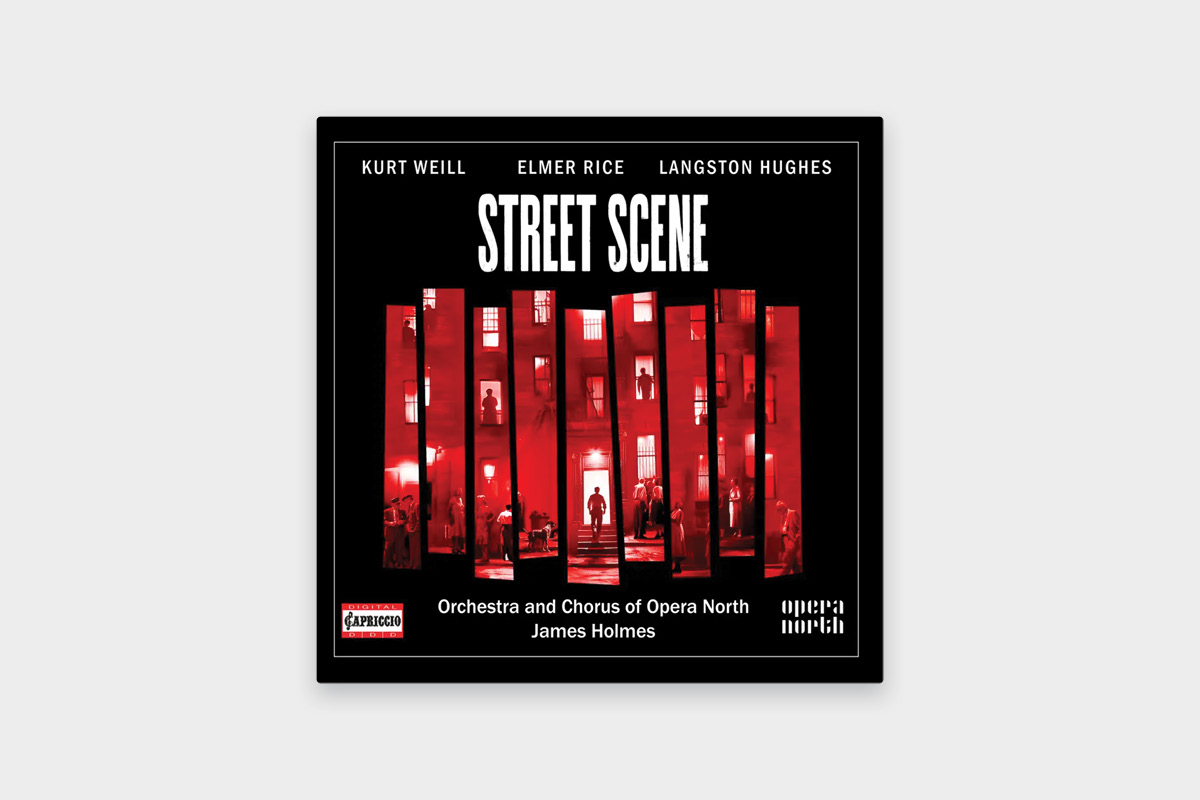
Based on Elmer Rice’s Pulitzer Prize-winning 1929 play, the lyrics were written by the distinguished Harlem-based poet Langston Hughes. Weill’s music – which won the first-ever Tony Award for Best Original Score – features operatically informed ensembles and the occasional extended aria alongside jazz, blues and some super-catchy Broadway melodies.
Set in and around a tenement block in Manhattan’s Lower East Side across two brutally hot days, the story focuses on the on-off romance between Rose Maurrant, a young woman desperate to transcend her working-class roots, and her neighbour, Sam Kaplan, a young Jewish intellectual. Rose’s life is torn apart when her narrow-minded father kills both her mother and the man with whom she’s been having an extramarital affair. A host of sharply drawn, frequently gossipy, and mostly immigrant neighbours lend the show a memorably melting-pot vibe.
This live recording comes from an acclaimed run at the UK’s Opera North in 2020, cast from within the company plus a handful of its regular guest artists. With no weak links and a thoroughly idiomatic presentation of the score by James Holmes and the Opera North Orchestra, the only issue here is the recording, where singers might have benefited from closer microphones, and the applause, which breaks the drama up where it might have flowed more effortlessly (the difficult to obtain 1989 English National Opera recording gives a better sense of the work’s overall cut and thrust).
Among a vast cast (there are over 30 named roles), Gillene Butterfield and Alex Banfield are eminently believable as Rose and Sam. She, especially, catches the character’s yearning for a better life in the aching What Good Would the Moon Be?. He is equally touching in Lonely House, one of Weill’s bleaker ballads. Giselle Allen brings a real edge to Anna Maurrant’s predicament, caught between an unimaginative husband and an occasionally timid lover. Her big aria, Somehow I Never Could Believe, throbs with unrealised passion. As her husband Frank, Robert Hayward brings stygian tone to the show’s darkest character.
Among the supporting cast, Quirijn de Lang sings up a storm in Wouldn’t You Like to Be on Broadway? while Michelle Andrews and Rodney Vubya stand out in the Broadway belter, Moon-faced, Starry Eyed (Andrews, by the way, yields nothing to the more glittery ENO casting where the role was sung by Catherine Zeta Jones!).
All the neighbours get their moment in the sun, but Christopher Turner in particular adds sweetness and complexity to Lippo Fiorentino in the Ice Cream Sextet and Dean Robinson leaves you wanting more as Sam’s Marxist father, Abraham a left-wing Jewish agitator who despises the capitalist newspapers and longs for revolution.
Composer: Kurt Weill
Works: Street Scene
Performers: Opera North, James Holmes
Label: Capriccio C5560 (2CD)








Comments
Log in to start the conversation.