

Joan Sutherland did the impossible. The down-to-earth diva took a sport-loving nation and turned it into an opera-loving one, so much so that capacity crowds would cram the Domain to hear her sing live. We even braved the lightning – I remember; I was there.

And so, I’m guessing, were a lot of the people gathered in the theatre posthumously named after her for the first performance of La Stupenda, celebrating Sutherland’s centenary and her legacy.
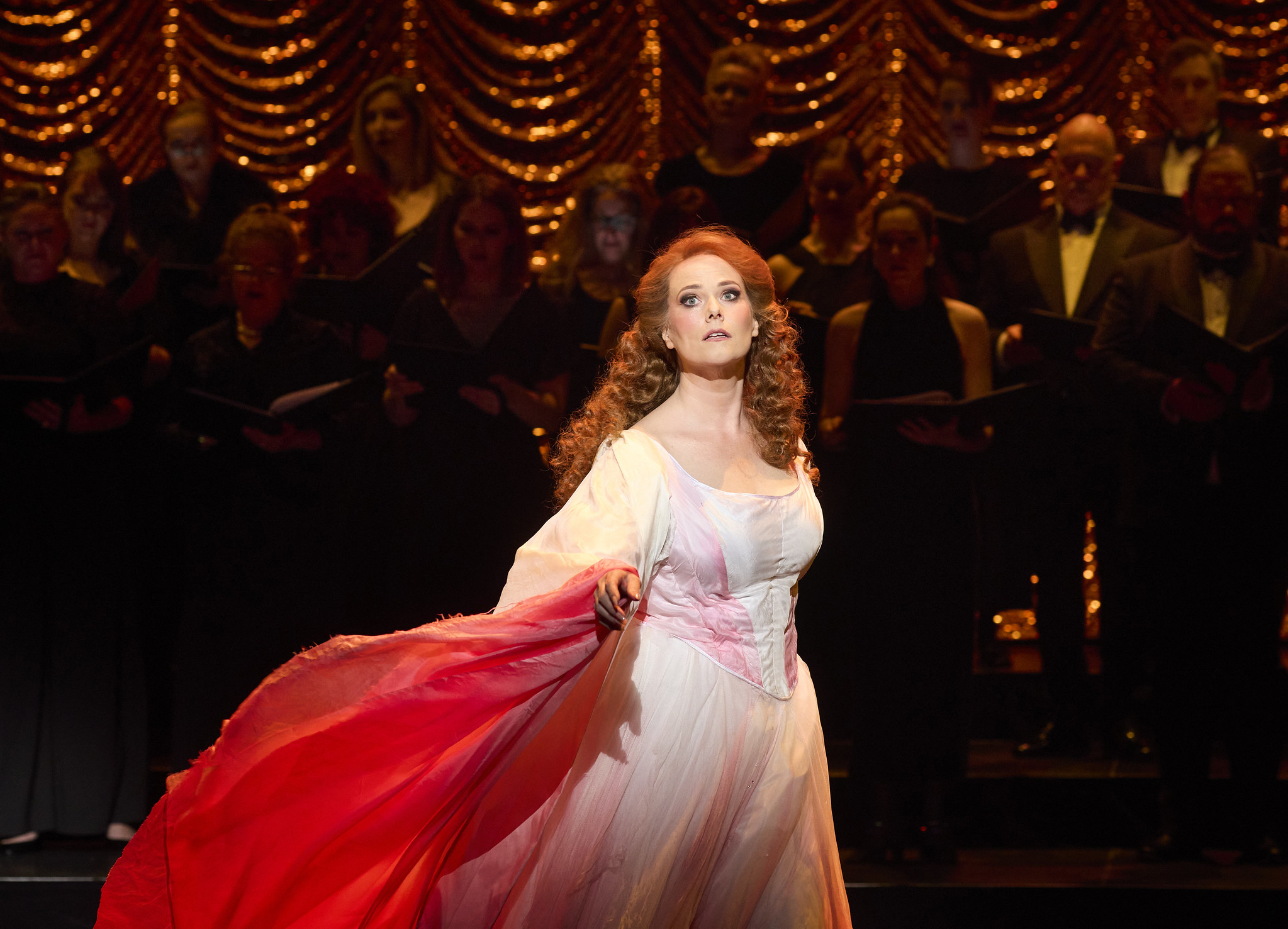
Jessica Pratt in Opera Australia’s La Stupenda. Photo © Keith Saunders

As MC Laura Tingle notes, for many, the opera world changed forever when Sutherland made her legendary title-role debut in Zeffirelli’s 1959 production of Lucia di Lammermoor at Covent Garden.

Today, there is opera before you hear Jessica Pratt sing Lucia, and there is opera after you’ve marvelled at her unique take on the role.

For many, this is that moment; for this writer it was on this very stage in 2018, when Maggie Beer even created a dessert – La Dolce Jessica – to mark the occasion, and again in 2024, when Pratt had a new production created for her by Opera Queensland’s Artistic Director Patrick Nolan.

It is in these cherished moments on home turf that Pratt demonstrates what she has long proven overseas: she is a superstar in her own right, and while she might carry the torch for Sutherland, she doesn’t walk in anyone’s shadow.

This is immediately clear from the moment she appears as Norma and sings Casta diva, resplendent in a flowing gown that glimmers with geometric brocade and mirror-inlay.

From her stratospheric top notes and pristine coloraturas to her formidable lower register, Pratt’s performance is impeccable. It is far more than a question of technical mastery; it is her profound musicianship, evidenced by exquisite dynamic shading; her command of intricate, sustained vocal line; and her embodiment of the characters she performs.

Jessica Pratt in Opera Australia’s La Stupenda. Photo © Keith Saunders

Masterclasses in both singing and acting, Pratt’s portrayals are all-encompassing, her intense gaze, judicious use of gesture and dramatic poise all serving the power of the music.

Nor is she alone. In two finely animated scenes directed by Stuart Maunder, Pratt is joined on stage by tenor Kang Wang, who ably matches her vocal prowess and dramatic intensity.

He first appears as Norma’s faithless lover Pollione and later, most affectingly, as Lucrezia Borgia’s dying son Gennaro, over whose body Pratt delivers a grief-stricken Era desso il figlio mio, the climactic passagework showing off her impressive vocal agility.

Alongside Pratt and Wang, mezzo-soprano Caitlin Hulcup holds her own as the temple virgin Adalgisa in the confrontation trio Oh, di qual sei tu vittima from Norma, and she also delights the audience during the Flower Duet from Lakmé with soprano Jennifer Black.

Other stand-out performances include soprano Jane Ede’s Antonia from The Tales of Hoffmann, her beauteous legato unwavering despite her increasing desperation as Dr Miracle (David Parkin) conjures the ghost of her mother (Hulcup) and forces her to sing to her death.

David Parkin and Jane Ede in Opera Australia’s La Stupenda. Photo © Keith Saunders

Parkin gets his own moment to shine as Raimondo in Lucia, his imposing bass put to fine use as he interrupts the revelers with his declamatory Ah! cessate quel contento, followed by an impassioned Dalle stanze, ove Lucia in which he informs them of Lucia’s madness.

Joining the scene as Lucia’s brother Enrico, baritone Dalibor Jenis is one of a handful of Opera Australia singers who enjoy brief appearances in this celebratory gala. They include tenor John Longmuir, baritone Luke Gabbedy and bass Shane Lowrencev, who begin the proceedings with a scene from Don Giovanni. The OA Young Artist Program is also represented by members of the incoming cohort, mezzo-soprano Sidra Nissen and baritone Jake Lyle.

It is, however, in the pit that another superstar works her magic as conductor Speranza Scappucci makes her OA debut with Concertmaster duties shared across Acts I and II by Matthieu Arama and his Associate, Huy-Nguyen Bui.

Scappucci sets the bar impossibly high during the overture from Semiramide, the tremulous opening followed by a glorious horn quartet with the bassoons joining in perfect harmony, while Huy-Nguyen Bui leads the violins in an uplifting mass candenza before the final ‘Rossini crescendo’.

Jennifer Black and Caitlin Hulcup in Opera Australia’s La Stupenda. Photo © Keith Saunders

From there, Scappucci and the OA Orchestra go from strength to strength, Cilea’s intermezzo from Adriana Lecouvreur surprising us with the relative modernity of its lush, late-Romantic string textures; and Arama delivering a tear-jerking rendition of the Méditation from Thaïs while a montage of Joan Sutherland’s performances is projected on stage.

It’s hard not to crane one’s neck to watch Scappucci conduct, either in the pit or on the monitors dotted around the auditorium. It’s truly impressive to watch her guide the musicians and singers as the music shifts from the structural clarity of Mozart and the bel canto masters – Rossini, Bellini, Donizetti – to the lightness of Offenbach and Delibes, and finally to the lush chromaticism of Massenet and Cilea.

Throughout, the Opera Australia Chorus under Paul Fitzsimon anchors the goings-on like a Greek chorus, providing a harmonic backdrop against which the vocal fireworks of Pratt and her fellow singers stand out even more.

Ultimately, however, it is Joan Sutherland who has the final word, singing Home! Sweet Home in a recording made during her farewell performance in Les Huguenots in 1990. Remember when the ABC used to simulcast operas and ballets on TV? One can only hope this performance is captured for posterity.


Opera Australia presents La Stupenda: A Joan Sutherland Celebration in the Joan Sutherland Theatre, Sydney Opera House until 22 August. 

Contribute to Limelight and support independent arts journalism.