


It was with some trepidation that I approached Justin Peck’s Copland Dance Episodes. I have never made my admiration for choreographer Agnes de Mille a secret, or Martha Graham for that matter, and knowing that the music commissioned for two of their foundational ballets (Rodeo and Appalachian Spring) was going to be repurposed here, I was a little wary of what was in store.
I needn’t have worried. Stripped of their narratives, Copland’s scores find new meaning in Peck’s insightful choreography that brings visual form to not only each note on the stave, but also each dynamic marking and harmony.
They are performed alongside Billy the Kid, commissioned for Eugene Loring’s 1938 ballet, and Fanfare for the Common Man, composed for the Cincinnati Symphony Orchestra in 1942 at the request of Eugene Goossens.
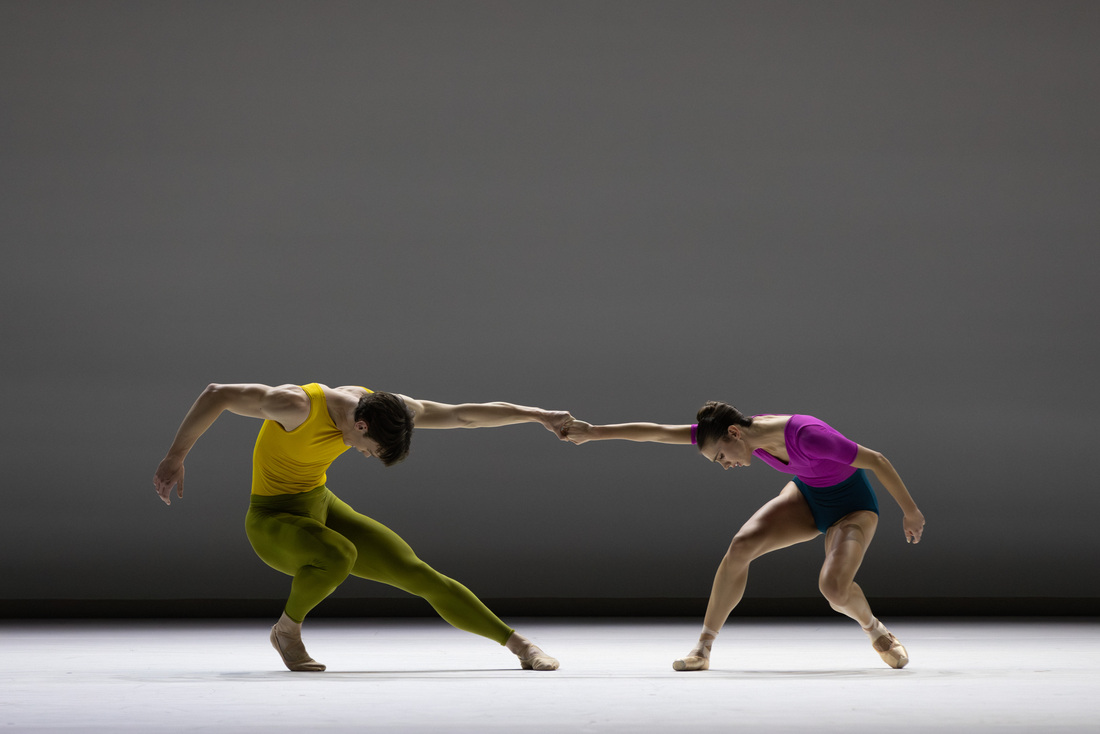
Isobelle Dashwood and Jeremy Hargreaves in The Australian Ballet’s Copland Dance Episodes. Photo © Kate Longley
Liberated from its militaristic connotations, the Fanfare opens the work, laying down the ground rules for what is to come. Here, the kinetic force of Copland’s music is reflected in the athleticism of The Australian Ballet’s dancers, led by Brodie James, who embodies the common note rather than the common man.
From Peck’s vivid tableaux, distinct groupings or chords emerge – in Rodeo, the pairing of Isobelle Dashwood and Jeremy Hargreaves alongside the trio of Cameron Holmes, Henry Berlin and Drew Hedditch; in Appalachian Spring, Benedicte Bemet and Elijah Trevitt with Riley Lapham, Yuumi Yamada and Grace Carroll.
All dance to perfection, the sultry pas de deux showing off each dancer’s exquisite lines. The partnering follows the binary model until it doesn’t, and there is a sense of gender fluidity throughout the work. Music is, after all, a universal language that transcends boundaries and embraces diversity, and Peck’s interpretation of this is both nuanced and profound.
Yes, one can discern a coming-of-age narrative if one chooses, but Peck’s artistry lies in giving human form to music, and just as there is consonance and dissonance, some couples are meant to be together while others aren’t.
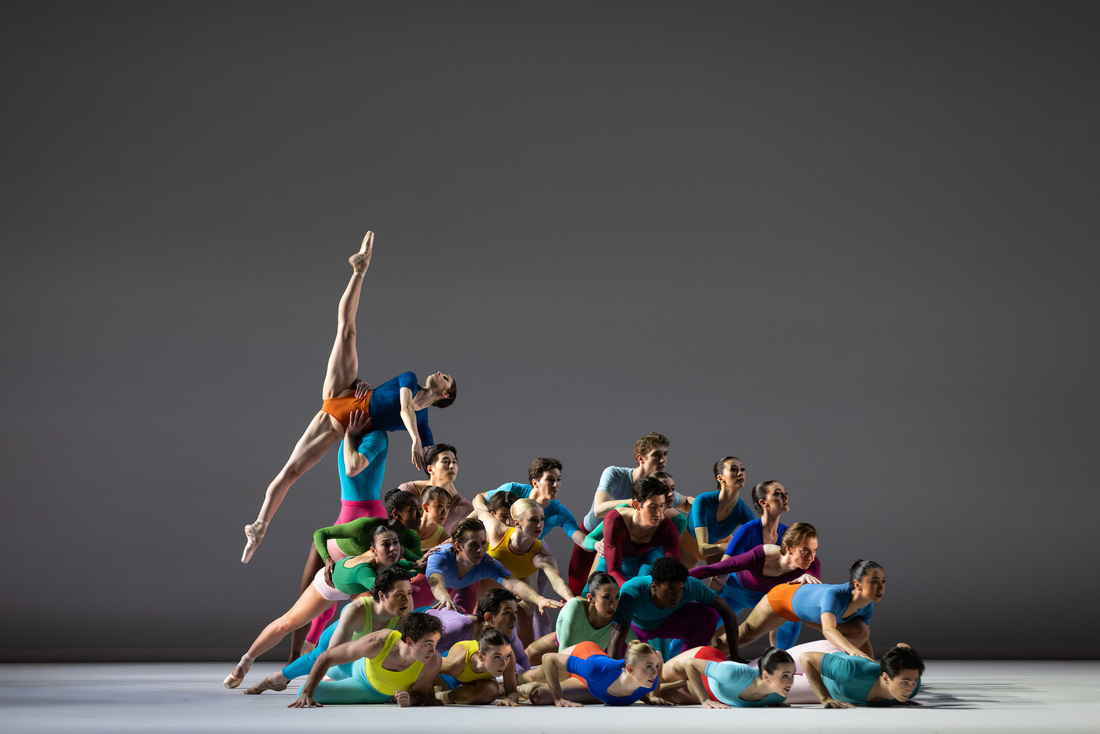
Dancers of The Australian Ballet in Copland Dance Episodes. Photo © Kate Longley
Despite the impossibly difficult choreography, TAB’s fleet-footed dancers make it look easy, with enough energy left over to imbue each intricate step with their own personalities and humour.
There are some lovely dollops of fun along the way, too, the dancers egging each other on and drawing gasps from the audience as they balance en pointe for an unbelievably extended period of time.
The last dance work I remember marrying virtuosity and playfulness so effectively would have to be Anthony Van Laast’s Variations, created on Wayne Sleep and staged as part of Andrew Lloyd Webber’s Song & Dance. There is even a nod to Sleep’s iconic fouettés en tournant, although here Cameron Holmes slows down rather than speeding up. In addition to providing a highly entertaining sight gag, this is considerably harder to execute and requires greater control over balance, timing and musculature rather than a reliance on momentum.
Peck makes no bones about his love of musical theatre, and just as Rodeo’s original choreographer, Agnes de Mille, brought ballet to Broadway when she choreographed the original production of Oklahoma!, Peck’s Copland Dance Episodes brings it full circle, imbuing ballet with the best of musical theatre.

Riley Lapham and Cameron Holmes in The Australian Ballet’s Copland Dance Episodes. Photo © Kate Longley
An exceptional addition to the neoclassical repertoire, Copland Dance Episodes underlines Peck’s New York City Ballet pedigree, and one can trace this work’s lineage all the way back to the abstract ballets of Fokine (Les Sylphides in 1909), Balanchine (Serenade in 1934, which was also inherently witty and preserved missteps from the rehearsal room) and Lifar (Suite en blanc in 1943).
While Copland Dance Episodes might be the obvious successor to Balanchine’s ‘black and white’ ballets, colour-wise it’s anything but. The vibrant palette of Ellen Warren’s costumes and the two front curtains by Jeffrey Gibson offer a visual parallel to Peck’s exploration of the building blocks of music, their kaleidoscopic effect echoing the dynamic Op Art of Bridget Riley and Victor Vasarely, the pioneering abstraction of Hilma af Klint and Seurat’s Pointillism.
These visual elements further help draw our focus to the music, and its impeccable interpretation by the Opera Australia Orchestra under Conductor Jonathan Lo and Concertmaster Matthieu Arama.
The musicians clearly love playing Copland’s compositions as much as the dancers derive joy from performing Peck’s choreography. From the first notes of Fanfare for the Common Man, we know we are in safe hands, and special mention has to go to Dominic Longhurst and Craig Ross on trumpet whose assured opening is reinforced by the horns under Sydney Braunfeld and Bourian Boubbov, as well as the trombones under Gregory van der Struik.
This is Copland done right, and in Peck’s instant classic, we get to see the music as well as hear it. What a stroke of genius!
The Australian Ballet presents Copland Dance Episodes at the Sydney Opera House until 21 November.






Comments
Log in to start the conversation.