

The Live at Yours innovation, born during lockdown, has morphed into a substantial concert series, bringing major artists to tour Australia. 35-year-old French pianist Lucas Debargue was the latest of these, performing in the acoustically and visually commanding interior of Sydney’s Great Synagogue (colourfully and atmospherically lit). 
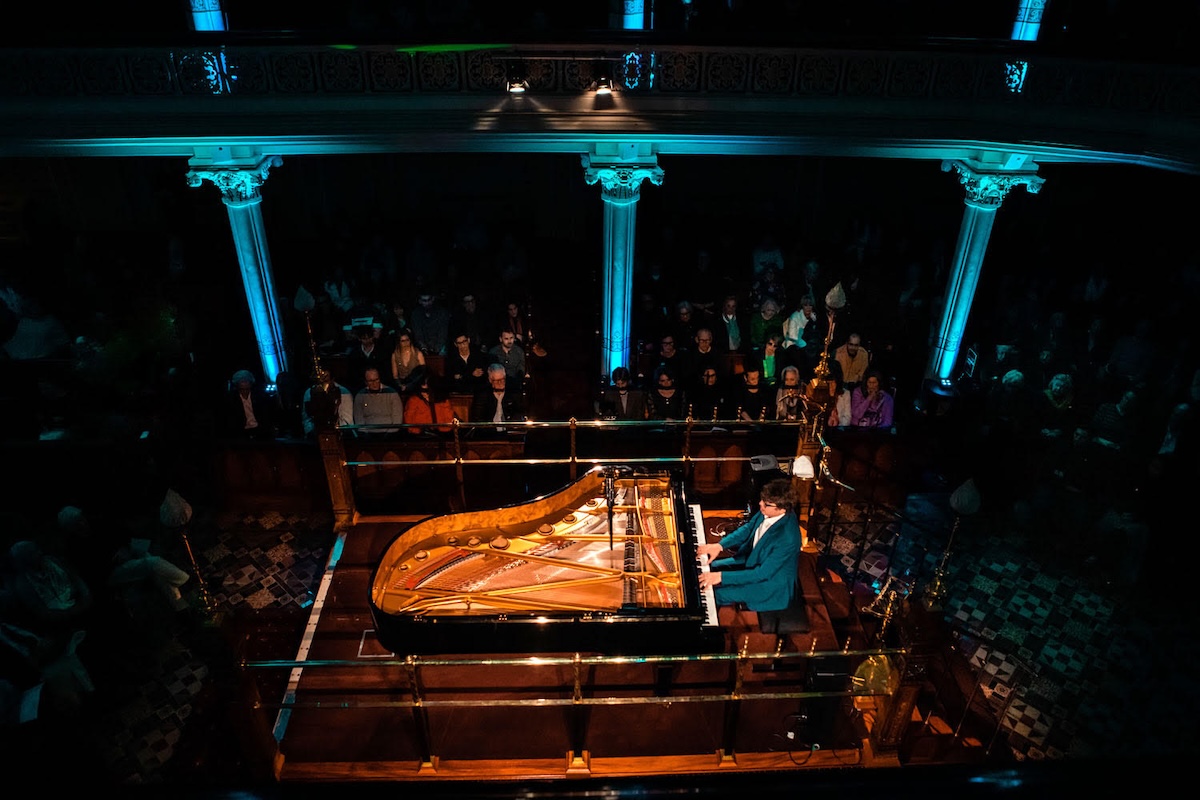
Lucas Debargue performs in Sydney’s Greart Synagogue. Photo © Irena & Jan Photography

Debargue is a virtuoso musician with an extraordinary, unforced technique that he puts entirely at the service of the interpretation. He has recorded notable collections of music by Gabriel Fauré and Domenico Scarlatti (reputedly his favourite composer). His ‘brand’ is also about freedom: he changes programs at will, depending on how he feels on the day, and his interpretive decisions at the keyboard are made spontaneously.

In last night’s concert, for example, half the advertised program was jettisoned (no Fauré!), and the title of the recital, L’Énigme Française, was either discarded or reinforced – depending on whether you were expecting French or enigmatic. What we heard was firstly an original improvisation in Bon a traditional Jewish prayer, an appropriately respectful beginning, then Beethoven’s Moonlight Sonata, Ravel’s Gaspard de la nuit, and a set of Debargue’s variations on Summertime (the last two as advertised).

To be honest, I’d have preferred a selection of Fauré’s Barcarolles or Nocturnes to the Beethoven, which bordered on self-indulgent. The ‘moonlight’ movement was slower than I have ever heard it. The music floated in a timeless, nocturnal world: Beethoven through the prism of  Debussy. That was an effective choice in the solemn surroundings, but the contrasting second and third movements were micro-managed to pieces. Debargue’s incessant pulling around of tempos and his extreme dynamics fought any momentum, especially in the finale, and Beethoven lost that bout. 

Lucas Debargue performs in Sydney’s Greart Synagogue. Photo © Irena & Jan Photography

Ravel’s horrendously demanding Gaspard de la nuit began beautifully with the watery Ondine, exquisitely played with the climaxes perfectly paced. Le gibet, the central movement was, strangely, less mesmerising than it might have been (a man near me kept looking at his watch).

Finally, Debargue’s formidable technical prowess was barely stretched by the third movement, Scarbo. His compelling interpretation stressed the darkness rather than the mere mischief in this sinister character study. His following Theme and Twenty Variations on George Gershwin’s Summertime (which he has also recorded) was a true Romantic showpiece: rather as if Rachmaninov had decided to give Gershwin the once-over. For an encore, Debargue was joined at the keyboard by Simon Tedeschi and they improvised on a blues sequence, which was fun.

A remarkable and very individual pianist.   

Contribute to Limelight and support independent arts journalism.