We have two second hand bookshops to thank for enriching our cultural heritage: First, one somewhere in Germany where Carl Orff came across a book catalogue referring to a 13th century Austrian manuscript of songs and poems, giving birth to his cantata Carmina Burana; second, one in Barcelona where, in 1890, the 13-year-old Pablo Casals found an neglected copy of the scores of JS Bach’s six cello suites.

He spent 12 years studying and performing them before finally recording them in the late 1930s and re-introducing them to the world.

German cellist Maximilian Hornung chose two of the suites – the sunny well-known first and the darker dramatic fifth – to bookend his Australian debut solo recital as part of the Utzon Music series in Sydney Opera House.
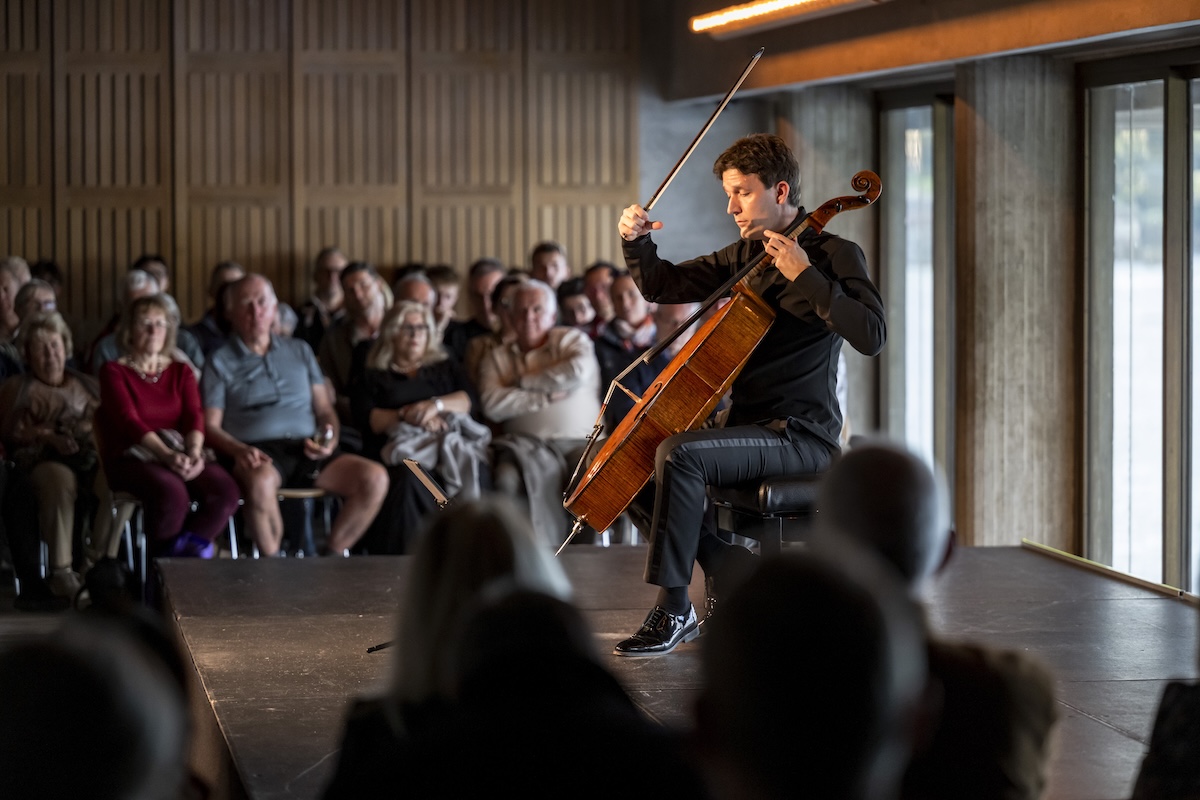
Maximilian Hornung in the Utzon Room, Sydney Opera House. Photo © Cassandra Hannagan

The 40-year-old protégé of Anne-Sophie Mutter had given us a delightful taste of what was come when, as an encore after his recent superb reading of Shostakovich’s first concerto with the SSO, he played the much-loved Prelude from Suite No. 1.

That treatment had been light, almost playful, but in the close acoustic of the Utzon Room it sounded weightier and more thoughtful. Subtle rubato and Hornung’s extraordinary palette of tonal colours were features of the six dances that followed.

The Courante was madcap fun as it capered and skipped with its accents, flourishes and off-kilter rubato. The noble Sarabande was profoundly moving with the sense that Hornung was talking to us through his 1730 Domenico Montagnana instrument.

The two Menuets were witty and nuanced, offsetting the galloping Gigue that closed the work.

Maximilian Hornung in the Utzon Room, Sydney Opera House. Photo © Cassandra Hannagan

German composer Hans Werner Henze’s 1949 series of miniatures, Serenade for Solo Cello, is a varied and entertaining 10-minute showpiece. There’s a tango, march, minuet and pastorale all included in the nine episodes.
The work obviously owes a great deal to Bach’s masterpieces, but it also shares much of the emotional landscape of Benjamin Britten’s three landmark suites composed a couple of decades later.

By turns lyrical, passionate and piquant the work exploits the full range of cello “tricks” – double stopping, bariolage, runs across all the registers and ghostly harmonics – and highlighted Hornung’s technical brilliance as well as his artistry.

This last quality was on display in US composer Caroline Shaw’s 2009 piece In manus tuas, based on Thomas Tallis’s motet, snatches of which are deftly woven into its fabric.

Hornung’s performance had a haunting spiritual impact on his audience, its glassy bowing and building and dying arpeggiated chords, augmented by his wordless vocals, describing a nine-minute arc.

His handling of Bach’s fifth suite, which closed the 70-minute recital, was dramatic and powerful – resonant bass notes, majestic trills and singing tenor register in the Prelude, and it was like watching a sculptor hewing the marble of the Allemande.

Slight slurring of notes lent a world-weariness to the infinitely sad Sarabande, reminding us that Yo-Yo Ma played it at a memorial service marking the 10th anniversary of the New York Trade Center attacks.

Just as this recital would not have been possible were it not for Casals, Hornung came back for an encore of El Cant del Ocelles, the Catalan folk song that the Spanish maestro had a made part of every solo performance.


For more informaton on the Utzon Music Series, visit this link.

Contribute to Limelight and support independent arts journalism.