Fans of the cello are having a bonanza month in Sydney with three top international virtuosi giving concerts and recitals.

Germany’s Maximilian Hornung, a protégé of Anne-Sophie Mutter, gave a stellar performance of Dmitri Shostakovich’s Cello Concerto No. 1 with Sydney Symphony earlier this month and English superstar Sheku Kanneh-Mason will be here next month to play Edward Elgar’s concerto in Sydney and to premiere Edmund Finnis’s work in Melbourne.

The meat in the sandwich is 34-year-old French-Belarusian Ivan Karizna, hailed as special by both Gidon Kremer and András Schiff, who brings his own brand of poetic magic and power to Robert Schumann’s Cello Concerto in A minor in this latest SSO concert marking the welcome return of German conductor Anja Bihlmaier.
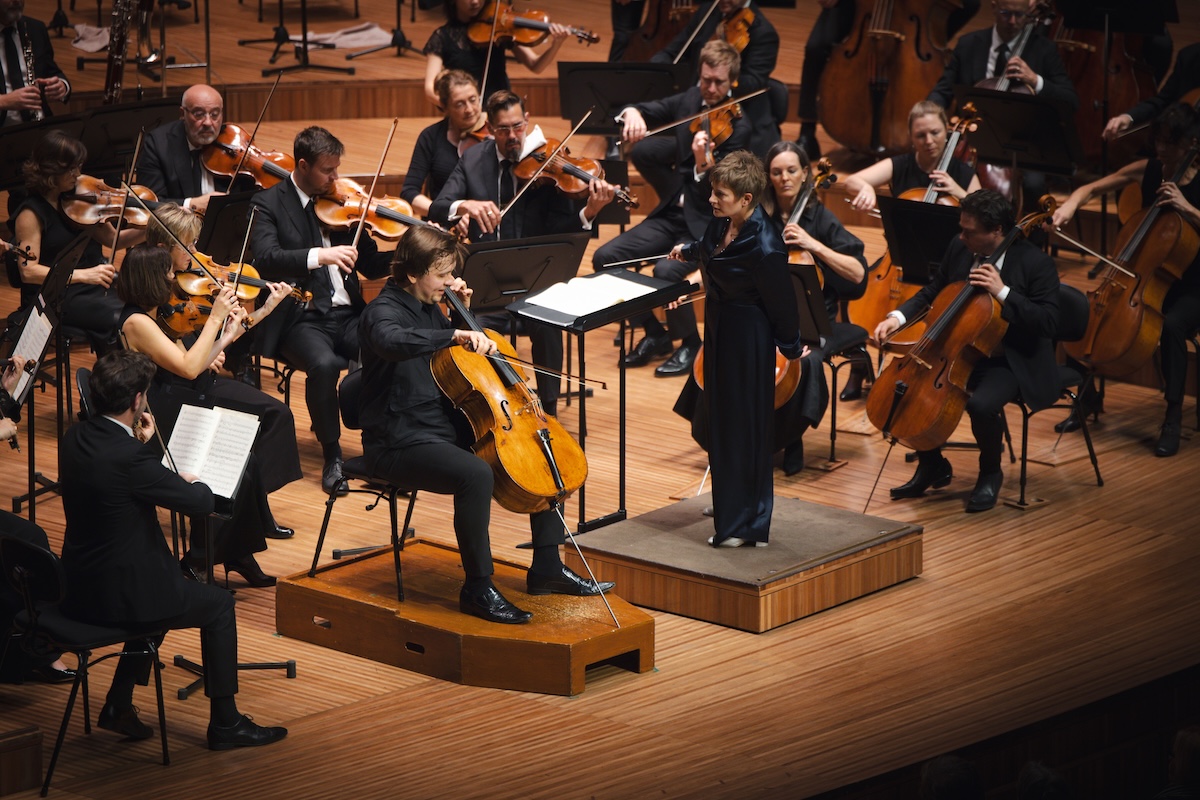
Ivan Karizna, conductor Anja Bihlmaier and musicians of the Sydney Symphony Orchestra. Photo © Sydney Symphony Orchestra

A huge stage presence, Karizna’s giant frame belies the subtlest of touches and within the space of a beat he can go from whispered sweet lyricism to immense power with booming bass notes on his 1760 Tassini cello once owned by Paul Tortelier.

Schumann’s orchestral writing is subtle and the energetic and attentive Bihlmaier ensures that it never overpowers the soloist.

The bipolar melodic fireworks of the opening movement feature some effortless daring runs up and down the fingerboard and faultless intonation coupled with Karizna’s sensitive use of dynamic. The all-too-short slow middle movement features some glorious interplay between Karizna and Finnish Guest Principal Cello Samuli Peltonen.

Playful scurrying runs in the lively finale builds to the passionate and fiery end of this mesmerising performance.

Conductor Anja Bihlmaier and musicians of the Sydney Symphony Orchestra. Photo © Sydney Symphony Orchestra

The concert opens with a short work by Melbourne-based Melody Eötvös, one of our most interesting and talented composers. Among her wide range of interests is archaeology and her 2016 piece The Saqqara Bird, written for the Tasmanian Symphony Orchestra, deals with the enigma surrounding a small wooden carving of a bird found in 1898 in a second century BC Egyptian tomb.

Among the theories is that it was a rich child’s toy, a weathervane or a carving for the masthead of a boat. There has even been speculation that it was evidence of the ancient civilisation’s experiments with aviation! 

Eötvös throws all these ideas into the mix in this nine-minute, large ensemble piece by using a tapestry of orchestral colours and textures, all driven by a persistent percussive pulse. Emma Sholl’s flute and Katlijn Sergeant’s piccolo do the honours for the bird sounds, but this is a composer who can pack a lot into a short work and solos are handed round liberally, including some agile violin from Concertmaster Andrew Haveron.

After some cinematic moments – Hitchcock’s The Birds and sword and sandal epics come to mind – the flute ends the flight accompanied by vibraphone.

Beethoven’s Fifth is so often programmed and so familiar to the listener that one is unlikely to get anything revelatory from a performance. That said, this one under Bihlmaier’s baton is hugely enjoyable.

The famous opening is clean, brisk and precise with the right amount of heft. The strings are buoyant and the opening movement bristles with urgency and energy until the moment halfway through when Shefali Pryor’s solo oboe seems to make time pause for a second.

The finale is pegged back almost to a whisper for the reprise of the dance theme of the third movement, before Bihlmaier puts her foot back on the pedal for the coda and a blazing, triumphant ending. 


Sydney Symphony Orchestra presents Beethoven’s Fifth in the Sydney Opera House Concert Hall, 19 and 20 June.

Contribute to Limelight and support independent arts journalism.