What an excellent program and stunning concert this was. The orchestra played at its impressive peak, led by the precise, expressive direction of Polish-Russian conductor Andrey Boreyko. This conductor has been in charge of orchestras as far afield as Antwerp and Florida, and most recently the highly respected Warsaw Philharmonic; I hope we see him often on our shores. His pacing of Stravinsky’s early ballet The Firebird had all the lyrical ardour, savage excitement and glorious colour it requires. The orchestra’s response was tight as a drum, with characterful (and beautiful) solo work from the woodwinds and brass. First among equals were flautist Emma Sholl and principal horn Samuel Jacobs.
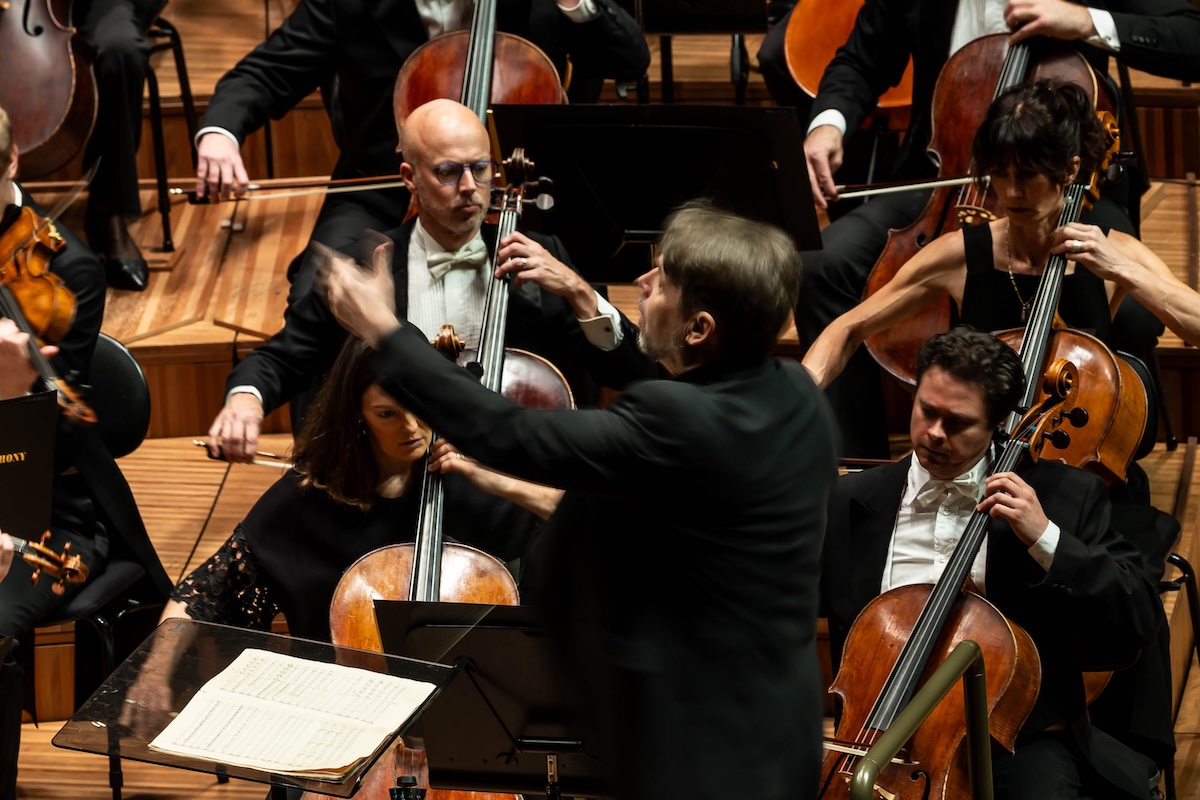
Andrey Boreyko and the Sydney Symphony Orchestra. Photo © Ken Leanfore

The Firebird was preceded by a work from the composer who received the original commission from entrepreneur Sergei Diaghilev but was too slow (or lazy) in getting started, causing the producer to turn to the young, unknown Stravinsky. That composer was Anatoly Liadov (1855–1914). From his scant but brilliant orchestral output, we heard the tone poem Kikimora (depicting a witch-like figure from Russian folklore). The spooky atmosphere of the opening and, later, the character’s malevolent glee made for a captivating ride, notable in particular for the tender cor anglais melody played with real warmth by Alexandre Oguey. In both the Liadov and Stravinsky works, written for large orchestras, Boreyko’s balancing of the textures was clarity itself.

Central to the program was Dmitri Shostakovich’s Cello Concerto No. 1. Composed in 1959 for Rostropovich, the work has become a mainstay of the concerto repertoire. The nervous opening movement, shot through with the composer’s musical signature, DSCH, is followed by a plaintive slow movement and tense finale, separated by a substantial solo cadenza. The soloist was German cellist Maximilian Hornung, who turns 40 this year and was appointed principal cellist of the Bavarian Radio Symphony Orchestra at the age of 23. In recent years, he has emerged as a soloist and conductor much in demand internationally.

Maximillian Hornung and the Sydney Symphony Orchestra. Photo © Ken Leanfore

His performance of Shostakovich’s work was masterful, perfectly capturing the sense of the individual (cello) against the state (orchestra). A rough-hewn tone in the first movement expressed the urgency and angst that underlie much of Shostakovich’s mature music, balanced by a touching, plaintive sonority in the slow movement. The demanding cadenza was dispatched not only with technical skill (including wonderfully accurate harmonics) but also with heartfelt humanity. Hornung’s performance was musically and interpretatively compelling. At the enthusiastic audience’s insistence, he returned with a delightfully nimble encore: the Prelude from Bach’s Cello Suite No. 1 in G major.

This was unquestionably one of the most satisfying evenings I have spent with Sydney’s splendid symphony orchestra.


Sydney Symphony Orchestra presents Stravinsky’s The Firebird in the Concert Hall, Sydney Opera House on 13 June.

Contribute to Limelight and support independent arts journalism.