




If you’ve never watched a classic film with a proper, thoughtful, custom-built film score played live by a real orchestra, the experience is fascinating. More importantly, it gives you an appreciation of how intimately a film director and composer must work together to build an impactful cinematic experience, and how amazingly skilled the players and the conductor must be to ensure that the music matches and deepens what’s on screen.
Alfred Hitchcock’s Psycho was scored for string orchestra by Bernard Herrmann, so as the Canberra Symphony Orchestra strings assembled on the Llewellyn Hall stage in a purple half-light before a giant silver screen, it was possible to imagine the original studio orchestra – assembled especially by Hitchcock – readying itself to record.
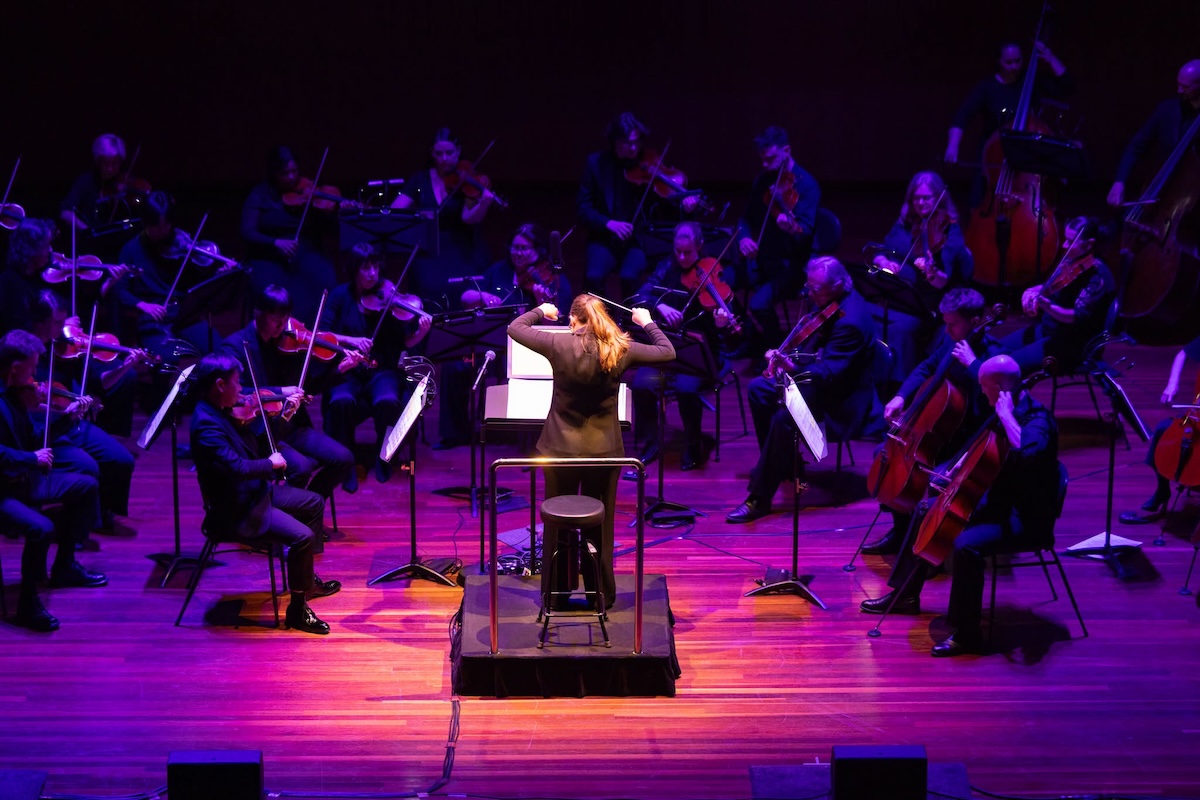
Jen Winley and the Canberra Symphony Orchestra. Photo © Arianne Schlumpp
First though, the orchestra performed a nature-inspired musical landscape by Leah Curtis, commissioned by the CSO, called Nightfaring. An experienced composer for film herself, this calm and meditative work opened with the most exquisite cello solos from principal Patrick Suthers.
The CSO was lucky enough to engage Jen Winley as conductor for this program. Not only is she Associate Conductor of the Western Australian Symphony, she’s also a specialist in conducting for film and theatre (and licenced by Disney to conduct their concert events).
Armed with a score marked with film cues, and an electronic clock, Winley directed the orchestra with style, energy and perfect precision. Never was a note out of sync with the action on the screen, and never did the music mask the dialogue. Yet there was no way to forget the orchestra was there – it was both unobtrusive but also intimately part of the experience.
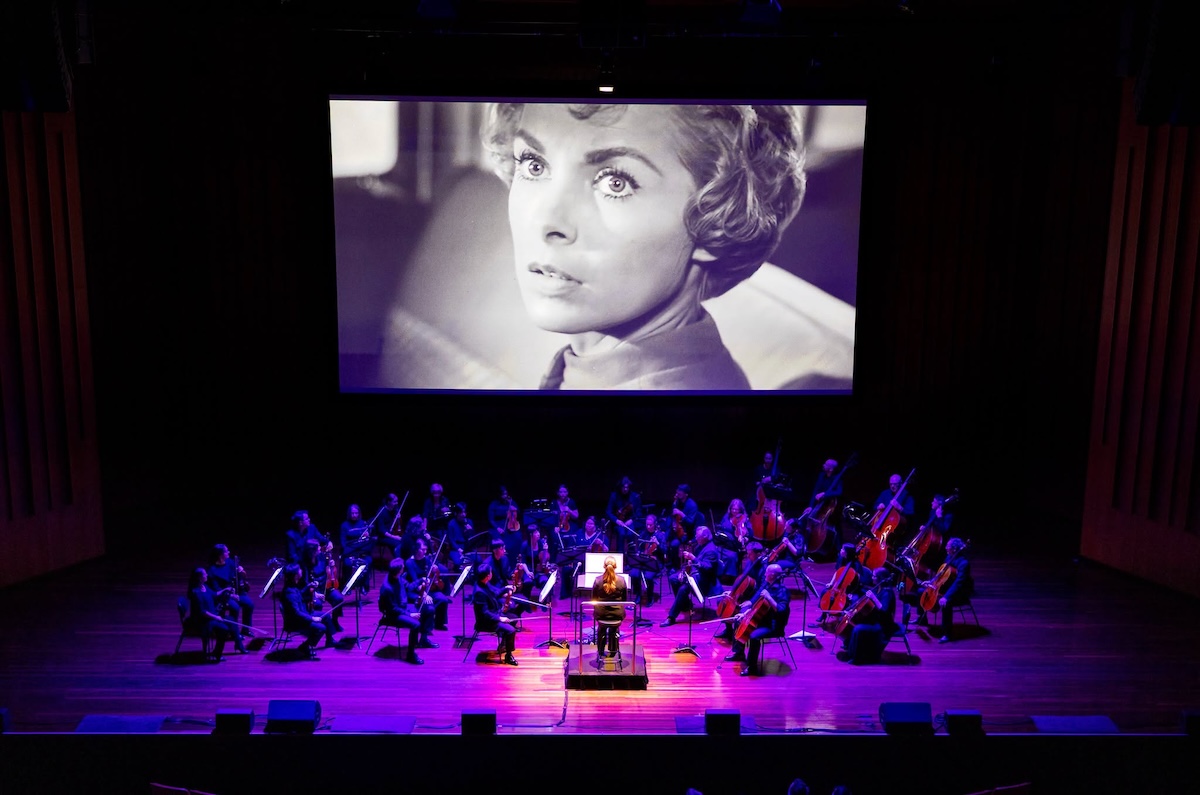
Psycho: Jen Winley and the Canberra Symphony Orchestra. Photo © Arianne Schlumpp
The character of Herrmann’s 1960 score somehow matches the black-and-white film texture of Psycho. The score doesn’t slavishly follow the action on screen, and its tendency towards dissonance works to portray the ‘fractured psyche’ of Norman Bates (played by the arrestingly good-looking Anthony Perkins). It has its own narrative, and this approach revolutionised American film music from the 1950s.
Herrmann had previously scored Citizen Kane and died the day after he’d finished recording the music for Martin Scorsese’s Taxi Driver in 1975. Having studied under Percy Grainger, George Gershwin and Aaron Copeland, Herrmann deeply understood theatrical music and modern American musical styles.
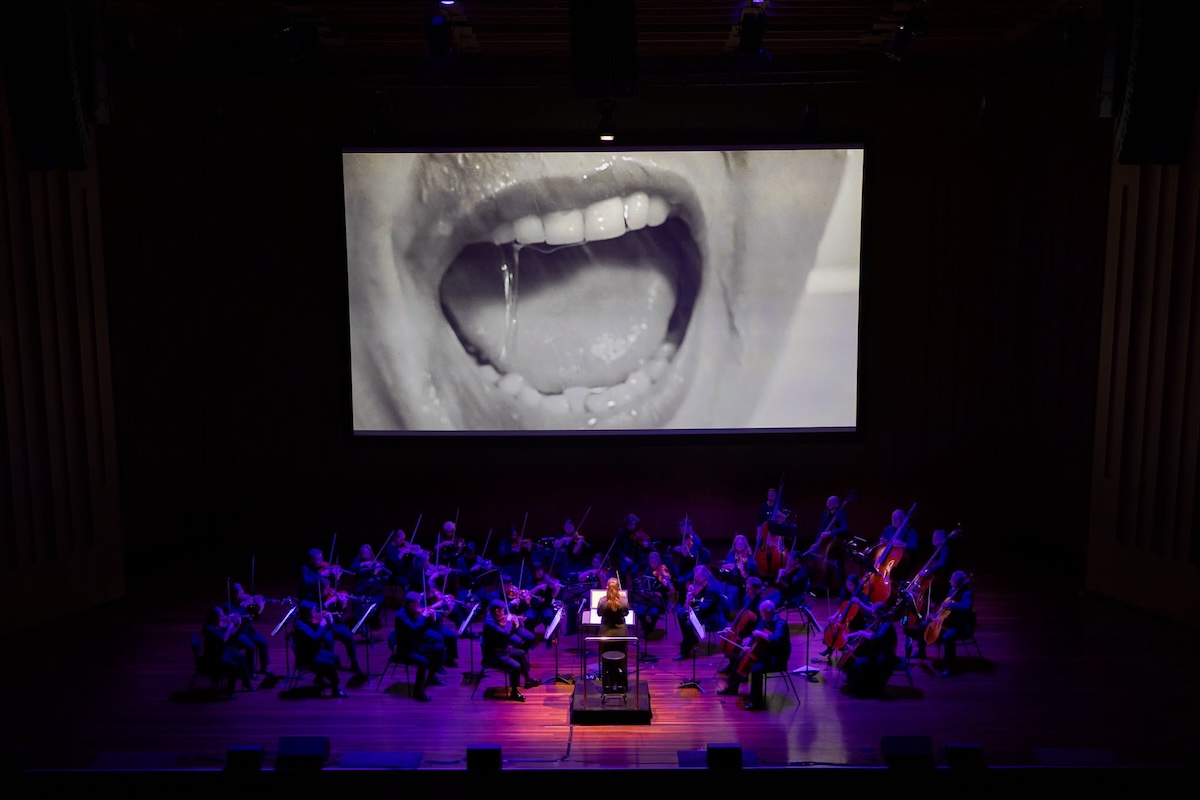
Psycho: Jen Winley and the Canberra Symphony Orchestra. Photo © Arianne Schlumpp
While of course the audience was anticipating the shower scene 45 minutes in (the stabbing, discordant high violins were magnificent), having the orchestra visible revealed many other clever musical tools and techniques. A simple scene of people walking suddenly becomes foreboding with cellos playing in the minor key as the backdrop. The highway driving scenes gradually build in tension with music that doesn’t resolve in the way you expect.
CSO’s performance of Psycho was a welcome reminder of how powerful the diligent melding of film and music can be – and how much work is involved in bringing it off.
It’s not a live concert form that you’d need to experience every week, but with the right material, it’s arresting (and in this case, still terrifying).






Comments
Log in to start the conversation.