


Guiseppe Verdi’s monumental Messa da Requiem (1874) remains so celebrated globally that two obvious curiosities risk going unnoticed. Firstly, he is and was known almost exclusively as a composer of opera (he wrote 28 of them). Secondly, Verdi was – if not agnostic – deeply sceptical about the Catholic Church and clericalism.
Interestingly, several other celebrated composers of the Requiem (Latin mass for the dead) – Brahms, Berlioz, Fauré and Britten – were also agnostic or had ambivalent relationships with the Christian church.
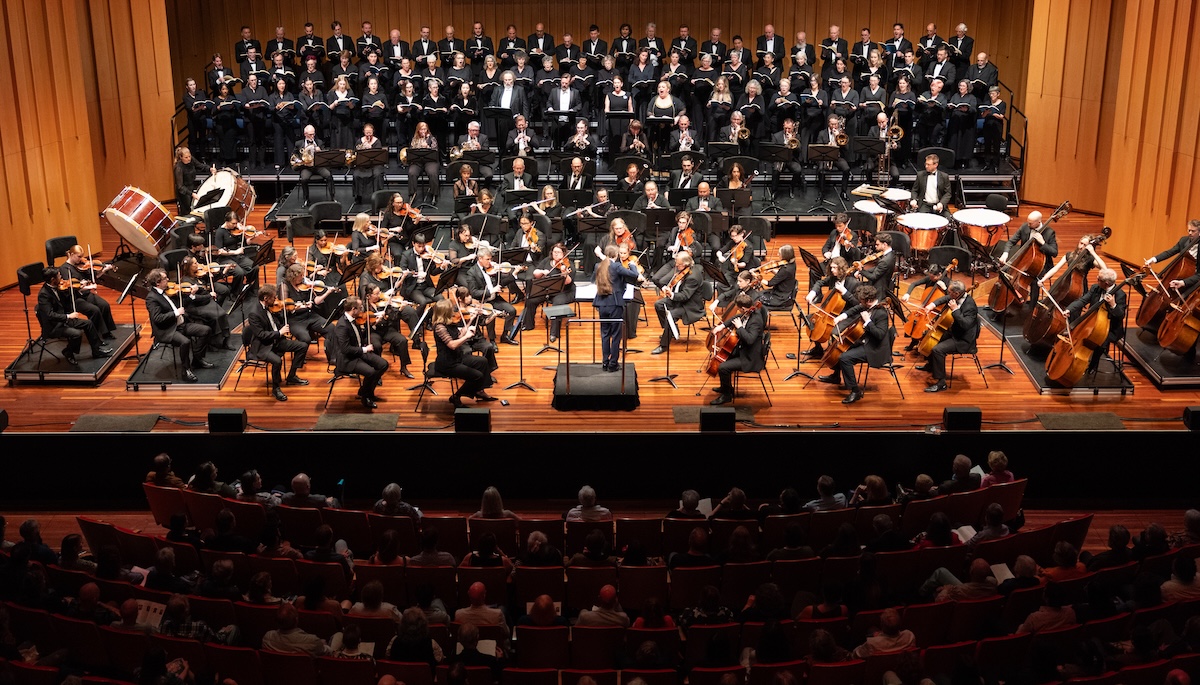
Canberra Symphony Orchestra: Verdi’s Requiem. Photo © Arianne Schlumpp
Verdi’s interpretation of the mass is much more an operatic concert piece than it is a piece of religious music. Canberra Symphony Orchestra chief conductor Jessica Cottis wisely chose soloists with big voices and extensive operatic (including Wagnerian) experience: Helena Dix (soprano), and Opera Australia veterans Deborah Humble (mezzo-soprano), Paul O’Neill (tenor) and Warwick Fyfe (bass).
As soloists in the work sing alone, in duet, in trio and in quartet, matched vocal ability and quality is especially crucial. They’re frequently singing with the choir, and with the orchestra playing at least mezzo-forte, so the solo voices need to be able to penetrate through this competition. Lighter lyrical voices commonly employed in oratorio work would not have coped.
The soloists were placed between the choir and the orchestra, elevated and mid-stage, rather than beside the podium. This was the right choice, as it assisted Cottis to hear and control the delicate balance and vastly changing dynamics Verdi requires of a large choir, a full symphony orchestra, and four big voices.
While each soloist proved more than accomplished in their roles across aria and ensemble sections, and passages with full choir, Deborah Humble’s ability to shine through with clarity, sensitivity and pathos was especially impressive.
Skilful deployment of both ‘head’ and ‘chest’ voice, with barely discernible transition between the two – and generous vibrato – made for a consistent presence. In a couple of places, soloists weren’t in complete tonal uniformity, which may have been a minor consequence of being some distance from (and behind) the violins. Dix’s control in her quieter solo passages, including the final Libera Me (deliver me, oh Lord, from eternal death), was extraordinary and exquisite, especially when Cottis held the magical silence before the applause for a full 22 seconds!
The choir assembled for this performance was big by Canberra standards – over seventy singers – and had obviously been well-prepared by choirmaster Tobias Cole. It sounded much smaller when it needed to but also rose magnificently to the occasion in the wheeling, colossal and apocalyptic Dies Irae (day of wrath).
Dynamic sensitivity and diction were rendered very well indeed. Energy and a physicality of vocal production were maintained throughout, avoiding any tendency to become plodding or muddy. Cottis’ own light and athletic guidance from the podium helped maintain dynamism and good attack.
While the orchestra wasn’t always perfectly precise with entries and endings, its warmth, responsiveness, ebullient confidence and tenderness with this dizzyingly contrasting score provided a special character that made for an altogether deeper experience.







Comments
Log in to start the conversation.