Until a week ago, Handel’s opera Serse (aka Xerxes) had not been performed in Melbourne since Victorian Opera’s 2009 production.

Now it’s déjà vu, with the University of Melbourne Conservatorium’s just-closed brief season quickly followed by Lyric Opera of Melbourne’s all-too-short outing. Established artists Sally-Anne Russell and Christopher Hillier are joined by several accomplished young singers in a Regency-inspired production of elegant simplicity.

Premiering in London in 1738, this opera nominally about the ancient Persian king Xerxes quickly disappeared. Finally revived in 1926, it has become a favourite of the modern era’s Baroque repertoire.

According to that debut season’s lighthearted introduction “some imbecilities, and the temerity of Xerxes (such as him being enamour’d with a plane tree …) are the basis of the story, the rest is fiction.” Driven by various muddled romances, it’s a vehicle for heightened emotion and comedy, which is enhanced by some crossdressing.
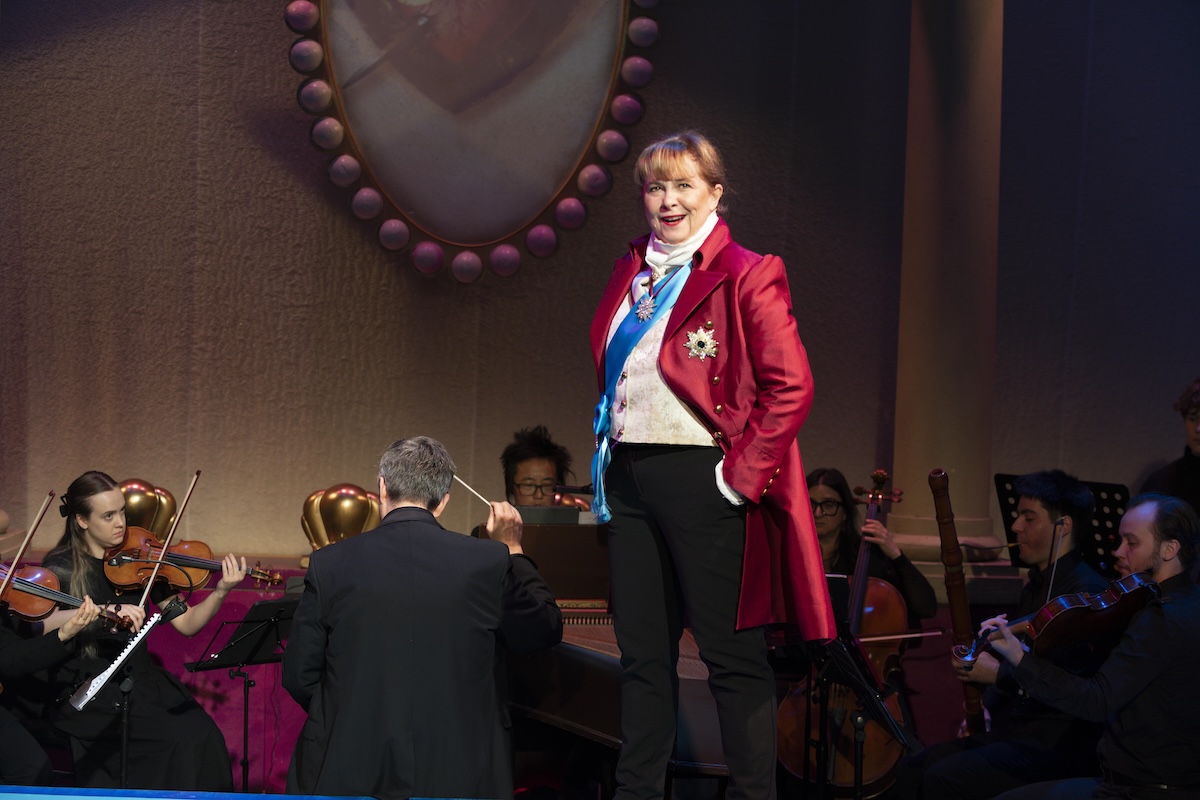
Sally-Anne Russell in Lyric Opera of Melbourne’s Serse. Photo © Jodie Hutchinson

In this amusing, clearly staged production directed by Beng Oh, the cross-dressing includes mezzo-soprano Russell in the title role, which was written for a castrato. With quizzical facial expressions and silly dance moves, she inspires plenty of chuckles with her petulant, self-important man-child Xerxes.

Starting with the opera’s famous arietta about that plane tree, Ombra mai fu, Russell’s consistently pleasing vocal interpretation is marked by warm tone and technical assurance.

However, as male singers increasingly reclaim this role with the the countertenor’s rise, there isn’t quite the vocal richness and range we’ve become accustomed to (in recordings at least). And yet, we’re lucky to have a singer of Russell’s calibre as Serse in this small company’s production, in a city that – two sudden Serses aside – sadly lacks Baroque opera performances.

Naomi Flatman and Kate Amos in Lyric Opera of Melbourne’s Serse. Photo © Jodie Hutchinson

Despite that lack of local opportunity the young cast are, for the most part, remarkably adept at the Baroque’s demanding style. Mezzo Naomi Flatman is particularly notable for her agile, precise vocal ornamentation in the traditional pants role of Serse’s brother, Arsamene.

Soprano Kate Amos sings with lovely clarity and brings comic charm to Romilda, who has reluctantly caught Serse’s eye. As her troublemaking sister Atalanta, soprano Rebecca Rashleigh also impresses, especially with her ringing top notes.

Mezzo Olivia Federow-Yemm struggles slightly with Baroque ornamentation, but is otherwise commendable as Serse’s betrothed, Amastre, who dresses as a man to observe his infidelity. As the comical servant Elviro, baritone Luke Belle is particularly funny when in disguise as a female flower seller (perhaps a foretaste of their imminent Melbourne Fringe Festival camp cabaret, Adore Händel’s Birthday Party).

Christopher Hillier in Lyric Opera of Melbourne’s Serse. Photo © Jodie Hutchinson

There’s luxury casting for the small role of the sisters’ father, Ariodate. One of Australia’s leading baritones, Hillier reveals his confident, burnished voice and flair for comedy.

Conducted by Lyric Opera’s Artistic Director, Patrick Burns, the orchestra of 10 includes Joy Lee on harpsichord. In a partially sunken pit in the middle of a rectangular stage, this small band is not just literally but also aurally exposed; so sometimes the strings inevitably sound thin and there’s nowhere to hide occasional imperfections.

A narrow, U-shaped walkway downstage is backed by a low, shallow, partially curtained platform, where a giant necklace’s pendant features a slow parade of projected period artwork details: a painted eye, perhaps, or a cameo tree.

Several columns and Serse’s beloved tree add visual appeal to Christina Logan-Bell’s refined, sparse set, which facilitates easy flow between the many short scenes, and dramatic elements such as spying. It’s harmoniously lit by Shane Grant.

Logan-Bell’s costumes are gorgeous confections whose early 19th century Regency styling reflect her more restrained set’s refinement. The sisters’ Empire-line gowns are graceful and vividly coloured (they appear to be partially made with sari fabric), while the male characters’ attire, including naval uniforms, reflect their status: fabrics become flashier and frock coats more smartly cut higher up the social ladder.

While we may lament the absence of Sydney’s splendid Baroque specialists, Pinchgut Opera, from Melbourne, or our own equivalent, praise is due to Lyric Opera (and the Con) for investing limited resources into something besides bums-on-seats Verdi et al.

The city is fortunate to have this taste of Baroque opera, served up by two highly regarded singers and some excellent emerging artists, with a delightful Regency cherry on top.


Serse is at Gasworks Theatre, Melbourne, until 13 September.

Contribute to Limelight and support independent arts journalism.