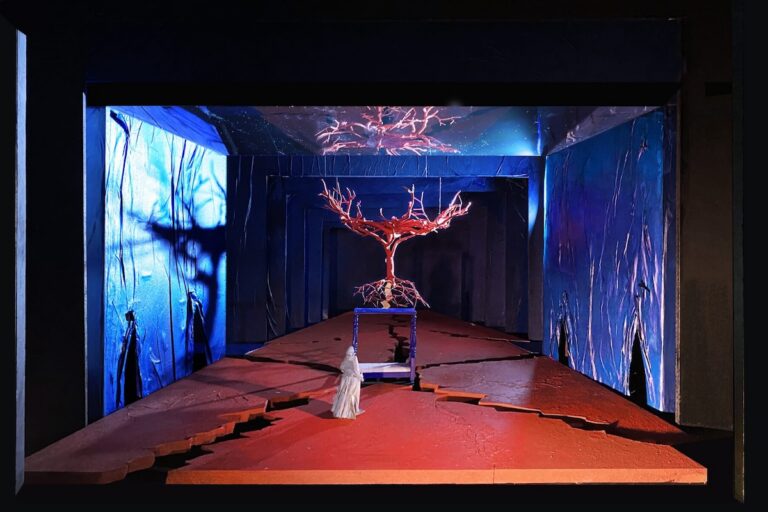
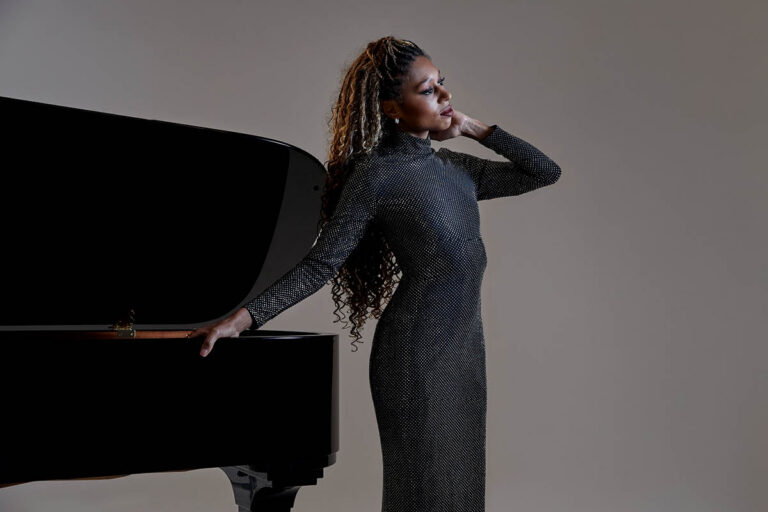
Why so long since Il trovatore has been performed in Melbourne? Semi-professional CitiOpera’s production was in 2017, and Opera Australia’s in 2004. Perhaps it’s because, according to Caruso, Verdi’s tragedy requires “the four greatest singers in the world.”

While Melbourne Opera hasn’t managed that, they have gathered three of Australia’s finest singers for this vocally impressive Il trovatore. Helena Dix, Rosario La Spina and Christopher Hillier may be the most exciting line-up this increasingly ambitious little company has offered yet (even while their non-government-funded budget remains tight).

Perhaps another reason why Il trovatore has become a rarity in this city is its plot, which is ridiculous and misogynistic even by traditional opera’s standards.
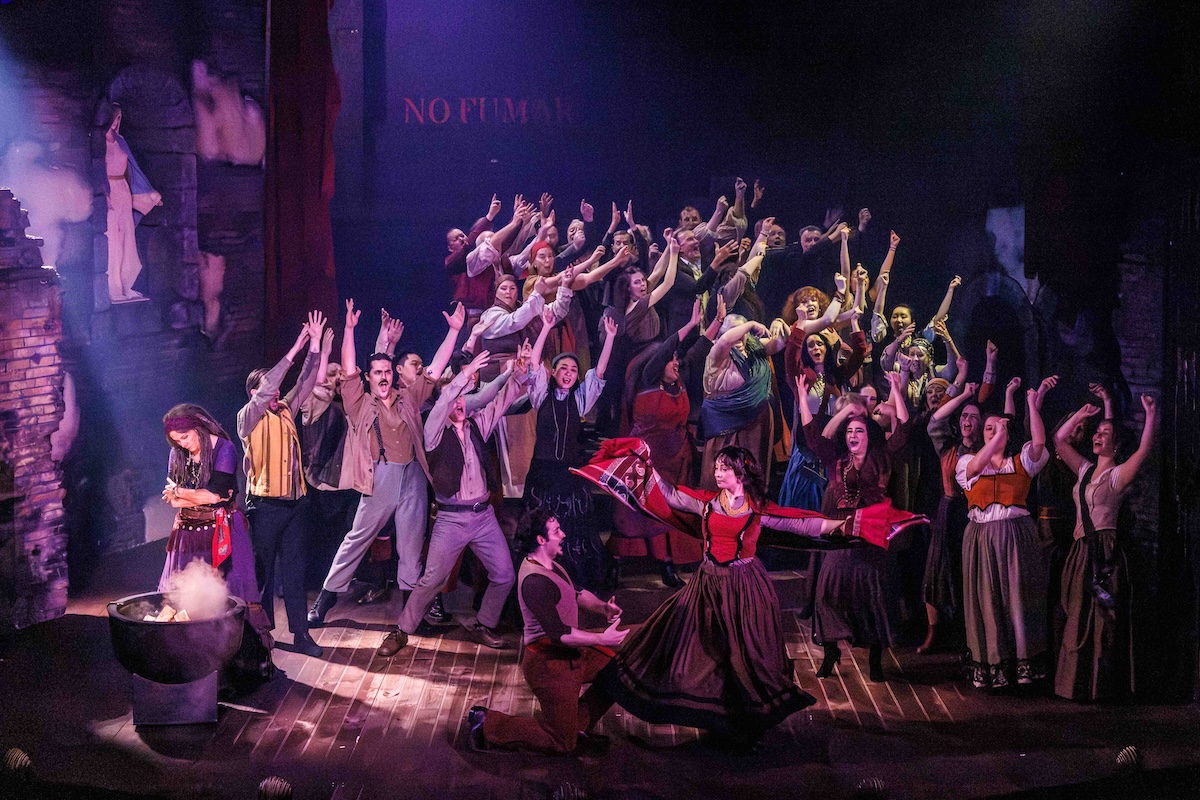
Melbourne Opera’s Il trovatore. Photo © Robin Halls

First performed in Rome in 1853, it’s driven by revenge for the past, when a Romany woman was executed for witchcraft. Her daughter, Azucena, apparently killed the accuser Count di Luna’s son, but actually threw her baby in the fire by mistake and raised the kidnapped child as her own.

In the present, we witness unwitting brothers Manrico and the current count as bitter rivals for Leonora. She’s cursed by her beloved Manrico for an act of self-sacrifice that includes taking suicidal poison rather hastily, before the finale’s fratricide and relationship revelation.

This potboiler of a plot is too much even for seasoned director Matthew Barclay, who in addition to international appointments was Opera Australia’s longtime Senior Resident Director.

He presents Il trovatore’s Molotov cocktail of extreme, irrational behaviour as theatre itself. The set is a ruined theatre, where events unfold on a stepped central stage.

Despite some clever dramatic touches, this approach is not persuasive; perhaps nothing can prevent this opera from being laughable and/or annoying at times. Ultimately we’re here for the singing, however, and for the most part, what splendid singing it is.

Helena Dix in Melbourne Opera’s Il trovatore. Photo © Robin Halls

At the opening matinee, I was once again amazed to witness Dix, at the peak of her powers, interpreting Leonora on the tiny Athenaeum stage in another humble Melbourne Opera production.

The circumstances are far removed from her title role of Norma at The Met, yet this performance is probably no less exquisite. The soprano’s balance of vocal strength and delicacy is delicious, especially in the aria D’amor sull’ali rosee, which is Dix at her most expressive.

I was also struck by La Spina’s appearance on that wee stage, considering his countless performances in principal roles for Opera Australia. After an excellent Melbourne Opera debut at the much larger Palais in last year’s Samson et Dalila, he is in suitably fine voice as Il trovatore’s titular troubadour, Manrico.

La Spina’s tenor is meltingly lyrical, with ardent expressiveness, silky legato and assured power. You could have heard a pin drop during his aria Ah, si, ben mio.

Hillier is one of this country’s most reliably excellent baritones, and a confident actor too. He’s subtly unpleasant as the count – including in the wordless payment of his militia – but its Hillier’s lovelorn aria Il balen del suo sorriso that stands out. Some slightly harsh big notes aside, it showcases his warm, supple voice and dramatic phrasing.

As Azucena, mezzo Sarah Sweeting is initially a little ragged in the upper register. She sounds better as her performance unfolds, and always delivers plenty of vocal drama.

So too does bass Steven Gallop as militia leader Ferrando, while the handful of small roles are well handled by emerging artists. The Melbourne Opera Chorus once again proves themselves among Australia’s best, despite their volunteer status.

Under the baton of Raymond Lawrence, the small Melbourne Opera Orchestra sounds unavoidably thin on occasion – and the solo flute rather too loud – but by and large they ably convey the moodiness and melodic energy of Verdi’s score.

Melbourne Opera’s Il trovatore. Photo © Robin Halls

Originally set in the 15th century, this Spanish tale unfolding during a civil war between elites and the marginalised is shifted to the early 20th century here (though one wig looks rather 1830s).

Lit with theatrical tenebrism by Tom Vulcan, Jacob Battista’s economical set sees that central wooden platform flanked with bits of ruined wall (plus the actual theatre’s rear wall). With additions such as a fire pit or prison bars, it suffices for any setting.

Following her astonishingly good graduating costume design for Melbourne University Conservatorium’s 2025 Cendrillon, Maya Anderson steps up to effectively dress a large cast, from nuns to militia. Dix’s blue ensemble is a standout for its delicate drapery, details and hues, which underscore Leonora’s social status and gentle nature.

Il trovatore is a silly story, and Melbourne Opera’s production has some low-budget rough edges. However, when Dix, La Spina and Hillier sing, whether in arias, duets or trios, this show soars above such trivialities.


Melbourne Opera presents Il trovatore at the Athenaeum Theatre, Melbourne, until 30 August.

Contribute to Limelight and support independent arts journalism.