




When the curtain rises on Charles Gounod’s romantic opera Roméo et Juliette, the sight of a crowd dressed in dark grey trench coats, aiming guns at each other while two children try in vain to knock the weapons from their hands, comes as a surprise. Considering the constant reminders of our warring world today, however, it is perhaps not so surprising after all – which may, of course, be the point.
Nonetheless, it is a thrilling opening from director Rodula Gaitanou, with the West Australian Opera Chorus recounting the tragic story of the Montague and Capulet feud in dramatic, rich-voiced harmony, accompanied by the impressive timbres of Gounod’s beautiful score, coaxed from the West Australian Symphony Orchestra under the baton of Christopher van Tuinen.
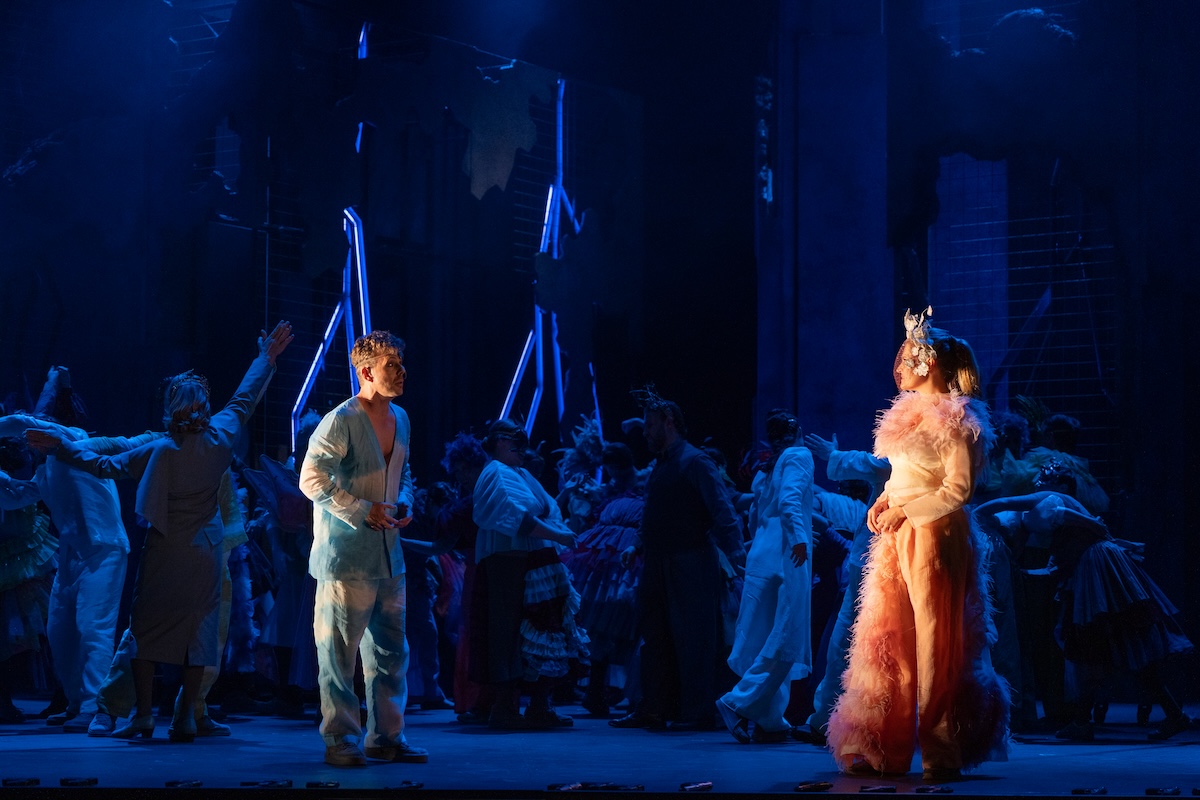
Alasdair Kent and Samantha Clarke in West Australian Opera’s Roméo et Juliette. Photo © West Beach Studio
This opening pays token respect to societal discord, since Gounod’s operatic scaffolding focuses mostly on the plight of the two lovers. The Chorus is astutely used for dramatic effect, as when, for instance, its rumbustious carousing at the Capulets’ masked ball, in rainbow-coloured party dress (costumes by takis), is effectively silenced when Romeo and Juliette experience their amazing and unexpected coup de foudre.
Neither of the couple is searching for true love or marriage at that moment. Romeo (tenor Alasdair Kent) has a girlfriend, while Juliette (soprano Samantha Clarke), having been told of her impending but undesired betrothal to Paris, sings of wanting to be free to enjoy her fleeting youth in the aria “Je veux vivre” (“I want to live”).
The West Australians Kent and Clarke, now very much part of the international stage, are sublime together. Their vocal prowess is matched by alluring stage presence, stamina and sexual chemistry. Their stunning voices swell in moments of ecstasy and soften in the pain and agony of being unable to thwart their fate.
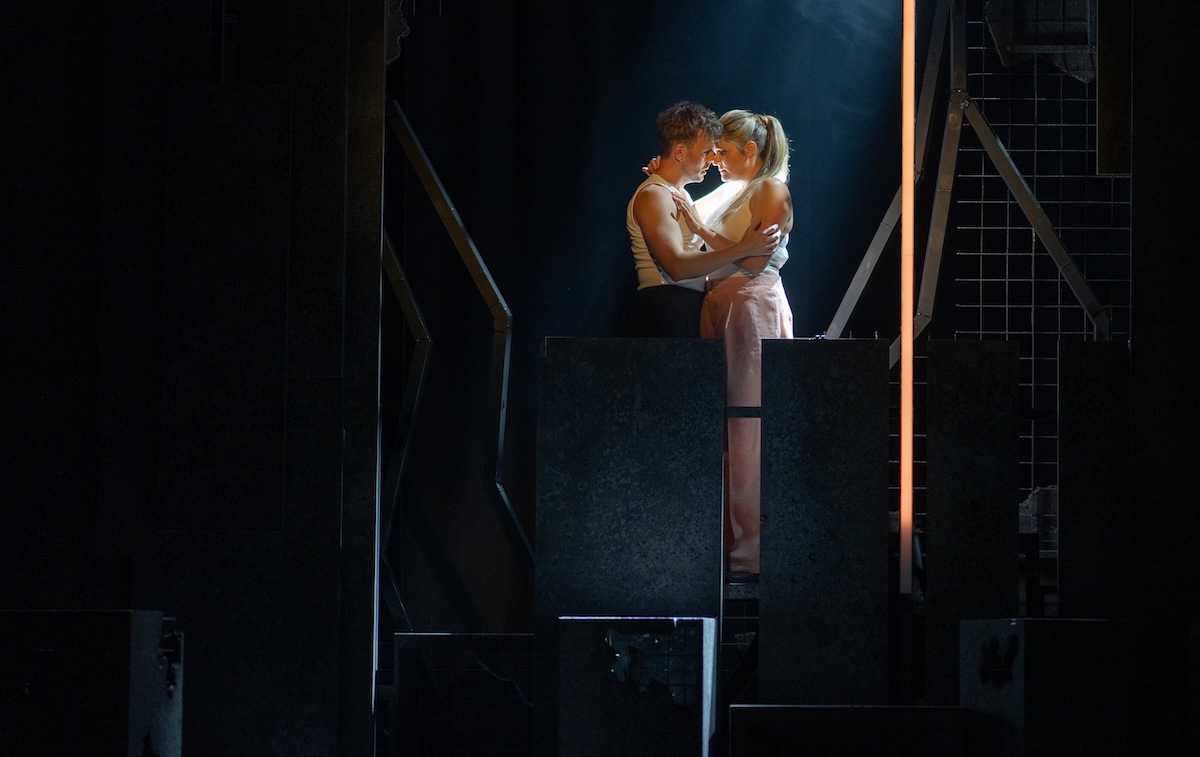
Alasdair Kent and Samantha Clarke in West Australian Opera’s Roméo et Juliette. Photo © West Beach Studio
They perfectly capture the potency of this trajectory in the four intensely intimate love duets that form the core of Gounod’s work: the Meeting Duet (“Ange adorable”); the Balcony Duet (“O nuit divine! Je t’implore”); the Nuptial/Farewell Duet (“Va! Je t’ai pardonné… Nuit d’hyménée”); and the tragic Tomb Duet (“Viens, fuyons au bout du monde”). Kent and Clarke are credible actors, and in each duet conjure episodes that, as Gaitanou contends, “strike like a blade” in the momentum of the saga.
The English subtitles soon make it clear that librettists Jules Barbier and Michel Carré are not going to remain faithful to Shakespeare’s text. This is particularly evident in the balcony scene, where Romeo’s “But soft, what light through yonder window breaks?” gives way to the famous aria “Ah! lève-toi, soleil” (“Rise, sun!”). By this point, however, you have decided to embrace the excellence of the songs, the music and the performances because, as Hamlet declares, “the readiness is all”.
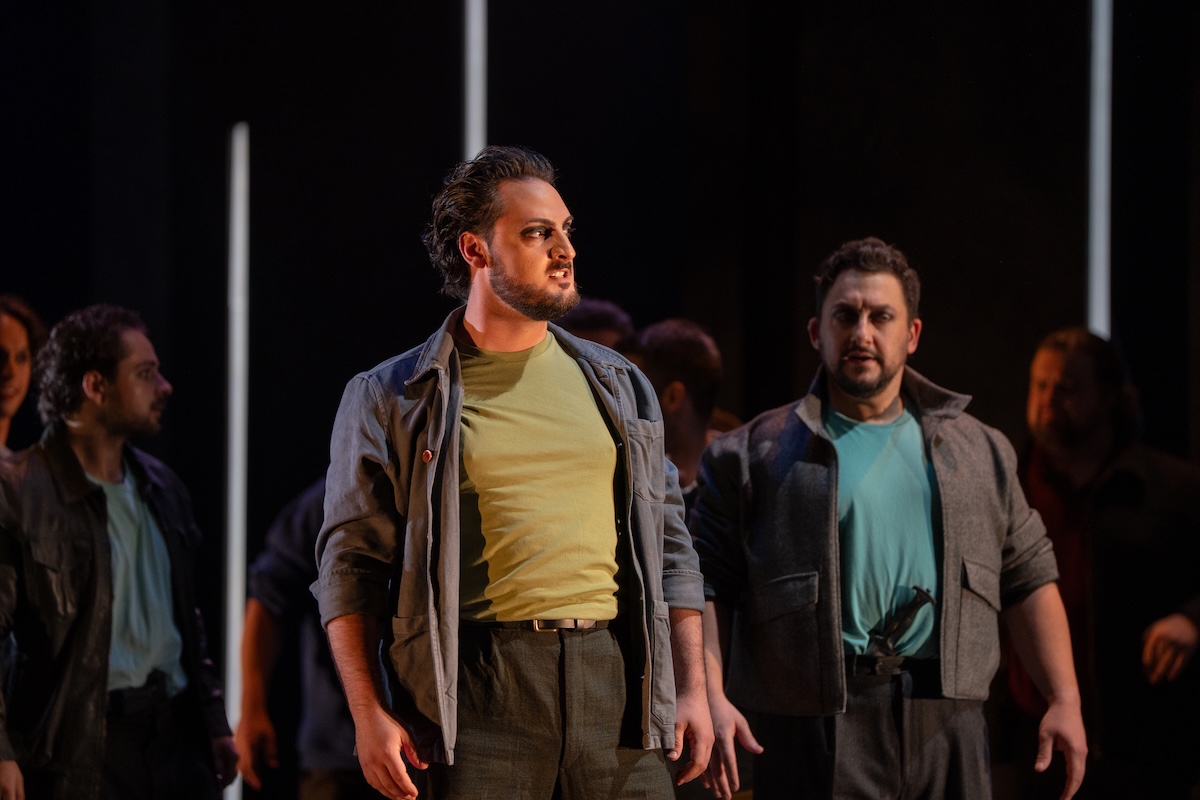
Benjamin Del Borrello (Mercutio) and Vin Trikeriotis (Benvolio) in West Australian Opera’s Roméo et Juliette. Photo © West Beach Studio
The supporting cast is brilliant on opening night. Fiona Campbell is touching and warm as Juliette’s nurse, while mezzo-soprano Ruth Burke is a standout as Romeo’s cocky page, Stephano. The crucial stoush between Mercutio (Benjamin Del Borrello) and Tybalt (Kohsei Gilkes) proves a highlight, especially when Del Borrello, in high spirits, cartwheels across the stage. Their youthful exuberance is a perfect foil for the more serious demeanour of the elders running the show, for better or worse: Count Capulet (Christopher Hillier), the Duke of Verona (Jake Bigwood) and the hapless Friar Laurent (Andrew Foote).
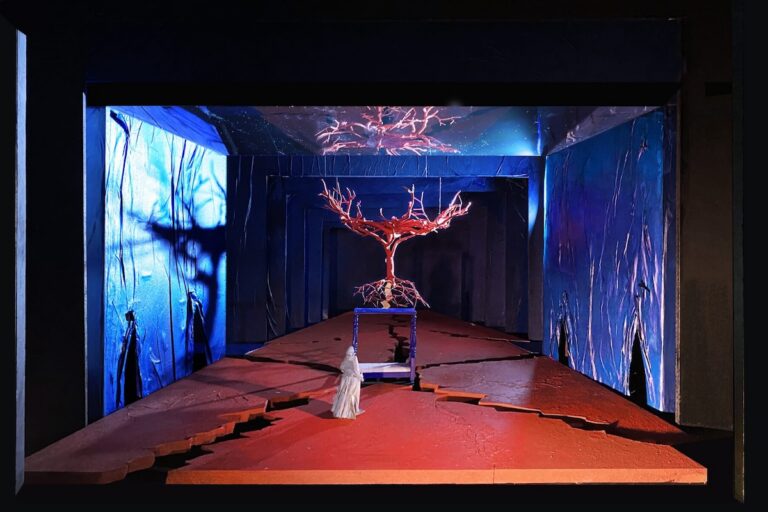
The set, designed by takis, features concrete statues and dark, dilapidated buildings, punctuated by strips of neon lighting running horizontally above the stage and vertically on it, in shades of pink, yellow and green. A mass of ethereal stars lights up at potent moments, shimmering across and down the sides of the stage. Particularly interesting is Juliette’s greyish-white bedroom, devoid of colour or comfort, with a sparsely furnished bed and a bedhead stretching high into a patterned triangular structure. Perhaps it suggests that their marriage is not destined to be a bed of roses.
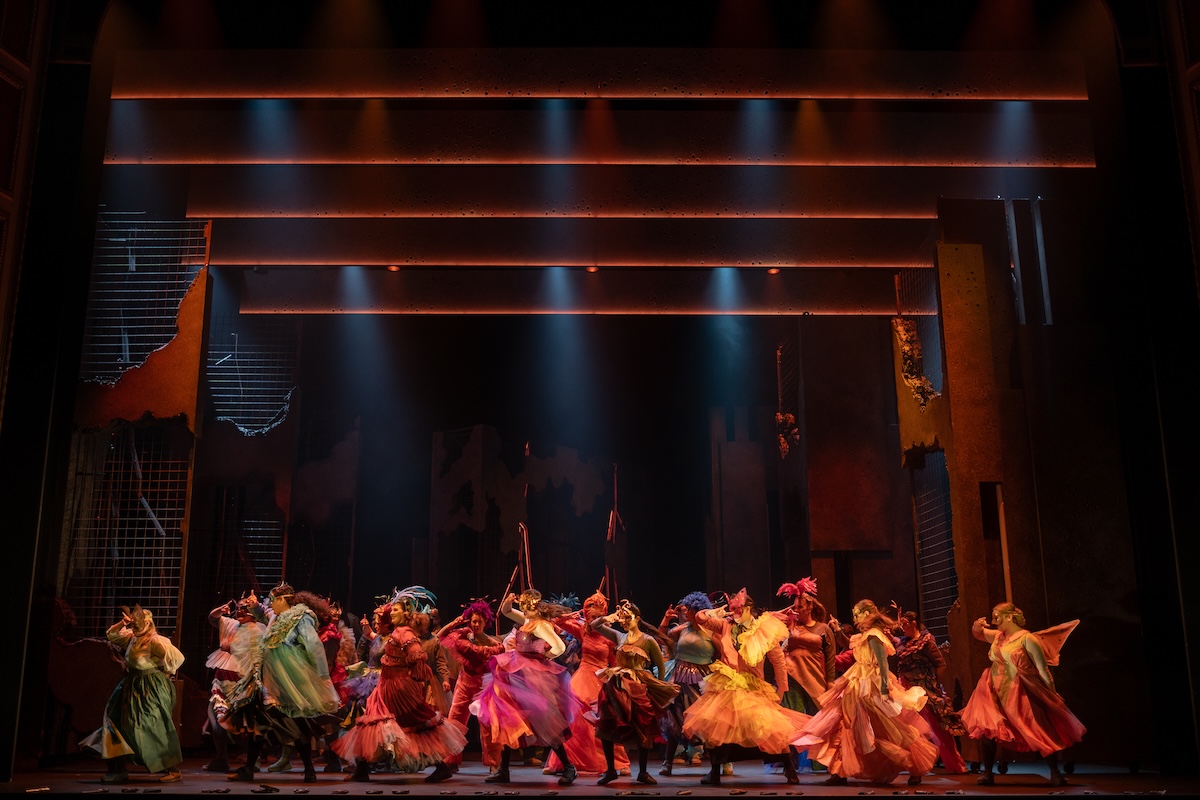
West Australian Opera’s Roméo et Juliette. Photo © West Beach Studio
Bernie Tan-Hayes’s lighting design is artistically impressive, with side lighting creating, at times, a cradle of soft, comforting orange and, at others, a blaze of hostile white, singling out the lovers and perfectly mirroring their contradictory predicament.
The production design, the emotional richness of the West Australian Symphony Orchestra, and the intensity of the Chorus and cast, led by the luscious voices of Kent and Clarke, blend perfectly with Gounod’s romantic, emotional and dramatic score. Despite the familiarity of the story, and the certainty that the lovers will once again bid farewell in the candlelit tomb, the production brings a well of unexpected tears to the eyes. It is a beautiful production.
West Australian Opera presents Roméo et Juliette at His Majesty’s Theatre, Perth until 24 October.
Roméo et Juliette is a co-production between West Australian Opera, State Opera South Australia and Irish National Opera.





Comments
Log in to start the conversation.