There is little doubt in Alexander Briger’s mind where he wants to take his audience for this tour marking the 15th anniversary of his Australian World Orchestra: Russia.

And more particularly the vivid and exciting orchestral writing of Igor Stravinsky’s ballet music. He has chosen Petrushka – the 1947 version with its sparser, more transparent sound palette.

“(It) is such a great piece of music. Stravinsky just works for this orchestra. It’s in my blood. My father was Russian. His family killed Rasputin.”

That event is, by all accounts, messy and drawn out. Not so this performance, or for that matter, those of the other two works on the program – Dmitri Shostakovich’s visceral Symphony No. 10 and an AWO-commissioned song cycle, Songs for the Stranger, by Australian composer and festival organiser Jonathan Mills, taken from his opera Eucalyptus and featuring tenor Michael Petruccelli.
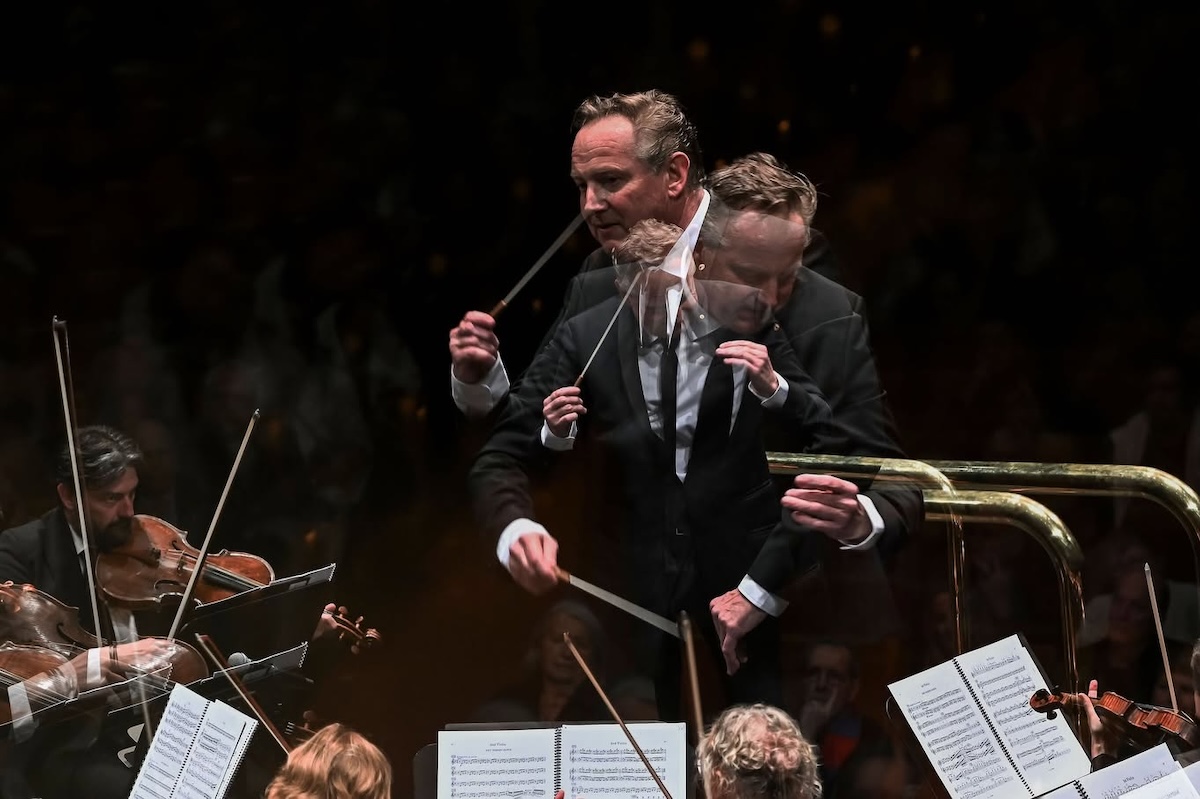
Alexander Briger and the Australian World Orchestra. Photo supplied

From the scintillating zip of the brass and woodwinds and buoyant strings of The Shrovetide Fair to the hair-raising climax of the Shostakovich, the night is a celebration of the creation of an orchestra that brings home top Australian musicians from all over the world.  The idea was planted in Briger’s mind as far back as 2000 when he was studying with Pierre Boulez at Aix-en-Provence.

It finally took root in 2011 with the inaugural AWO concerts for which Briger and Simone Young shared conducting duties.

Fifteen years on and the AWO has been conducted by Zubin Mehta, Ricardo Muti, Young and Sir Simon Rattle. It has toured India twice, appeared at the Edinburgh Festival and the BBC Proms, commissioned four major Australian works, won the Helpmann Award for Best Concert and took out People’s Choice in the 2022 Limelight Artist of the Year awards.

Musicians of The Australian World Orchestra. Photo supplied

Mehta described it as one of the top 10 orchestras in the world while Rattle compared conducting them to “lassoing galaxies”.

Its trademark rich and golden string tone, a legacy of so many of the musicians playing with leading German orchestras, is a feature of night, especially in the Moor’s Room section when you can almost see the sway of striding camels.

The winds and brass sections seem to be a cut above the normal, despite the fact that the all-important principal trumpet had to withdraw at short notice, to be replaced at the last minute by Jenna Smith, Principal Trumpet of the West Australian Symphony Orchestra, with Daniel Henderson, a regular guest for the MSO stepping in to take the open part.

And that is not all. Briger recounts the litany of last-minute dramas for the Sydney concert: A Trumpeter caught COVID, a cellist had an injury, the Concertmaster for the first half, Natalie Chee, came down with an illness and a flautist had an accident, all within the production week.

Alexandra Osborne, Associate Concertmaster of the SSO, filled in for Chee, Andrew Nicholson (Principal Flute with WASO) became principal, with MSO’s Wendy Clarke stepping in only two hours before the show into the open part, and Australian Youth Orchestra’s Principal James Monro, stepped in to take the open cello part – also becoming the youngest non-academy member of the AWO.”

Despite all this drama it is a pitch-perfect electrifying performance and illustrates the depth of talent this country enjoys.

Michael Petruccelli and the Australian World Orchestra. Photo supplied

Mills’s opera Eucalyptus, with text by Meredith Oakes after the novel by Murray Bail, starred Petruccelli as the Stranger who tells stories, sometimes sad and often quirky, to the heroine Ellen as she grows up with her father in the country. For the song cycle Mills has used three of these tales – a lovelorn fruiterer in Carlton, the tragic fate of a Moldovan woman refugee and a monster yarn set in Mauritania – and added two new ones.

One of these, Drummoyne, illustrates the eccentric flavour of the text: “What would you say to a man called Sackler living alone with a hundred canaries?”

Petruccelli is an expressive singer with the ability to inhabit his role and put over a story. Mills’s orchestral score, replete with plentiful spiral woodwinds, percussion effects (including a bowed vibraphone) and dissonant atmospheric chords, matches the sung narration neatly.

Briger knew he wanted some Shostakovich to finish but initially couldn’t decide between the popular Fifth and the less-performed but no less powerful Tenth. This work, completed just months after Stalin’s death, proves the perfect climax to the night. Its granite-like dark and bitter first movement and the terrifying heavy-footed dance of the second movement, said to be a portrayal of the tyrant, were both written before the Soviet leader’s death.

The release of tension is palpable in the third movement and Shostakovich asserts his presence with the hammered repeated DSCH motif – the composer’s musical signature – in the thrilling finale.

Briger allows his players their head when needed, while keeping a tight rein on tempo and structure.

Contribute to Limelight and support independent arts journalism.