

There was a sense of family mixed with nostalgia when Sydney Symphony Orchestra’s former Chief Conductor David Robertson made his latest return to the Sydney Opera House’s Concert Hall stage for a trio of concerts.

With him was his brother-in-law violin maestro Gil Shaham, here to perform the Beethoven concerto, and the second work on the bill, Carl Nielsen’s Symphony No. 4, The Inextinguishable, was the piece that Robertson led for his first ever SSO appearance way back in 2003. 

Other than that performance this massive and powerful work has only been performed once by the SSO – in 2019 to mark the retirement of the late Paul Goodchild as Principal Trumpet.
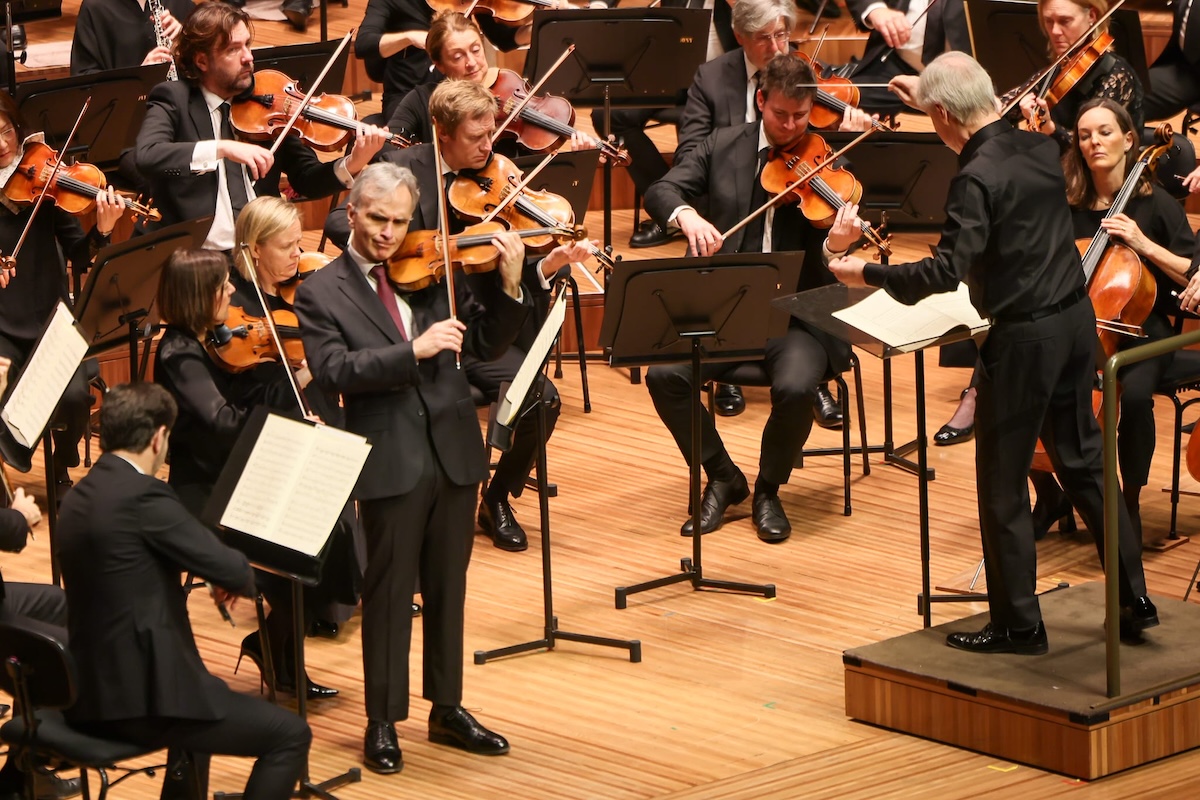
Gil Shaham, David Robertson and the Sydney Symphony Orchestra. Photo © Sydney Symphony Orchestra

Although it is one of the most harrowing of war symphonies, up there with Shostakovich’s Eighth, this was nevertheless a joyful homecoming for the American conductor who imbues all his appearances with dazzling energy and enthusiasm – a contagious feeling that infects players and listeners alike.

It was also a welcome return for Grammy Award-winning Shaham, last here 11 years ago performing concertos by JS Bach and Samuel Barber, whose pianist sister Orli is married to Robertson.

In his grey suit and dark red tie the 55-year-old cuts a compact and dapper figure. He has a compelling stage presence, showing total engagement with both audience and orchestra. You almost sensed he was psyching himself up for his entry during the four-minute long orchestral introduction, and as the entry point approached he was fingering the opening solo passages on his 1699 “Countess Polignac” Stradivarius before lifting the bow.

David Robertson and the Sydney Symphony Orchestra. Photo © Sydney Symphony Orchestra

When he did the auditorium was filled with the incomparably sweet tone, pure intonation and effortless technique of a virtuoso who has been praised for combining “old world opulence” with modern precision. All the colours, layers and dynamic shifts were perfectly integrated between soloist, conductor and players.

There was an exquisite moment just before the cadenza in the first movement where the delicate trilling and silky runs were pulled back to a whisper, only to be ramped up to lead into Fritz Kreisler’s cadenza. This was gloriously played with fautless trills, double-stopped harmonies and snaking runs.

After the still beauty of the Larghetto came the irresistible momentum of the Rondo and finale. In quieter moments Shaham and Robertson achieved moments of great transparency, but it was the dance-like close which had Robertson at one stage crouching on the podium before whipping up the final crescendo.

I’ve heard this popular work played differently, but never better. This was gold standard.

Gil Shaham and the Sydney Symphony Orchestra. Photo © Sydney Symphony Orchestra

It brought the house to its feet and Robertson sat down behind the spare timpani set – there are two required for the Nielsen – to listen to Shaham give a delightfully buoyant rendition of JS Bach’s Gavotte en Rondeau from the Partita No. 3 as an encore.   

The Inextinguishable, composed at the outbreak of World War I, is Nielsen’s reaction to the dreadful events taking place just 1000km south of his neutral homeland.

It is an incredibly powerful, organic work which grows to an almost unbearable climax in the third movement when two sets of kettle drums battle with each other like opposing artillery units and the huge string section finally answers with the “inextinguishable” force of life – and music – which overcomes all.

The SSO were in scintillating form for this work which achieves the hellishness of Shostakovich, the grandeur of Sibelius and the melodic beauty of Mahler and Bruckner.

Play it again, please!


For more information on the Sydney Symphony Orchestra in 2026, visit sydneysymphony.com

Contribute to Limelight and support independent arts journalism.