


IThere are few names in Australia’s theatrical canon that can fill a room like Suzie Miller.
A playwright whose work has travelled well beyond our shores, Miller has established herself as one of Australia’s most significant contemporary voices.
Her 2019 play Prima Facie became a landmark of modern Australian theatre, earning international acclaim for its unflinching examination of sexual assault and the legal system.
Its follow-up, Inter Alia, offered a counterpoint to Prima Facie by centring a female judge, premiering in the West End in 2025 with Rosamund Pike in the lead role.
More recently, RBG: Of Many, One, Miller’s play about pioneering U.S. Supreme Court Justice Ruth Bader Ginsburg, toured nationally before returning to a sold out Sydney Theatre Company stage.
Together, these works have cemented Miller’s reputation for crafting politically urgent, deeply human stories that challenge audiences long after the curtain falls.
Her new work, Strong Is the New Pretty, marks a departure from the legal system, turning instead to Australia’s sporting culture and the fight to establish the AFL Women’s league. But for a playwright whose previous works have been defined by their conviction, urgency and moral complexity, the pivot proves disappointing. Where Miller’s plays have previously roared, Strong Is the New Pretty barely manages a squeak.
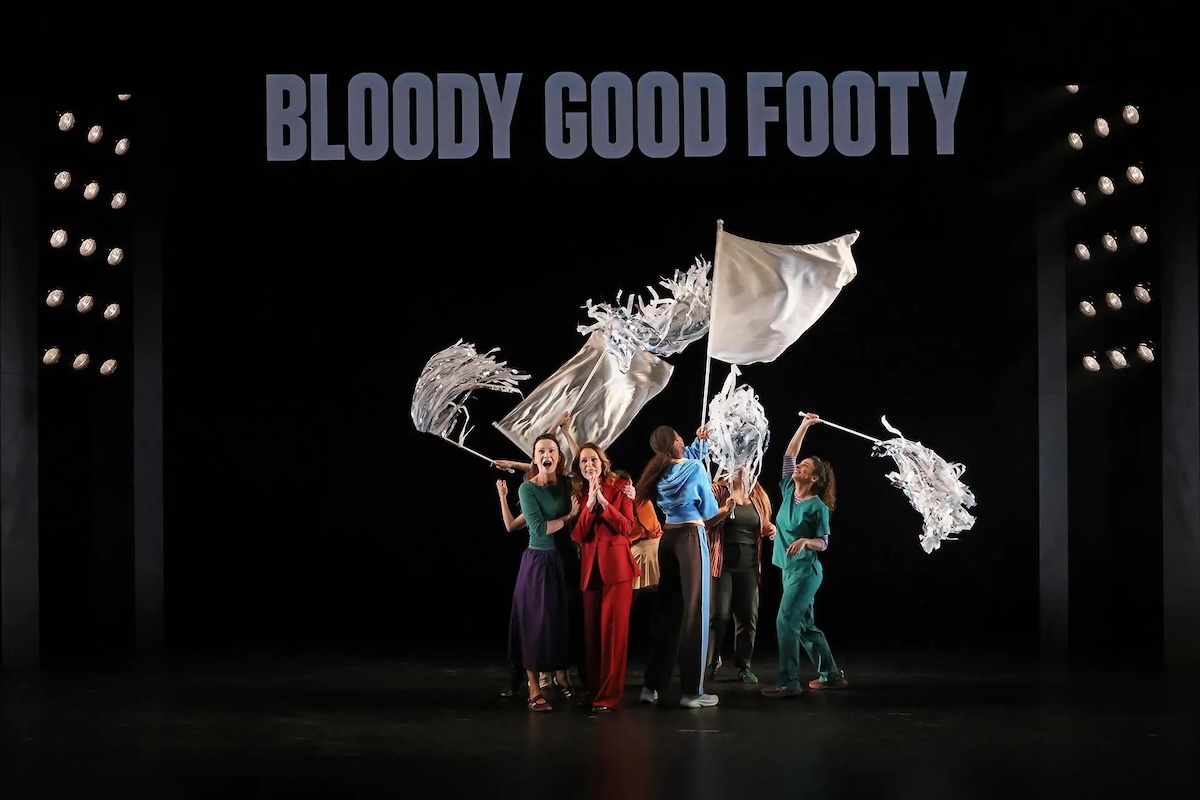
Strong is the New Pretty. Photo © Prudence Upton
That is not to say the story itself lacks merit. Charting the fight to establish a national women’s AFL competition, this 80-minute play spans 24 years across five chapters, from the dreams of young women who simply want to play the game to the first televised exhibition match, the AFLW’s inaugural season in 2017 and the season’s grand final.
Miller finds her legal entry point through the AFL’s first female commissioner, former lawyer Sam Mostyn, fictionalised here as Alison Newton (Lucy Bell), and the league’s first female manager, Jan Cooper, reimagined as Jane Hooper (Tara Morice). It is a story of genuine historical significance, but one that has already found its “roar” in sports journalist Samantha Lane’s 2018 book Roar.
The challenge for Miller, then, is to find something theatrically distinctive in a story whose triumphs and struggles have already been documented. While the fight for recognition in women’s sport is rich with dramatic potential, Strong Is the New Pretty rarely translates that history into the urgent, emotionally resonant theatre that has defined Miller’s best work.
Instead, she presents a fantasy world in which women possess little complexity beyond their burdens, everything miraculously goes right (cue dance-infused celebration), and every problem seems to have a neat solution (or happens off stage). The messy realities of institutional resistance and systemic inequality are smoothed over in favour of an uplifting narrative that feels unearned.
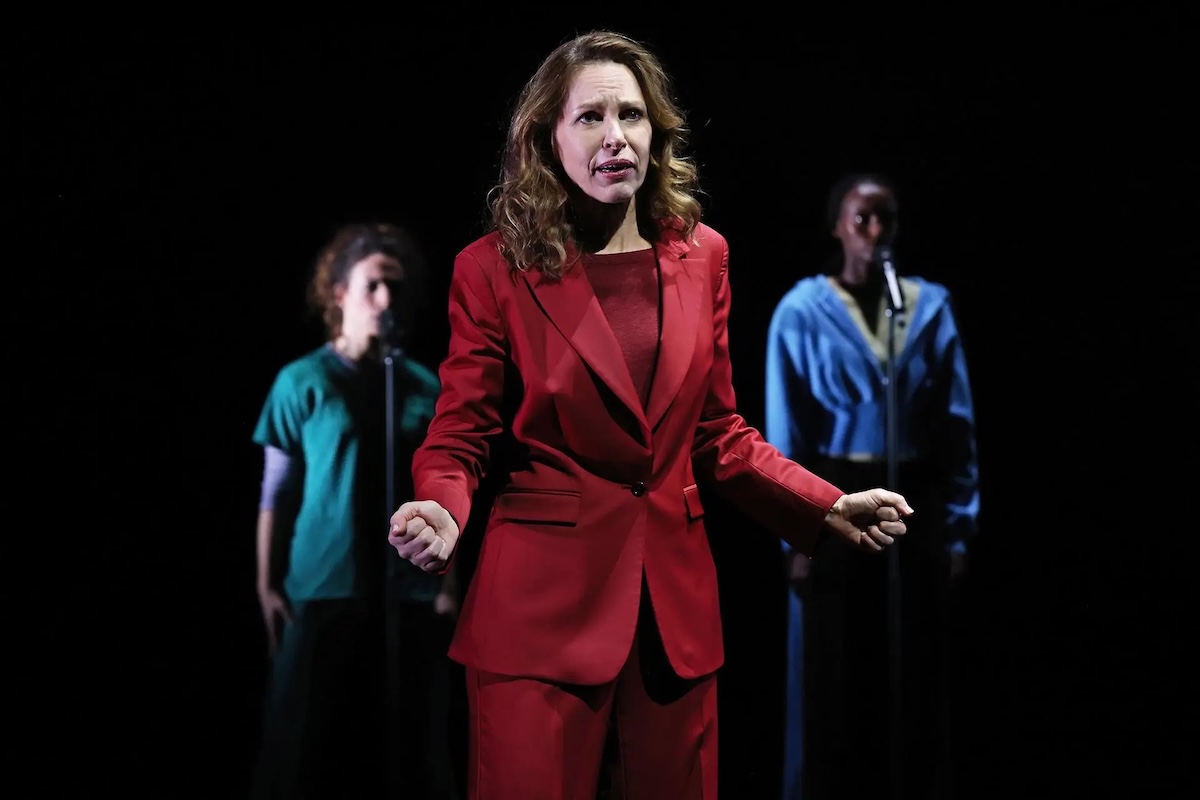
Lucy Bell (centre) in Strong is the New Pretty. Photo © Prudence Upton
The ensemble-based writing is another departure from Miller’s previous work, but one that comes at the expense of character depth. It isn’t helped by Sarah Giles’ direction, which pushes the script further from its potential. As in RBG: Of Many, One, Miller relies on a chronological retelling of events, but history presented in sequence makes for tedious theatre, particularly when it lacks a central performance compelling enough to transform the material.
Here, the procession of milestones feels less like dramatic progression than a dramatic reading of a Wikipedia page. Giles attempts to inject some life into the proceedings through dance interludes, digital banners, familiar chart hits and physical theatre, but these flourishes only compound the problem, rendering the subject matter frivolous. There is remarkably little ‘strength’ to be found.
The frivolity is most glaring in the play’s treatment of privilege and racism. The pressures placed on women to do it all – hold down jobs, raise children, maintain relationships – while simultaneously fighting for their right to take the field are acknowledged only in passing quips. Its engagement with intersectionality is even more superficial, approached with a troubling nonchalance that no amount of diverse casting can rectify.
Apparently, systemic racism in Women’s AFL can be dismantled with one pep talk and a skipping rope. If this is intended as satire, the point is lost in the performance and direction; if it is intended sincerely, it is woefully inadequate.

Strong is the New Pretty. Photo © Prudence Upton
There is plenty of room on Australian stages for uplifting, cheerful theatre. There is also enormous value in celebrating the women who fought to change the game, particularly in a sporting culture where their achievements have too often been overlooked. There’s no doubt that audiences will find plenty to celebrate in this re-telling, but celebration alone is not enough.
The story of AFLW’s creation deserves more than a chronological account punctuated by choreographed enthusiasm; it deserves the dramatic complexity, character driven storytelling and political critique that have made Miller’s best work so powerful.
For a playwright who has previously commanded the stage with such force, Strong Is the New Pretty feels like a missed opportunity.
Strong Is the New Pretty plays in the Drama Theatre, Sydney Opera House until 12 December.









Comments
Log in to start the conversation.