




British playwright Harold Pinter was a master of quotidian dialogue laden with psychological tension in claustrophobic settings.
Making that subtlety sizzle requires a talented cast, which is certainly the case for this production of The Homecoming that, at first glance, seems fairly humble.
An Australian Shakespeare Company co-production, it’s a disturbing slow-burn reveal of a family’s dynamics with hints of their past and present. This, together with the production’s mid-century London working-class design, got me thinking notorious gangsters the Kray twins might drop by at any moment.
Premiering in London in 1965, The Homecoming won the Tony Award for Best Play two years later. It unfolds in the living room of an all-male North London family: retired butcher Max; his sons Joey, a semi-professional boxer, and Lenny, whose profession remains obscure for most of the play; and Max’s brother Sam, a never-married chauffeur.
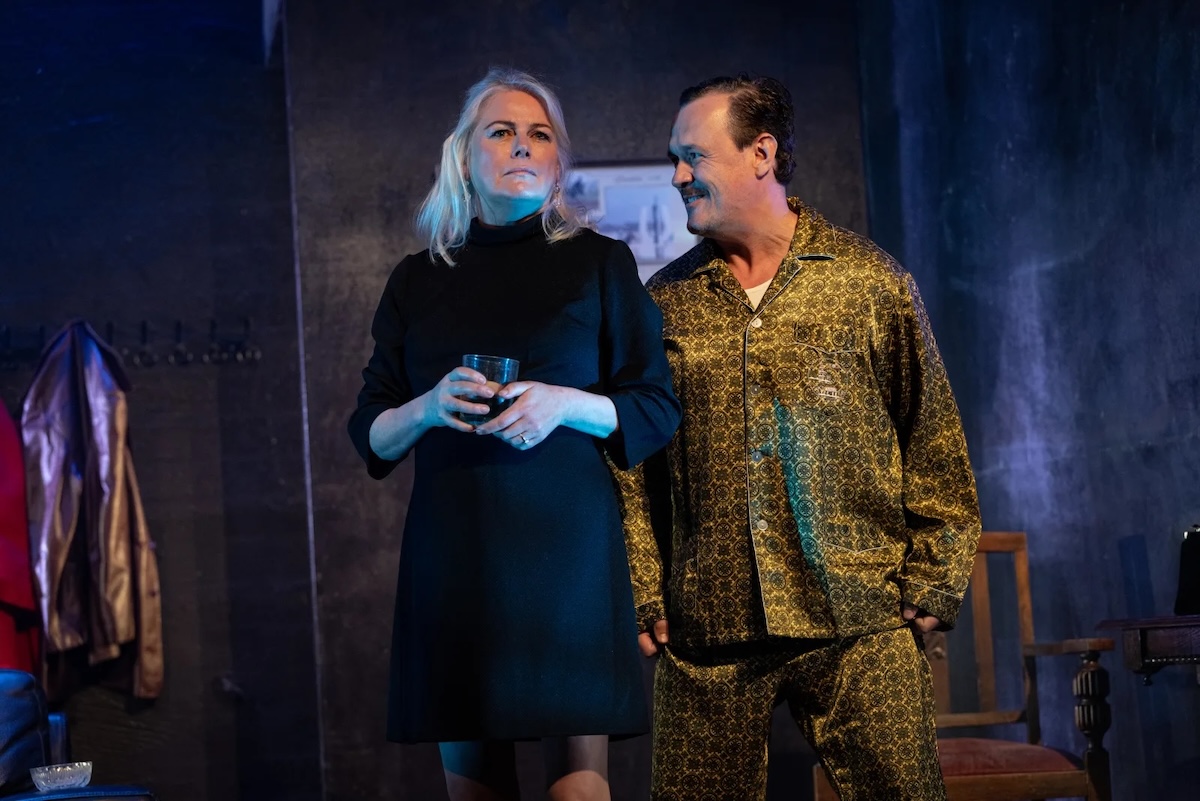
Kate Kendall and Ben Geurens in The Homecoming. Photo © Ben Fon
Eldest son Teddy, a philosophy academic, arrives unannounced from America with his wife of six years. He’s never told his family about Ruth, or their three children. That’s just the beginning of an increasingly unsettling family snapshot that questions the conventions of the day.
This new production directed by Greg Carroll has a firm handle on classic Pinteresque banter and silences fraught with tension; in this case the constant jockeying for power, toxic masculinity, desire, disappointment, and the absent presence of Max’s late wife.
It’s not so successful at conveying the comedy of Pinter’s dialogue, which saw his early works including The Homecoming described as “comedy of menace.”
The quality of the cast is perhaps surprising given the choice of theatre: the Athenaeum’s secondary space, a spartan yet effective black box well suited to intimate performances that is curiously underutilised.
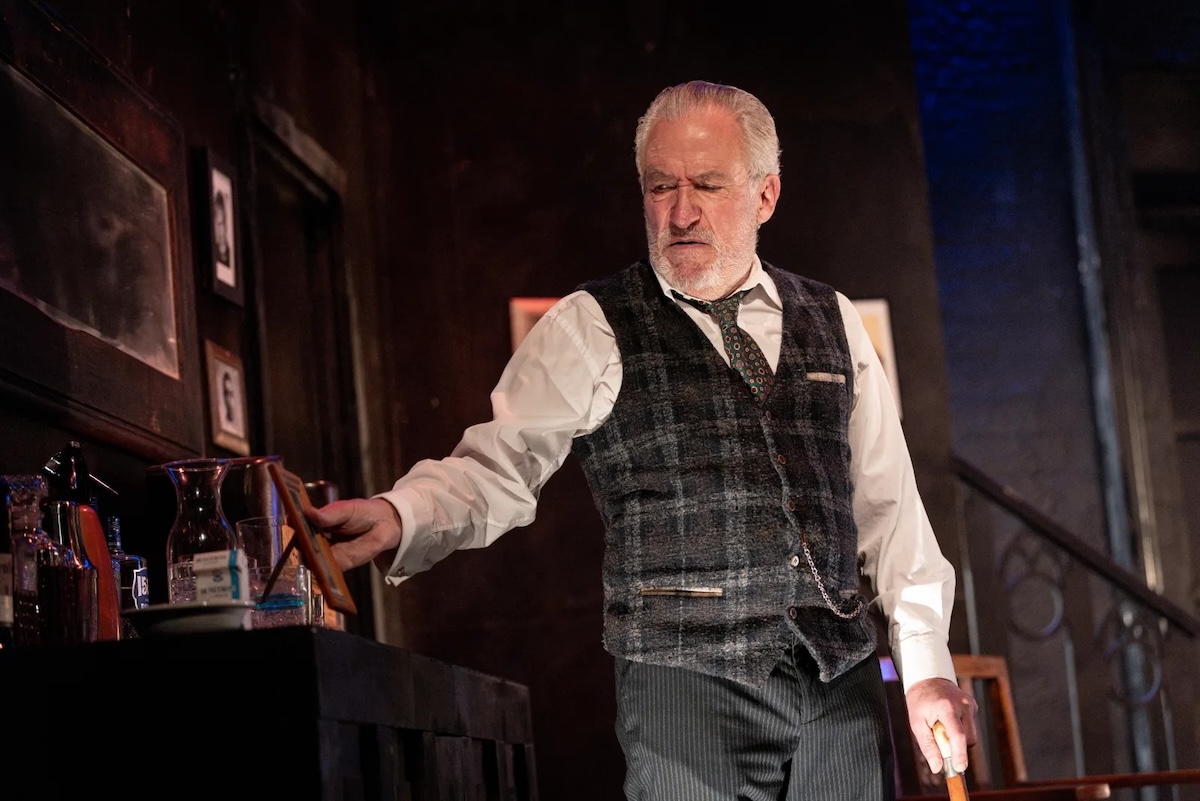
Richard Piper in The Homecoming. Photo © Ben Fon
Richard Piper (seen recently in Malthouse’s Break of Day) seems born to play Max, starting with this UK-born-and-raised veteran’s natural accent. A gregarious performer, he winkles out the script’s dark humour best among the cast. Piper also conveys Max’s waning grip on his once formidable power with loud reminiscences and feeble gesticulations with his walking stick.
As Teddy, Peter Houghton reveals through restraint of physicality, emotion and voice – including a neutral accent – that the eldest son has escaped the family’s masculine aggression and banter. He’s taken refuge in intellectualism and emotional detachment, but his anaemic relationship with Ruth shows how this approach is deeply – indeed shockingly – flawed.
Ben Geurens’s Lenny is creepy and sleazy, with a sing-song Cockney accent and tone of voice that’s always subtly threatening. His cocksure veneer includes hair combing, sharp suits and silk pyjamas – highlights among costumes by Amelia Carroll and Margaret Goy that nail time, place and characters.
The short-sleeve tops they dress Eddie Orton in reveal muscles that are Joey’s overt form of threat. He shows the youngest brother as a man craving success so he can gain his family’s respect, while in some respects remaining childlike.

David Field in The Homecoming. Photo © Ben Fon
David Field suggests Sam is a closeted gay man. Like Teddy, he has withdrawn from the family’s aggressive masculinity, sitting off to the side with legs crossed, saying little and being polite when he does, even as Max flings insulting accusations about his sexuality.
Ruth, the greatest cypher of the piece, is played with enigmatic coolness by Kate Kendall, who rapidly but almost imperceptibly transitions from unhappy wife and quiet observer to a more formidable role. Her face is usually unnervingly blank, even as she uses her sexuality like a dangerous toy.
The set designed by Carroll is a grim living room with all-black walls. Most of the furniture and ephemera are from earlier decades, alluding to Max’s heyday, including his wife. A large, modern, black-leather couch dominates the centre of the stage, representing both the next generation’s rise and the sexual thread running through The Homecoming.
Peter Amesbury’s lighting is traditional, including fade-to-blacks between scenes – brief intervals enriched by sound designer Paul Norton’s apropos selection of mid-century jazz.
This is old-school theatre: a simple, honest setting that allows a fine cast to reveal the hazardous currents and depths of Pinter’s dialogue. His plays have become a rarity on Melbourne’s stages lately, so whether you’re a longtime fan or curious to know if this Nobel Prize-winning playwright still has currency, catch The Homecoming while you can – the season is sadly short.
The Homecoming is at Athenaeum II, Melbourne, until 3 October.






Comments
Log in to start the conversation.