




Four-time AWGIE Award winner Tom Holloway returns with a new play, which looks back at AI’s (surprisingly distant) origins through the lens of the ethical and existential challenges it has now wrought.
Melbourne Theatre Company’s world premiere production of Eliza is nimbly directed by Paige Rattray, and realised by a cracking cast of three and spot-on visual design.
Based on real events, it’s set in an MIT computer lab in the mid-1960s. Professor Joseph Weizenbaum, with assistance from his secretary Becky and fellow academic Ronald, develops a computer program that uses talk therapy’s open-ended questions to simulate human conversation.
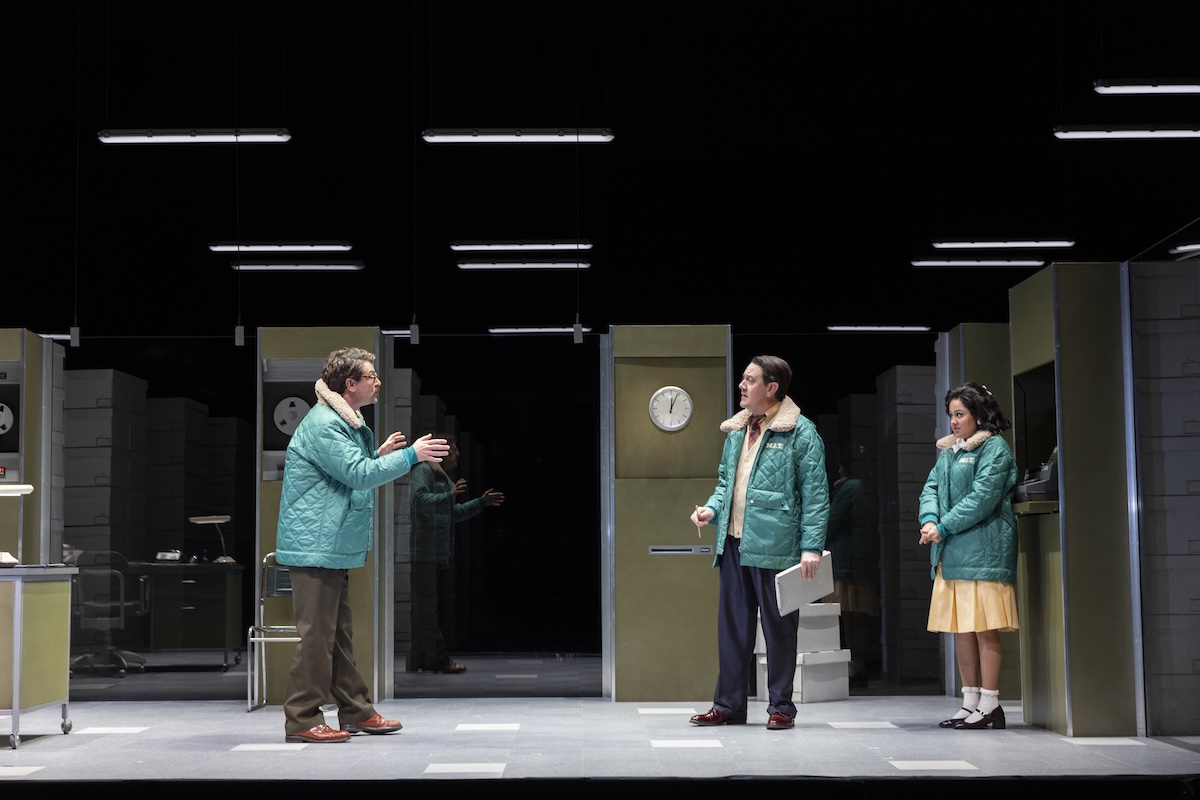
Dan Spielman, Hamish Micheal, Manali Datar in Melbourne Theatre Company’s Eliza. Photo © Pia Johnson
Named Eliza after the character in George Bernard Shaw’s play Pygmalion, and the period’s film adaptation, My Fair Lady, the program is put through its paces: Weizenbaum delves into troubled memories of his father, while Becky, whose problems are in the present, appreciates the feeling of being listened to.
Initially Weizenbaum encourages Becky to actively participate in the project. Their relationship sours, however, as he becomes obsessed with his work, then angry that Eliza is wrongly perceived as artificial intelligence and may also be used in ways he abhors.
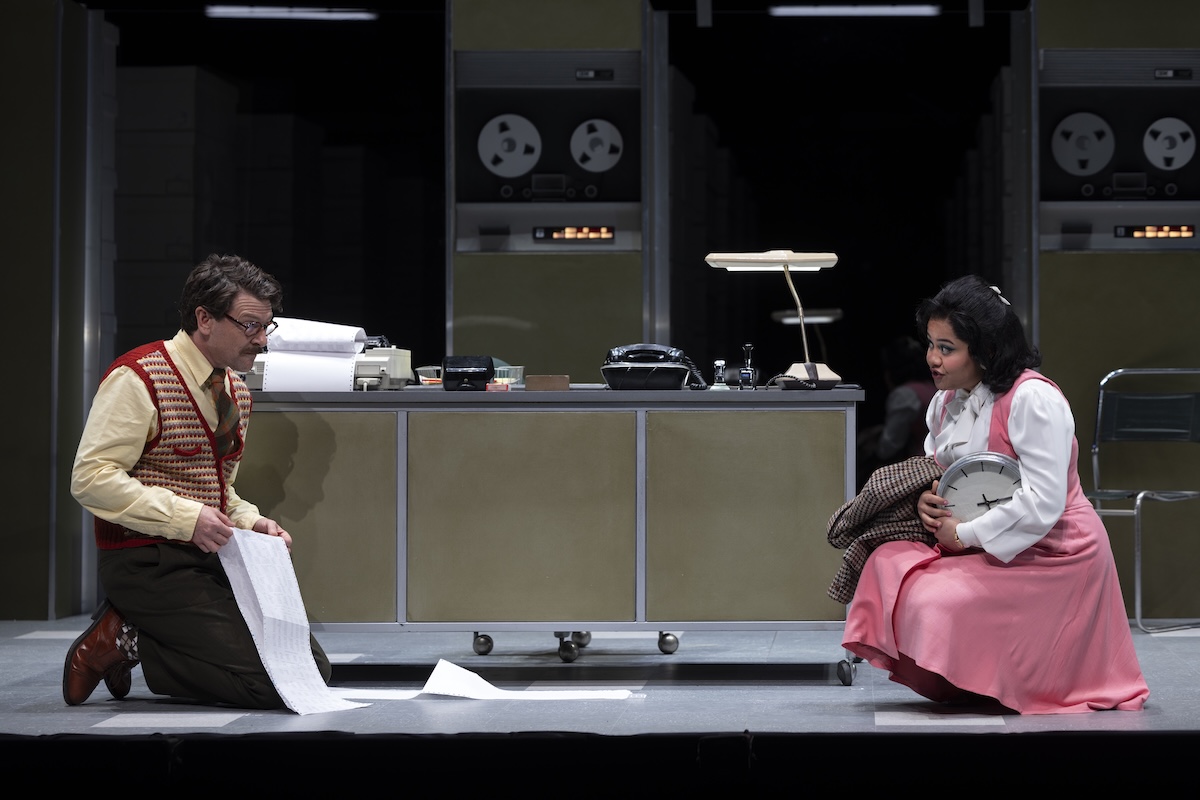
Dan Spielman and Manali Datar in Melbourne Theatre Company’s Eliza. Photo © Pia Johnson
Even as this IT Oppenheimer fails to connect with people, particularly Becky, who is arguably the play’s true Eliza (she even throws shoes at the professor), Weizenbaum defiantly lauds humans above machines. “There be dragons” he repeatedly warns those who think his creation is the start of a more equal footing.
Of course, 60 years on, we’re simultaneously embracing the dragons and terrified of them, as AI isn’t just blurring the line between human and machine but possibly poised to kill us all. It’s this retrospective knowledge that makes Eliza unnerving, as well as a timely celebration of human creation and experience; Holloway pointedly opens his play with the characters doing a reading of Pygmalion.
It’s a clever analysis of the present through the past, albeit slightly over-stuffed with ideas. References abound, from 2001: A Space Odyssey to murmuration (which may allude to AI’s swarm intelligence).
It’s also tonally erratic. Across 100 minutes Eliza is My Fair Lady-meets-The Office funny, and a drama of fraught relationships, past and present, before evolving into a psychological thriller: Weizenbaum mentally disintegrates … though he may not be mistaken about shadowy government forces.
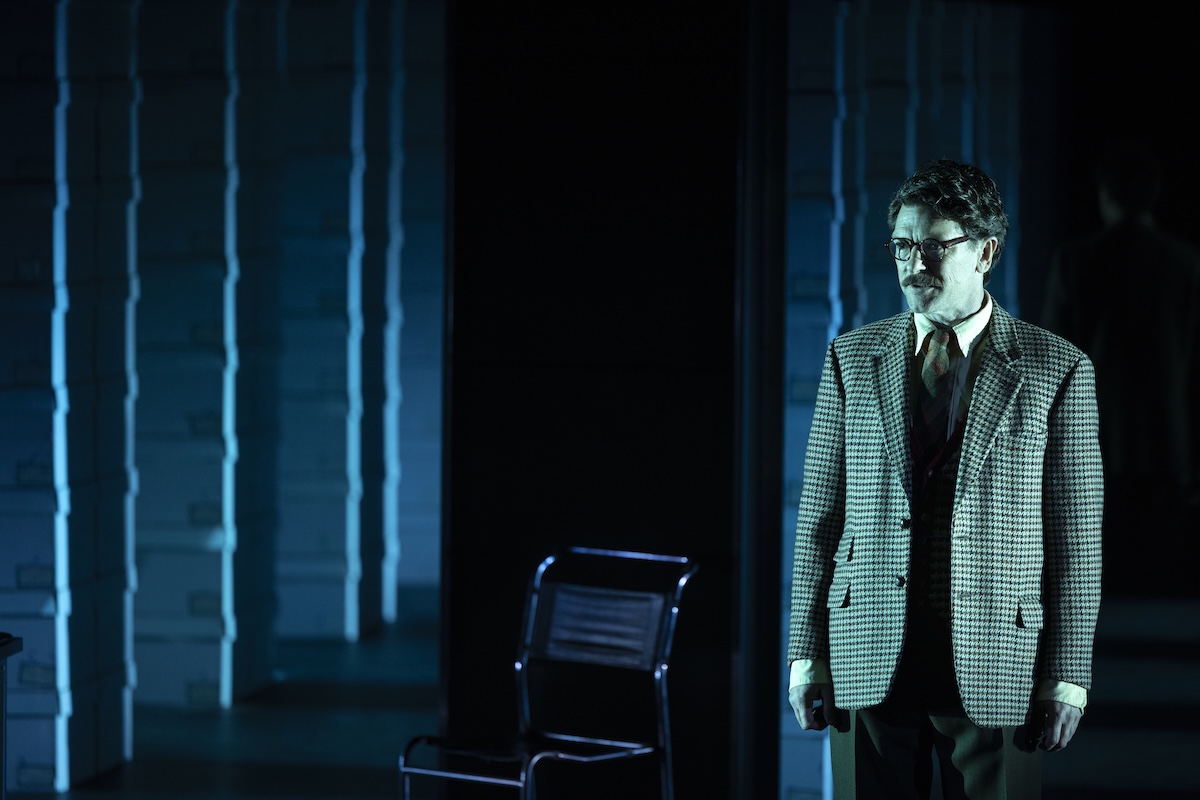
Dan Spielman in Melbourne Theatre Company’s Eliza. Photo © Pia Johnson
Dan Spielman leads the uniformly excellent cast. His Weizenbaum is physically rigid and speaks matter-of-factly, but there’s always a sense of underdeveloped sensitivity that implodes into mania.
Manali Datar deftly interprets Becky as an openly sweet, quietly bitter young woman. She also briefly transforms into the role of an older, wiser psychiatrist.
Hamish Michael makes several astonishing transformations, conjuring characters with distinct comic styles including aloof, wise-cracking Ronald, a kooky senior academic and hyper-enthusiastic journalist. Michael has almost become typecast as an unpleasantly manipulative alpha man on screen, so his humorous turns here are a series of delightful surprises.
Thanks to voice and dialect coach Amy Hume, the cast’s accents are wonderfully varied, authentic of time and place, and character appropriate. Costume designer Matilda Woodroofe ticks the same boxes, from Weizenbaum’s knitted vest to Becky’s girlish Mary Jane shoes.
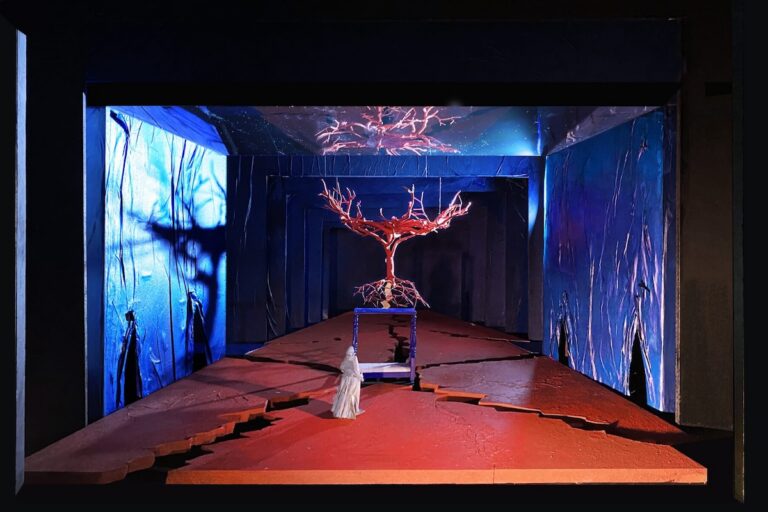
Dale Ferguson’s set impresses despite being understated and largely static, with the desk shifted here, a chair there. They appear within a few panels sporting minimal vintage tech, while either side and beyond are stack upon uniform stack of white document boxes that ominously recall today’s data centres.
Paul Jackson’s anaemic office-style lighting compounds the set’s soullessness, before blue light and deep shadows support the narrative and past-is-present psychological crisis.
Eliza is fictionalised history that can’t fail to resonate with our current reality. There be dragons indeed.
Eliza is at The Sumner, Melbourne, until 31 October.







Comments
Log in to start the conversation.