Two weeks after opening night, this return visit to Graeme Murphy’s production of Lehár’s The Merry Widow for Opera Australia is very much a fresh encounter.

Having reviewed the premiere cast led by Julie Lea Goodwin, the focus here shifts to Emma Pearson, who is making her role debut as Hanna Glawari.  What emerges is far more than a case of a performer slotting neatly into an established template, as so often happens in revivals of classic operas and replica musicals.

Instead, Pearson reshapes the evening in her own image, her portrayal firmly rooted in the Viennese operetta tradition, and the entire company comes to the party. The result feels like a different show altogether – a testament to the durability of Murphy’s elegant Art Deco production.
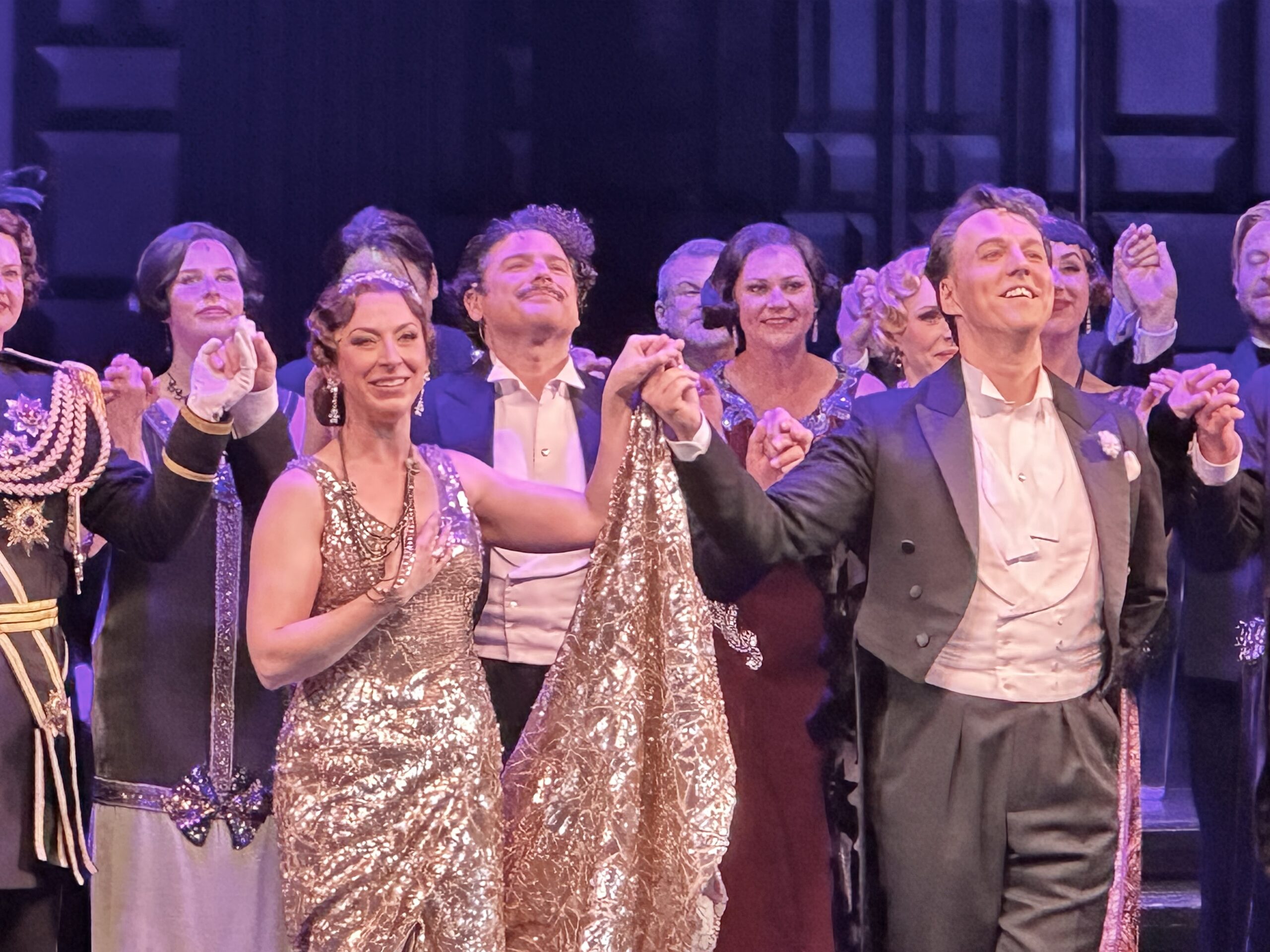
Emma Pearson with Alexander Lewis and John Longmuir (second row) in OA’s The Merry Widow. Photo © JJ Antmann

In her Limelight interview earlier this year, Pearson discussed her preparations for the role and the need to maintain a classical style without ever sounding heavy. Having spent much of her career in strictly acoustic European opera houses, she also noted the impact amplification might have on her vocal performance, in particular her consonants and sibilant sounds.

She needn’t have worried, her years ensconced in the German and Austro-Hungarian repertoire clearly paying off.

She boasts a warm bel canto line and portamento that adds a touch of sentimentality with each delicate swoop. It’s the epitome of Viennese operetta, topped off by her use of rubato, which is expertly supported by conductor Vanessa Scammell, and adds an almost waltz-like lilt to Vilja’s duple metre.

Partnering Pearson, Alexander Lewis shows off his chameleonic abilities as Danilo Danilovich, his voice taking on a more full-bodied, operatic colour to match hers.

The simmering sexual tension that gradually came to a boil in the opening-night pairing of Goodwin’s Hanna with Lewis’s Danilo also plays out differently here.

Right from the off, Pearson and Lewis are completely simpatico, recalling the affectionate yet playful ‘Noël Coward-esque’ dynamic that Francesca Annis and James Warwick famously enjoyed in their Agatha Christie adaptations for London Weekend Television. They revel in the light-hearted comedy, Pearson’s Hanna remaining unflappable throughout, while Lewis ups the ante on the early slapstick, evoking Buster Keaton’s drunk scene in the 1932 film Speak Easily.

Emma Pearson with (from left) Benjamin Rasheed, John Longmuir, Vanessa Scammell, Alexander Lewis, Alexandra Flood, Richard Anderson; Second row: Tom Hamilton, Jane Ede, Nathan Lay, Ian Henderson and Helen Sherman. Photo © JJ Antmann

For purists, this version of The Merry Widow will come across as more cohesive, from its consistent comic tone to the more traditional vocal blend in, for example, the glorious Act II quintet that follows the summer house scene, in which Pearson and Lewis are joined by Alexandra Flood (Valencienne), John Longmuir (Camille de Rossillon) and David Whitney (Baron Mirko Zeta).

Compared with the opening night performance, it is clear both interpretations are utterly legitimate and of equal merit. Goodwin’s capitalises on her enviable experience in contemporary musical theatre; Pearson’s is firmly rooted in Viennese tradition and musically transports us to the Theater an der Wien in 1905.

Both however capture the sophisticated, Roaring-Twenties charm of Murphy’s production and deliver a rollicking good night out. You’d do well to see both.


Opera Australia presents The Merry Widow at the Joan Sutherland Theatre, Sydney Opera House until 18 August. Emma Pearson performs the role of Hanna Glavari until 26 July. Julie Lea Goodwin performs the role, 31 July – 18 August.

Contribute to Limelight and support independent arts journalism.