


Vaughan Williams’ A Sea Symphony is a remarkable first symphony (eight more were to follow). A vast work, Mahlerian in scope and orchestration, it is a setting of verses about the sea by Walt Whitman, a poet popular with composers in the early 20th century.
As well as a large chorus, the work employs a solo baritone and soprano. It was composed over six years, from 1903 to 1909, and premiered at the Leeds Festival in 1910.
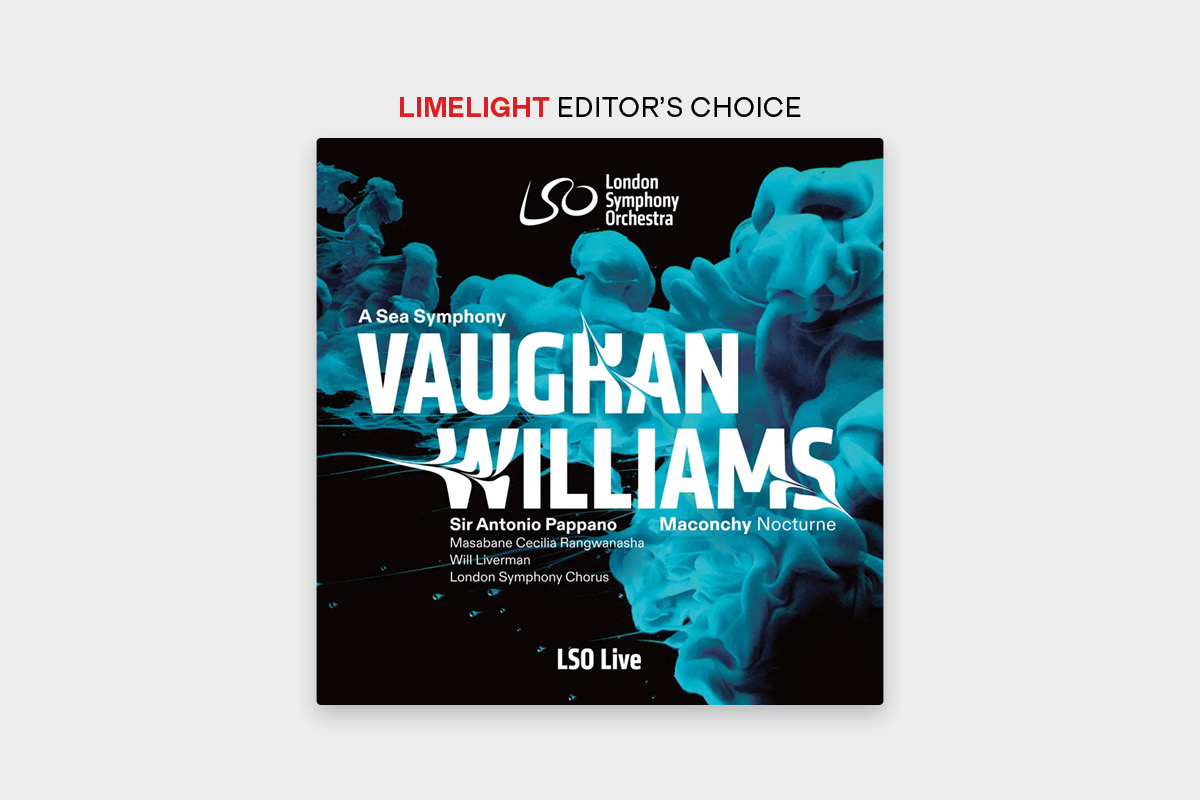
The composer was in his 30s at the time. This was not his first setting of Whitman: the cantata Toward the Unknown Region for chorus and orchestra was written and performed during the symphony’s gestation. The orchestral writing is imaginative and assured, reflecting Vaughan Williams’ studies with Maurice Ravel in 1907/08, while the choral writing reflects the English hymn tradition (notably in the first movement, A Song for All Seas, All Ships). Other strong influences include Elgar, and Charles Villiers Stanford, with whom the composer had also studied.
The nine symphonies of Vaughan Williams are now recognised as one of the major symphonic statements of the 20th century and are increasing in popularity. They are being programmed in America, in Sydney (under Simone Young), and in London with the LSO and its conductor Sir Antonio Pappano. This recording is the third in Pappano’s series of the complete set. A year ago, I raved about their performances of the Fifth and Ninth symphonies (also released on the orchestra’s house label). No. 1 similarly shows the orchestra in a strong, dazzling light, but this time I have some caveats.
A friend who was present at the concert when this performance was recorded remarked that the chorus struggled to create the vast choral sound the piece requires, due to space restrictions in the Barbican. On disc this is less of a problem: they are tight in ensemble and very clear, but compared to, say, the Royal Liverpool Philharmonic Chorus on Andrew Manze’s excellent recording, they lack sheer amplitude.
Soprano Masabane Cecilia Rangwanasha displays the requisite strength and purity in her sections of the work, and Pappano’s conducting is typically vivid. However, baritone Will Liverman has an unfortunate habit of rolling his r’s and stretching out his vowels (common with American oratorio singers). Whitman’s poetry is in English, but you cannot always tell from Liverman’s delivery. I much prefer John Cameron on Adrian Boult’s early mono recording on Decca (available again in an Eloquence box), or Mark Stone who sings the part for Manze. Admittedly, both of Pappano’s soloists are lovely in the transcendent coda (O, my Brave Soul).
Rather than another Lark Ascending, the symphony is coupled with a rare work: Nocturne for Orchestra, written in 1950 by the English composer Elizabeth Maconchy (1907–1994). She is best remembered for her series of 13 string quartets, and a pair of neoclassical concertinos for clarinet and orchestra. This piece of moonlit impressionism has an attractive undercurrent of unease, and a turbulent middle section. Orchestral textures are perfectly balanced in Pappano’s well-paced performance. It is worth getting the disc for this piece, even if you already have another version of A Sea Symphony.
Composer: Ralph Vaughan Williams
Works: A Sea Symphony, Nocturne for Orchestra
Performers: Will Liverman bar, Masabane Cecilia Rangwanasha s, London Symphony Orchestra & Chorus with Antonio Pappano
Label: LSO Live LSO0910





Comments
Log in to start the conversation.