Alex Turley’s Substratum is inspired by the tropical rainforest floor. In his introduction to this world premiere performance, flautist Joshua Batty praised the AFCM for commissioning several new works scored for flute and strings. Violinists Doretta Balkizas and Dimity Hall, British violist Benjamin Roskams, and cellist Charlotte Miles provided a convincing illustrative backdrop.

Turley’s music flowed through three continuous movements. The first represented earthy leaf matter, which metamorphosed in the second section and, in the third, was propelled towards the light above ground by choppy, driving strings. The work was an admirable vehicle for Batty’s impressive virtuosity and mellow tone as he championed Turley’s curling, meandering and embellished melodic strands.

Composed in the late 1820s, towards the end of Schubert’s life, Winterreise (Winter Journey) is a setting of 24 poems by Wilhelm Müller for voice and piano. In this concert, several songs used Iain Festeraine’s arrangements for two violins (Dimity Hall and Dene Olding), viola (Irina Morozova) and cello (Miles).

This much-loved song cycle is about a heartbroken man trudging through an icy, snowbound landscape to put distance between himself and his former lover.
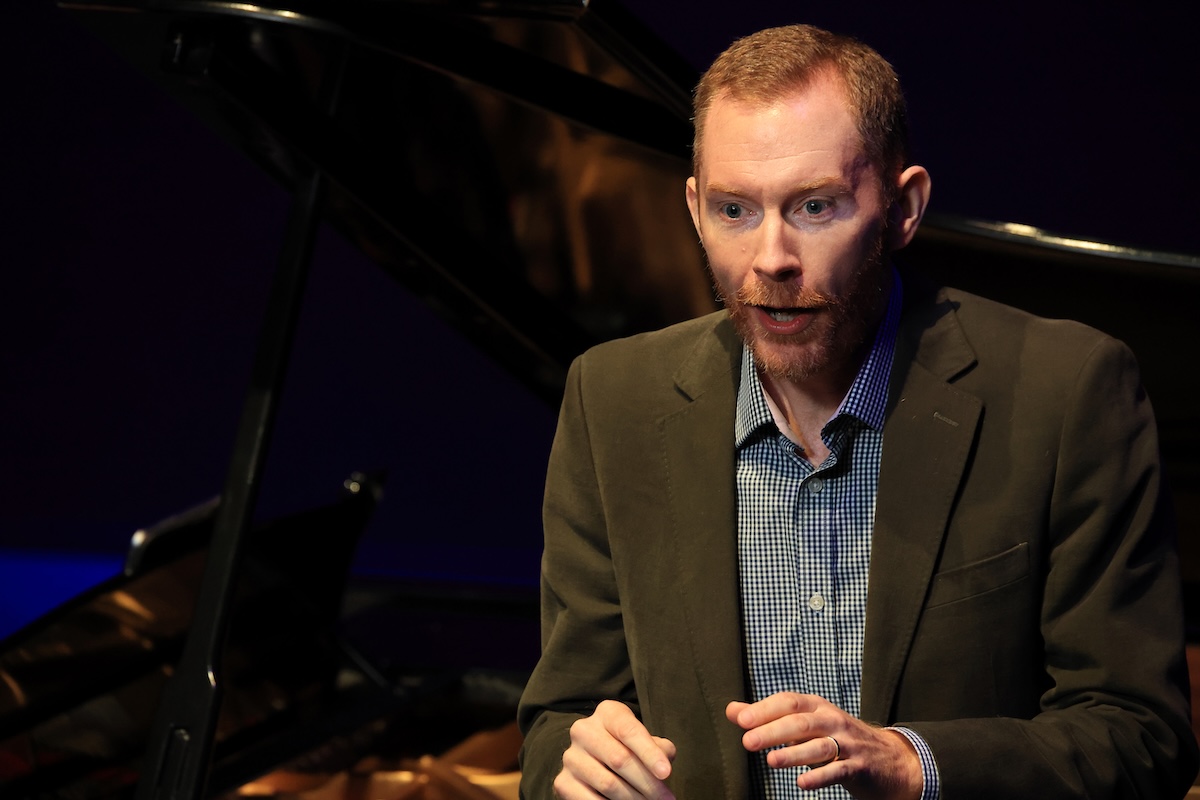
Robin Tritschler. Photo © FrontrowFoto

Despite its European wintry setting, Australian audiences love the work, and the warm, balmy evening in far north Queensland merely added to the irony. I overheard someone express disappointment that only 12 of Schubert’s 24 songs had been programmed.

Schubert’s cycle wallows in industrial-scale gloom, enhanced by lovely lyricism. Each of the songs, set to poems by Wilhelm Müller, references aspects of the inhospitable landscape to communicate the man’s despair.

Tenor Robin Tritschler sang the spurned man’s thoughts with soaring emphasis, using every shade of colour and nuance he could muster in his vividly dramatic account. His phrase shaping was infinitely varied and, leaning into the peak of each phrase with voluminous tone, he squeezed every drop of despair from the music. Tritschler is a magical storyteller who communicates directly with the audience. Blessed with a radiantly winning voice, his delivery ranged from acute emphasis to a chilling whispered pianissimo.

Piers Lane’s piano in Gute Nacht, the opening song, was straightforward and matter-of-fact, representing the traveller walking. Incrementally, the emotion was ramped up through Lane’s searching fingers, with the harmonies shading Tritschler’s melodic grief. Der Lindenbaum, in which the strings conjured cinematic rustling trees, was a standout. One of the most emotional songs is Erstarrung, which has a distressed vocal line. Lane’s frenetic piano triplets mirrored the hero’s panic.

Between each of Schubert’s songs, Tritschler narrated a poem that resonated with the sentiments of the ensuing song. He recited works by Stevie Smith, Edgar Allan Poe, John Donne and Thomas Moore.

As this program was dedicated to the memory of Australian literary giant David Malouf, a poem by him would have carried even greater resonance.

Arguably, the additional poems inserted between each song to set the mood were unnecessary, as translations of Müller’s original poems were printed in the program. But a festival is an occasion on which risky ideas can be trialled. Surtitles could have provided additional clarity, but the AFCM’s program reaches across several Cairns-Gimuy venues, and perhaps that is asking too much.

The performance was not as detailed and meticulously realised as it can be when Winterreise is presented as a standalone major work, but the emotional content poured off the stage, and the audience clearly appreciated it.


This year’s Australian Festival of Chamber Music concluded on 1 August. 

Contribute to Limelight and support independent arts journalism.