


Is a performance of the complete set of Frédéric Chopin’s 21 Nocturnes a worthwhile education or too much of a good thing?
Certainly, it required some audience concentration. On the other hand, piano nocturnes and preludes are so often played singularly and in isolation (opening a concert or even more frequently as encores) that hearing them together gives a sense of the form’s intent.
London-based Australian pianist Piers Lane knows Chopin’s music so intimately that he played the nocturnes in chronological order, without score, and provided unscripted narration explaining how Chopin’s expression of the form developed over his short life.
Snow Concert Hall Artistic Director Ana de la Vega first explained that Lane had been involved in selecting the magnificent Steinway concert grand piano to match the concert hall’s acoustic as it opened in 2022. Any concert hall’s beating heart is its piano!
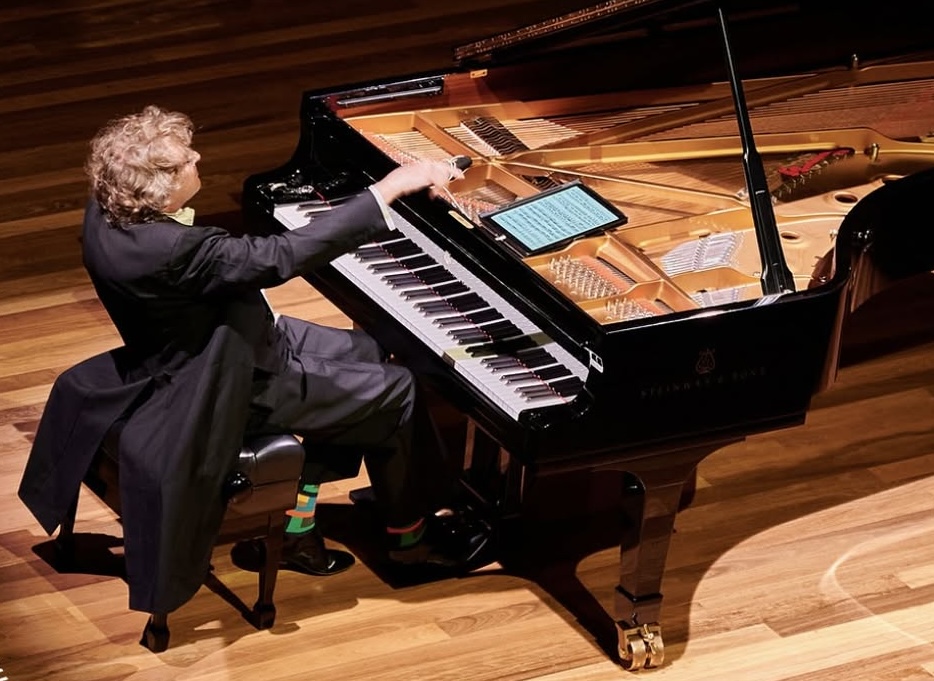
Piers Lane. Photo supplied
Lane is an unassuming character, confident of his scholarship and ability, but entirely unpretentious in his presentation and his playing. His appearance on stage in a marbled bright blue jacket was possibly a gentle taunt to the extroversion of certain contemporaries?
Beginning with the three early works that Chopin wrote as a teenager (in C minor, E minor and C-sharp major), but which weren’t published until after his death, Lane explained the nocturne origins and form.
Often tranquil or contemplative, evoking sounds of nature, with the right hand ‘singing’ like a human voice (or chimes), nocturnes were intended to be played in the evening, rather than be necessarily evocative of night. Usually short, and in the form of a single movement, Irish composer John Field developed the concept further, leading later romantic composers to a structure where a theme or mood is repeated at the beginning and end, bracketing a more animated, resolute or tempestuous middle section.
Lane took the audience on Chopin’s journey through progressively more sophisticated takes, beginning with Opus 9: the B-flat with a repeated melodic phrase with the final note flattened on the repeat, and then the more ornamented version of the famous E-flat nocturne. Lane darkened the tone, and emphasised pauses and changes in tempo for the three Opus 15 works: the F major has a note progression spelling out the composer’s name F(r)EDE(ri)C; the G minor is inspired by Hamlet, with questions left hanging in the air and sudden, tolling bells.
And so the lesson proceeded, works became more dramatic, more ethereal, more despairing, more poignant and – in the case of the late works – more anticipatory of death. The matched pair of Opus 27 works (marking Chopin’s 1830 departure from his home and family in Warsaw, never to return) were played with especially affecting expression and sensitivity. Likewise, the agonising sense of solitude expressed in the C minor work in Opus 48 (admired by both Beethoven and Ravel) was conveyed with profound feeling.
Piers Lane may not have the most delicate touch on the keyboard, nor stretch out the pauses so dramatically that the audience is loath to breathe, but he delivered this journey with authenticity, historical insight and technical excellence that brought his topic to life.







Comments
Log in to start the conversation.