Baroque music was not all po-faced seriousness. Jean-Philippe Rameau’s Platée, Domenico Scarlatti’s Cat Fugue and Biber’s Battaglia are just some pieces that served the citizens of the era a healthy dose of humour in their theatrical entertainment. Like any other society, they had their moments of levity.
Director Eugene Lynch returns to Pinchgut with more amusement in this collection of three mini-operas and a flute concerto, deftly interweaving their narratives. Soprano Ariana Ricci, tenor Nicholas Jones, baritone Morgan Pearse, actor Mitch Riley and flautist Melissa Farrow perform with a small period instrumental ensemble from the Orchestra of the Antipodes, directed from the harpsichord by Erin Helyard.
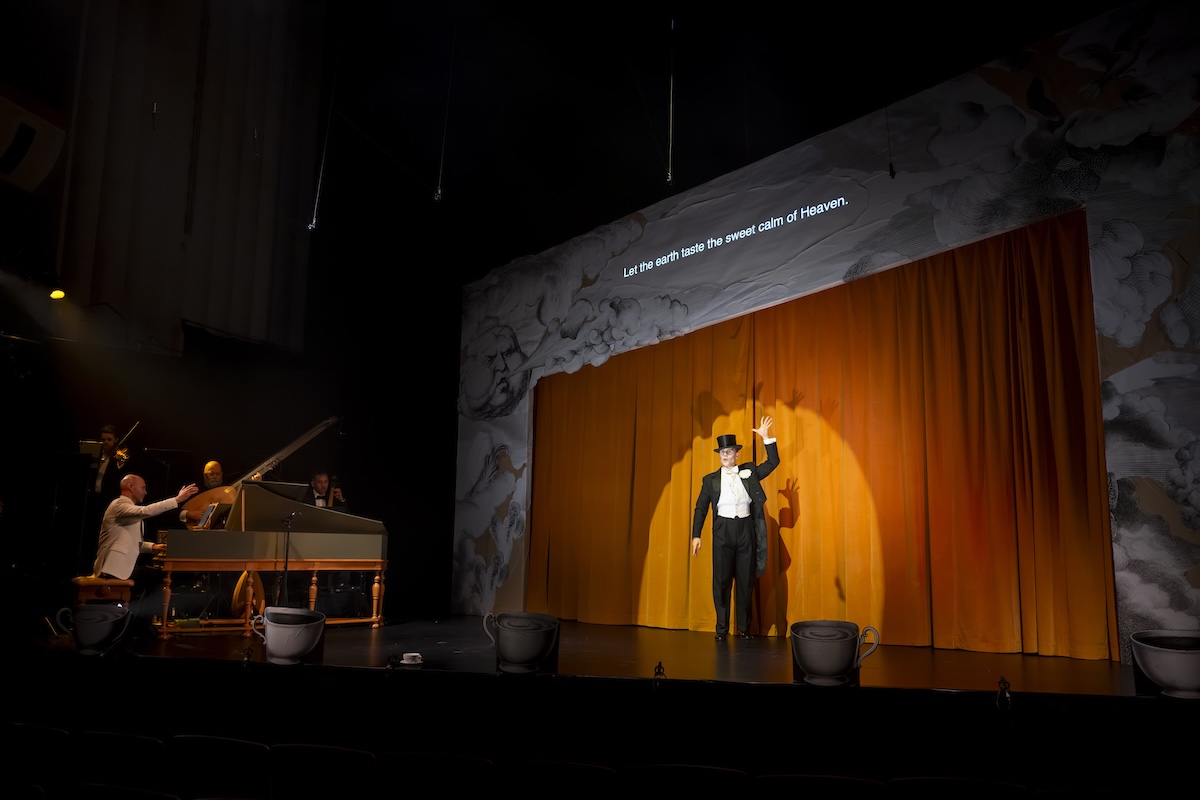
Nicholas Jones in Coffee and a Dead Canary. Photo © Cassandra Hannagan
With visual gags aplenty, the production is themed around the unlikely pairing of coffee and a canary, set in the period when coffee arrived in Europe in the mid-17th century. Drinkers fell victim to its intoxicating grip. Not much has changed as I write this caffeine-fuelled review.
Coffee was considered a seductive and stimulating brew. Monks drank it to stay awake through the night to pray, and it was even considered seditiously akin to alcohol and banned. What better topic for some merriment?
The musicians are on stage, a tuxedo-clad combo; designer Melanie Liertz’s diagonally placed proscenium arch frames the action and adds depth to the setting. Her costumes span the eras, from Nicholas Jones’ suave top hat and tails to Ricci’s technicolour Baroque confection as Lieschen. Véronique Benett’s imaginative lighting adds to the drama, notably in the graveyard scene.

Melissa Farrow, Mitch Riley and Nicholas Jones in Coffee and a Dead Canary. Photo © Cassandra Hannagan
Nicolas Bernier’s cantata Le Caffé was composed for soprano, violin or flute and continuo. Lynch and Helyard hand the solo role to Nicholas Jones, with Farrow taking up the dialogue with the voice. Jones delivers an engaging and nimble performance in a pas de deux with an oversized coffee cup danced by Riley, aptly conceived, as the arias, notably the Gigue of the second aria Café du jus de la Bouteille, are infused with dance rhythms. What is lost in this gender swap is the awakening of the young soprano to the pleasures not only of coffee but of her sexuality, as expressed in Louis Fuzelier’s hedonistic text.
Bernier’s music was performed several times at the Concert Spirituel, a series at the hub of Parisian non-operatic productions, founded in Paris in 1725. Pierre-Gabriel Buffardin was another Frenchman whose music was heard here.
Buffardin’s Flute Concerto in E minor is one of only two of his compositions that survive. It’s not known if Buffardin was influenced by birdsong, but Lynch and Helyard have tapped into its soundscape to introduce the relationship between the canary, danced by Riley clad in delicate layers of trembling feathers, and its owner (Pearse).
The first movement, Allegro, ripples with triplet figures and arpeggios that fill the solo line. Though firmly in the Baroque era, its aesthetic looks to the style galant of the Classical era, with undulating melodies and ambulating continuo. The Andante is a fine dialogue between Matthew Greco’s first violin and flautist Farrow.

Ariana Ricci in Coffee and a Dead Canary. Photo © Cassandra Hannagan
The final movement, Vivace, is a virtuosic caper that leaps and runs through demisemiquavers, navigated with judicious breathing and a slight but emphatic ritardando. Riley gives an excellent portrayal of a canary mirroring the music. Expressive as his movements are, they detract from Farrow’s performance.
Baritone Morgan Pearse makes a welcome return to the Pinchgut stage and to Lynch’s direction after his star turn as Uberto in Maid Made Boss. His solo cantata, Trauer-Musik eines Kunsterfahrenen Canarienvogels (“Funeral Music for an artistically skilled Canary”) by Georg Philipp Telemann, is an eight-movement pairing of arias and recitatives. Pearse is impressive in this Italianate mini-opera, vocally superb and delivering a performance that is poignant, with a touch of the comedic, as he mourns the now-dead canary.
There is a lyrical reminiscence of the bird’s singing, moving to a rage against death. We feel the grief in the return to mourning with the heartrending aria Mein Canarine, gute Nacht! as the tiny creature is committed to the earth.

Nicholas Jones in Coffee and a Dead Canary. Photo © Cassandra Hannagan
The Coffee Cantata BWV 211 gives an inkling of the warmth and humour of JS Bach, who, with four adult daughters of his own, undoubtedly faced some of the aggravations that the headstrong Lieschen caused her long-suffering father Schlendrian. Ricci plays a sassy Lieschen. Her two showpiece arias, Ei! Wie schmeckt and Heute noch, are a treat, lithe and pure-toned.
The ingénue Lieschen delivers a rapturous ode to coffee as her sexuality awakes, demanding three cups of coffee a day, a demand hastily abandoned at the promise of a husband. Pearse is a suitably cantankerous father determined to have his daughter wedded and bedded. The interaction with the audience (no spoilers) and Riley’s cameo are brilliant touches.
A fresh and clever take on some unusual Baroque repertoire.
Pinchgut Opera presents Coffee and a Dead Canary at City Recital Hall, Sydney until 13 September, then at the Joan, Penrith on 17 September.

Comments
Log in to start the conversation.