




The collection published posthumously as Schwanengesang, D957 was never arranged as an integrated song cycle by Schubert himself, but was assembled by publisher Tobias Haslinger from settings of Ludwig Rellstab, Heinrich Heine, and Johann Gabriel Seidl. Completing their survey of Schubert’s major Lieder collections for ABC Classic, baritone David Greco and keyboardist Erin Helyard maintain Haslinger’s traditional sequence for this landmark Australian period-instrument release.
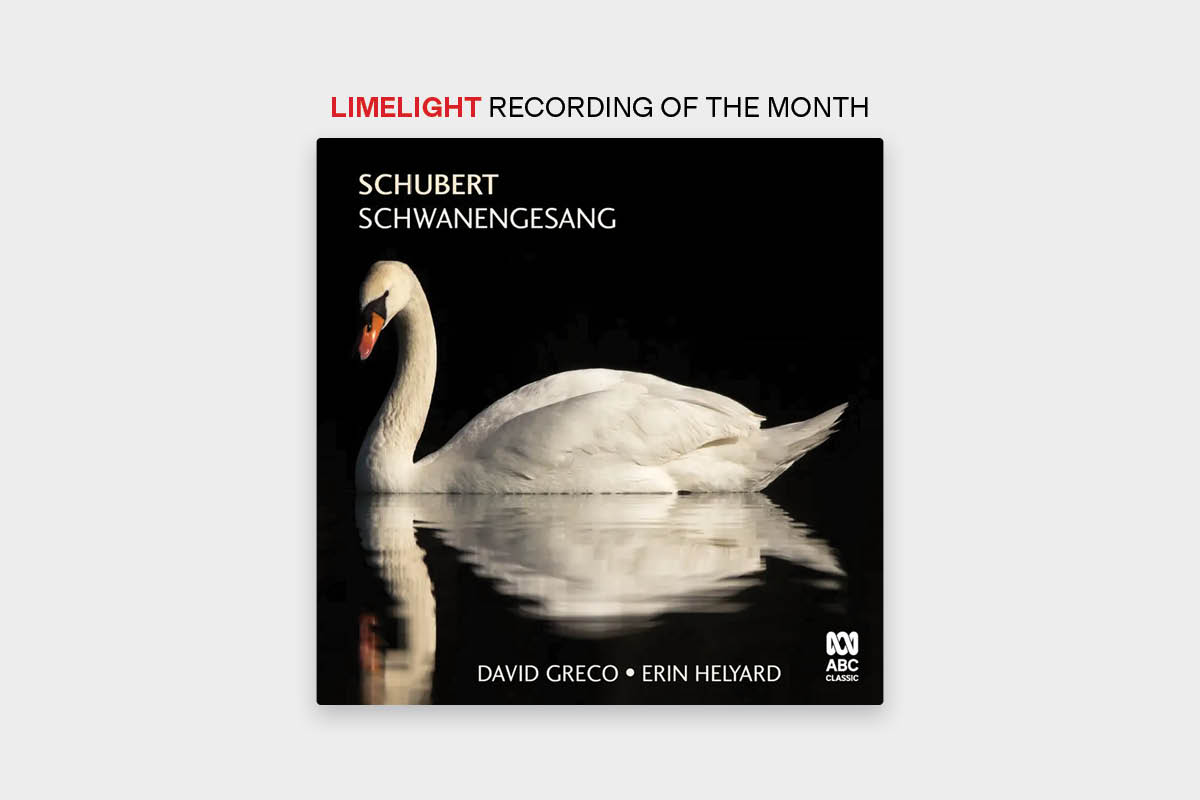
Recorded on a replica of an early 19th-century Graf fortepiano, the album joins a small discography of historical-keyboard accounts. While pioneering period recordings by Michael Schopper with Jos van Immerseel and Dominik Wörner with Christoph Hammer established the sonic possibilities of original Graf instruments, and Christoph Prégardien with Andreas Staier remains a benchmark for tenor readings, Greco and Helyard offer a distinctive baritone perspective.
The fortepiano’s light wooden construction and swift acoustic decay alter the balance between singer and accompaniment. Unlike the modern grand tradition – where singers must contend with broad acoustic power, as heard in Dietrich Fischer-Dieskau’s authoritative readings with Gerald Moore, Matthias Goerne’s dark inwardness with Christoph Eschenbach, or Gerald Finley’s smooth lyricism with Julius Drake – Helyard’s Graf replica establishes a natural chamber-music dialogue without forcing the vocal line.
Greco’s vocal delivery applies 19th-century performance practices, including expressive portamento and flexible declamation, to heighten the poetic text. In the Rellstab settings, Helyard’s crisp articulation provides definition to the aquatic motifs of Liebesbotschaft and the martial rhythms of Kriegers Ahnung. In the starker Heine settings, Greco avoids exaggerated vocal weight. Der Doppelgänger achieves a ghostly intensity through breath control and diction, while Die Stadt utilises the fortepiano’s unique damper resonance to create a sinister acoustic backdrop.
The release is further distinguished by its programming. Following Die Taubenpost, the performers insert Maximilian Stadler’s Fugue on the Name of Schubert, played by Helyard as a reflective contrapuntal transition before four additional songs. The recital concludes with Helyard’s solo performance of the Ungarische Melodie in B minor, D817, ending the album with quiet melancholy. Following their earlier recordings of Winterreise and Die schöne Müllerin, Greco and Helyard’s Schwanengesang completes a significant contribution to historically informed Lieder interpretation.
Composer: Schubert
Work: Schwanengesang
Performers: David Greco bar, Erin Helyard p
Label: ABC Classics ABCL0089D








Comments
Log in to start the conversation.