It is 150 years since Richard Wagner’s ambitious gamble to stage a summer festival dedicated to his visionary ideas, with his vast tetralogy, Der Ring des Nibelungen, standing as the fullest expression of his synthesis of music drama, philosophy, mythology and theatrical innovation.

Since its inception in 1876, Bayreuth’s approach to staging The Ring steadily evolved away from the strictures of Wagner’s original intentions; his stage directions remained largely inviolable until 1931, by which time 41 complete cycles had been presented across 18 festival seasons. Thereafter, literal visualisation gradually gave way to symbolic interpretation, ushering in the artistic freedom that has since become one of Bayreuth’s defining characteristics.

To mark the anniversary, and acknowledge the technological transformations that define contemporary society, Bayreuth has invited artificial intelligence into the creative process. Subtitled Ring 10010110 — From Myth to Code, the result, however, often feels less like theatrical innovation than a dumping ground of relentless, overwhelming imagery.
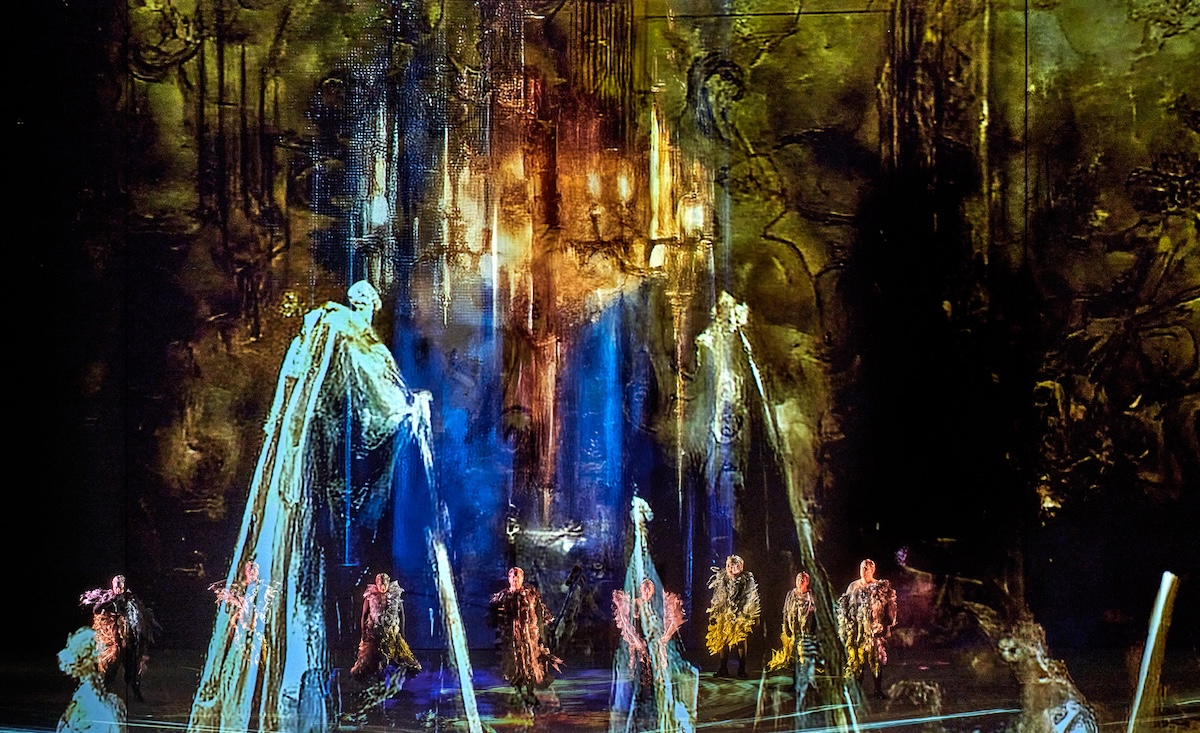
Bayreuth 2026: Das Rheingold. Photo © Enrico Nawrath

Artificial intelligence is already a remarkable creative tool, but at its present stage it still requires human creative clout to shape meaning, establish dramatic purpose and distinguish insight from novelty. Bayreuth instead presents a production that celebrates the festival’s artistic, political and social evolution through AI-generated imagery while predominantly embracing the static conventions of a concert performance.

No director is listed in the credits – the production’s first and most telling blunder. Instead, curator Marcus Lobbes oversees an artistic concept that fuses Bayreuth’s history – drawing upon archival footage, stage designs, costume studies and imagery from every Bayreuth Ring production between Wagner’s original 1876 staging and 2024 – with AI-generated visuals and experimental digital theatre.

The anniversary production ultimately seems more concerned with commemorating its own historical significance than creating compelling theatre.

The consequences are immediately apparent. Seemingly without dramatic direction, the singers enter, deliver their music in largely concert formation and shuffle off. Few relationships develop physically, touching is almost non-existent, and even the many deaths brought about by the Ring’s curse barely register theatrically. Only as the cycle progresses – after an especially stiff and dramatically inert Das Rheingold – do the performers gradually reclaim some humanity.

Lobbes provides one consistent framework by beginning each scene with imagery drawn from the 1876 premiere before referencing Bayreuth’s subsequent fourteen Ring productions through an evolving collage of historical visual styles. Doubtless, some audience members delighted in identifying the imagery; I suspect many others, myself included, had little interest in playing the game.

Bayreuth 2026: Die Walküre. Photo © Enrico Nawrath

Lobbes has spoken of the many questions The Ring poses. Throughout the performance, however, other questions became more pressing. What freedom had the performers been given to shape their characters? How much agency remained once AI had assumed responsibility for the production’s visual language? And, over more than 15 hours, how was an audience expected to remain emotionally invested when so little dramatic interaction unfolded?

On stage, there are no storytelling props — no Ring, Tarnhelm, Nothung or gold, either literal or symbolised. The restless imagery does occasionally gravitate towards the text, producing fleeting moments of recognition: a dragon-headed serpent appears as Alberich transforms into a giant snake; toads flood the visual field as he assumes their form; a giant bear’s head hovers as a reference to Siegfried’s captured beast; and an assortment of birdlife arrives in abundance with the Woodbird.

The production also attempts to overlay The Ring’s 150-year journey with the historical events surrounding it, producing connections that are more decorative than dramatically meaningful. Hitler appears during Brünnhilde’s descent on Wotan’s command to abandon Siegmund.

Footage from the presidential motorcade moments before John F. Kennedy was assassinated appears to foreshadow Siegfried’s fate. Astronauts Neil Armstrong and Buzz Aldrin loom over Wotan and Siegfried during their pivotal confrontation in Act III of Siegfried, before the young hero shatters Wotan’s spear and presses on to Brünnhilde. Later, a sign reading “Sorry! No gas today” as Brünnhilde awakens, appears to reference the 1970s oil crisis — an abrupt visual joke, perhaps suggesting a depleted fuel source for the fire surrounding the Ring.

Such imagery occupies only fleeting moments across the vast span of the cycle. It remains strangely memorable – functioning almost like subliminal advertising, creating an impression of significance before disappearing. The effect is mildly seductive but ultimately hollow. Furthermore, each scene becomes an isolated island, occasionally beautiful, but rarely connected to the dramatic current flowing between them.

Bayreuth 2026: Seigfried. Photo © Enrico Nawrath

The singers are positioned between a foreground scrim and a rear screen, both capturing imagery that often creates a striking three-dimensional effect. Yet little sense is made of Pia Maria Mackert’s wacky, dark, ink-stained and feathered costumes, which evoke a strange collision of fin-de-siècle decadence and an exaggerated American Indian-inspired aesthetic. Each character appears almost like part of a collectible set – at times flickering like holograms beneath the relentless barrage of imagery, while the lighting alternates between moments of golden clarity that allow the figures to emerge with beauty and passages so dimly lit that the singers themselves almost disappear.

Most frustratingly, the pleasure and frustration of analysing a director’s conceit is absent. For more than 15 hours, the same relentless format persists — there is little sense of discovery, no gradual unfolding of a theatrical vision, and no feeling of the sprawling narrative gathering meaning. This is not to say there are no moments of beauty or vivid detail where music, character and imagery briefly converge. Yet too often the projections simply drift and reform like ink in water, illustrating rather than interpreting the drama.

If the production struggled to create dramatic meaning, the musical standards were altogether another matter – Bayreuth assembled an exceptional cast of Wagnerian artists whose performances rose above the concept imposed upon them.

Now 26 years on from his Bayreuth debut, and having conducted all 10 of Wagner’s mature operas at the festival, Christian Thielemann is the hero of The Ring. Thielemann carries the momentum along with impressive, articulated beauty while allowing the music to both draw breath and pause to elicit anticipation. Meticulously detailed, from the most delicate finery to enveloping explosiveness, his is a masterclass in musical storytelling that continually transcends the relentless distraction of the imagery.

If there is one musical reservation, it lies in Siegfried’s Forging Song, which lacked the bellows needed to ignite the scene. Otherwise, the score glistens throughout. Perhaps the production’s wisest theatrical decision is to begin each scene behind a closed curtain as the preludes unfold — a reminder that The Ring ultimately lives through Wagner’s music.

A seasoned interpreter of Wotan, German baritone Michael Volle – long one of Bayreuth’s defining artists and surely destined to be remembered among the great Wotans of the 21st century — gives a dynamically sculptured performance of immense authority and conviction. Nuanced, text-attentive and gifted with remarkable fluidity of voice, he commands with the power of a great church organ filling its space.

Volle emerges as the cycle’s most completely realised character, alongside German tenor Gerhard Siegel’s outstanding Mime. As Alberich’s whining brother, Siegel combines sharply inflected singing with wonderfully animated characterisation, producing one of the production’s richest dramatic portrayals.

Bayreuth 2026: Seigfried. Photo © Enrico Nawrath

German baritone Jochen Schmeckenbecher brings dark, masterly intent to Alberich, while German tenor Klaus Florian Vogt undertakes the formidable achievement of singing three major roles across the cycle. His agile instrument, lyrical warmth and ringing upper register remain immediately attractive, although such an undertaking inevitably invites compromise. As Loge, greater vocal animation would have added more mischief and fire. His Siegmund is nobly sung, while as Siegfried there are moments where vocal pacing and sculpturing fall short of the exhilaration the role can ultimately achieve.

Finnish soprano Camilla Nylund charts Brünnhilde’s remarkable journey from warrior goddess to self-sacrificing woman with commanding vocal shading and an assured radiance that avoids unnecessary heaviness. She also brings magnetic stage presence to a production that too often leaves its singers dramatically isolated. The concluding duet of Siegfried, bringing together Nylund’s Brünnhilde and Vogt’s Siegfried, “Heil dir, Sonne! Heil dir, Licht!”, however, felt more like two impressive voices in competition than a single dramatic union. That emotional fusion was restored in Götterdämmerung, where their short Act I duet proved compelling, heralding a richer, fresher-sounding Vogt as Siegfried moved towards his fateful end.

Another standout achievement comes from Mika Kares, employing his deeply carved bass with towering impact in the roles of Fasolt, Hunding and Hagen. Matching self-assured stability with plummy vocal intensity, Anna Kissjudit makes an impressive Fricka. Evelin Novak is especially radiant and penetrating as Freia, as is Elza van den Heever’s anguished Sieglinde.

Christa Mayer brings outstanding plushness to both Erda and Waltraute, while the Rhine Maidens Katharina Konradi, Natalia Skryckar and Marie Henriette Reinhold blend into a gleaming vocal trio.

Magdalena Hinterdobler steals the Ride of the Valkyries scene with a spectacular, jolting Helmwige of fearless brilliance before bringing an equally electric charge to Gutrune. The chorus is superb, ringing out splendidly but cunningly kept out of view, providing a moment of tearful elation in the beauty of “Heil dir, Gunther!”

Through to the culminating Immolation Scene, the regality and resoluteness Nylund sustains remain affecting. Along the way, however, a disappointing moment occurred during Siegfried’s Funeral March when – just after Siegfried was struck in the back by Hagen in a rare moment of genuine dramaturgy – the curtain abruptly closed, robbing this monumental passage of its full dramatic impact.

When the cycle concluded, the final curtain call looked much like every other evening – until the creatives made their appearance and an eruption of boos thundered through the Festspielhaus, unlike anything I had experienced before.

Bayreuth 2026: Götterdämmerung. Photo © Enrico Nawrath

Tucked into a tranquil, hedged courtyard to the southeast of the Festspielhaus on Green Hill lies a memorial garden that conveys more emotional truth about the repercussions of unchecked, ruthless power than this AI-driven undertaking ever manages. Here, among the stories of artists whose lives were irrevocably changed by the festival’s unquestioned links to Hitler’s Nazi regime, Bayreuth-born soprano Claire Born is among dozens memorialised. Forced from the German stage because her husband was deemed a “Jew,” her story is a poignant reminder of the human cost of tyranny.

While Bayreuth has demonstrated admirable courage in facing its past, marking a 150th anniversary with a production that merely recycles and morphs imagery from the festival’s history – without any attempt to confront and distil the artistic achievement of Wagner’s Ring itself – ultimately settled for far less than what it might have been. The work and everyone on both sides of the stage deserved better.

The 2026 Bayreuth Festival continues until 26 August.

Contribute to Limelight and support independent arts journalism.