


Simone Young talks to Jo Litson about her love of Wagner, the differences between conducting at Bayreuth and in concert at the Sydney Opera House, and why Richard Strauss’s Salome is the perfect opera to program after the conclusion of the Sydney Symphony Orchestra’s triumphant Ring Cycle.
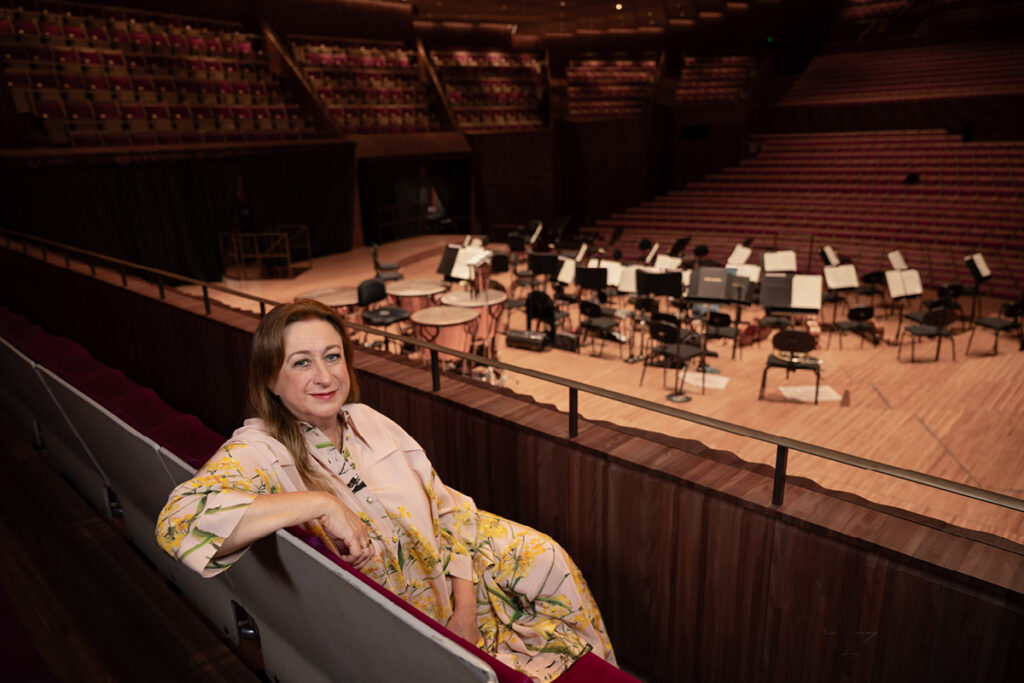
Simone Young can remember exactly when Wagner first entered her life and changed it forever.
“I was about 14,” she says. “I used to travel from [my] school on Sydney’s North Shore to the Conservatorium once a week, because I was studying music theory at a more advanced level. One afternoon, our teacher put an LP on the turntable. He didn’t say very much. He just said, ‘Listen.’”
“It was the Prelude to Tristan und Isolde. I’d never heard anything like it. Wagner hadn’t written piano music, so as a young pianist I simply hadn’t encountered him. I was absolutely transfixed. That single piece of music changed my life. From that moment, [Wagner] became a lifelong passion.”
Her first experience actually playing Wagner was, she says, “just as life-changing”.
“I was working for Opera Australia as a répétiteur. One day, I was due to play at rehearsals for The Merry Widow with Richard Bonynge. At exactly the same time, downstairs, Stuart Challender was rehearsing Act I of Die Walküre with Marilyn Richardson and Robert Gard.”
“Martin Handley was playing the piano. Richard wanted Martin upstairs to deal with something involving the chorus, so someone said, ‘Simone can go downstairs.’ I protested all the way [saying], ‘I’ve never played Walküre. I don’t know it.”
“I like to think that if Mahler had ever visited Australia, he would have fallen in love with Uluru.”
“I was terrified of Stuart,” admits Young. “He simply said, ‘You’ll prompt the singers.’ I admitted I barely knew the German. Finally, I said, ‘I can sightread if you conduct me.’ So, Stuart conducted and I sightread the entire first act of Die Walküre.”
“At the end of the rehearsal he walked over to me and said, ‘The last person around here who could do that was me. I think I hate you!’ Half an hour later he asked me to become his assistant for the Seymour Group. That was the beginning of our long working relationship [until his death in 1991]. So, Wagner has been part of my life for almost as long as I can remember.”
Young is now firmly established as one of the world’s leading interpreters of Wagner, Mahler and Strauss. She conducted her first full Ring Cycle in Vienna in 1999 followed by cycles in Berlin and Hamburg.
In 2013, to mark the bicentenary of Wagner’s birth, she conducted all 10 of his major operas during a landmark three-week festival at Hamburg State Opera, where she served as Artistic Director and General Manager from 2005 to 2015.
“Daniel Barenboim is the only other person who’s done that,” she says now. “It was something you can only really attempt in an anniversary year. What astonished me was how much I learned about each work simply by having them in such close temporal and physical proximity. I came out the other end a changed musician.”
In 2024, Young made history as the first woman and first Australian to conduct the Ring at the Bayreuth Festival in the theatre Wagner built to stage his operas. That same year, she conducted three performances of Das Rheingold (the first opera in the tetralogy) at Teatro alla Scala in Milan, replacing Christian Thielemann, who had to withdraw to have tendon surgery, and she returned to La Scala in March this year to conduct the full Ring Cycle directed by David McVicar.
Now a go-to music director at Bayreuth, she will conduct Die Meistersinger von Nürnberg there in 2027.
On the last day of this year’s 150th-anniversary season, she was invited to deliver a tribute at a ceremony honouring Barenboim, who was named the first Honorary Member in the history of the Bayreuth Festival.
“I [felt] very touched because my first Bayreuth experience was as Daniel’s assistant,” says Young. “Then, I went on to conduct my own Ring cycles there. My Ring at La Scala was the first there since his, so there are lots of connecting points.”
This month, Young will conduct Götterdämmerung at the Sydney Opera House, completing the four-year Ring Cycle in Concert she initiated at the Sydney Symphony Orchestra, where she has been Chief Conductor since 2022.
It’s been a thrilling venture, with Limelight awarding five-star reviews to each of the first three operas – Das Rheingold in 2023, Die Walküre in 2024 and Siegfried in 2025. With a cast led by German tenor Klaus Florian Vogt, making his Australian debut as Siegfried, and German-Italian soprano Anja Kampe as Brünnhilde, Götterdämmerung promises to be every bit as exciting.
Inspired by Australia’s Landscape
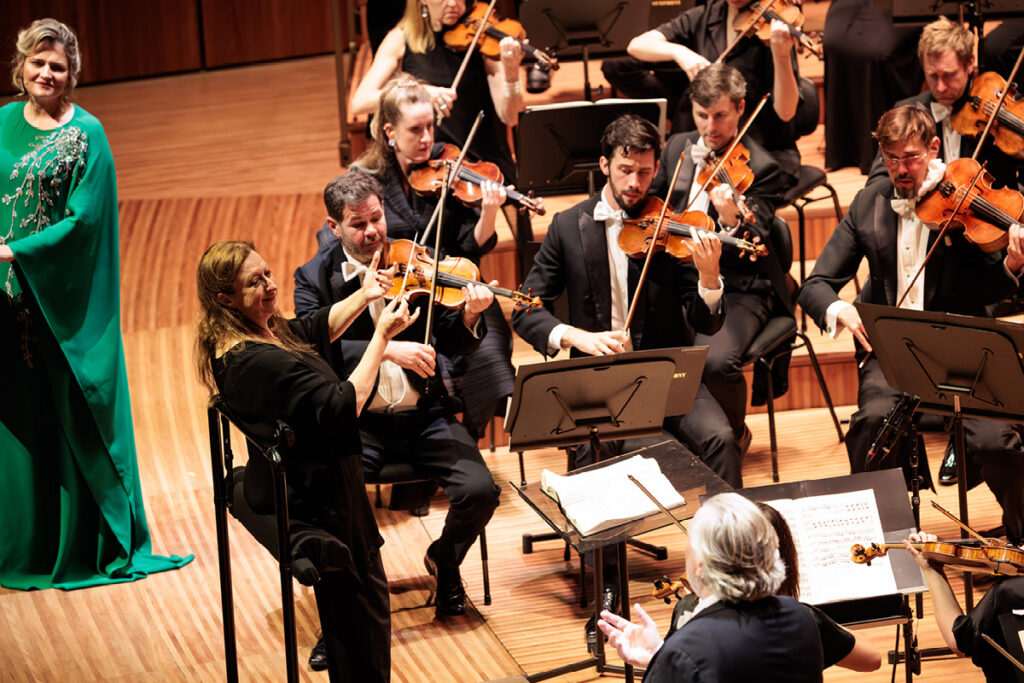
Young is in an expansive mood as she faces a two-prong encounter with Limelight in her Sydney Opera House dressing room, answering questions from two journalists for this feature as well as a news story about the SSO’s 2027 season.
Noticing that her silk shirt is almost exactly the same mulberry colour as the sofa on which she is sitting, she quips that she could easily disappear into the upholstery. Not likely! With her forceful intelligence, insightful mind and eloquent conversation, there is no way that Young would ever fade into the background. Instead, she is wonderfully illuminating as she discusses Wagner and Richard Strauss, whose opera Salome she will conduct in concert with the SSO in 2027.
Asked where she draws inspiration when conducting their works, she admits she’s “not especially interested in biographies”, though she has, of course, read all the major ones.
In 2027, she continues her tradition of opening the SSO’s new season with a Mahler symphony – this time the Seventh.
“My husband and I have just moved house in England, which meant unpacking and reorganising my entire library. I own a facsimile of Mahler Seven in manuscript, and I’ll spend time studying that again,” she says. “I deliberately kept all my Mahler and Janáček books out of storage so I can reach them whenever I need them.” (She conducts Janáček’s Katia Kabanova for Opéra national de Paris in January/February 2027.)
“I don’t believe music belongs in a museum,” she says, “but I do believe if you’re going to be an honest performer and an honest conductor, you have to make every effort to walk in the composer’s footsteps.”
Surprisingly, perhaps, Young finds inspiration for her approach to Mahler and Wagner in the Australian landscape – “standing out in far Western New South Wales or in the Northern Territory, where you can turn in every direction and see nothing but horizon. Perhaps there’s a single saltbush. The overall landscape is immense – almost beyond comprehension – but within it, those tiny details suddenly become profoundly significant. That’s how I think about Mahler.”
“I spend a huge amount of rehearsal time thinking about what I call the aural perspective within a Mahler symphony,” she continues.
“Too often people hear Mahler as though it’s two-dimensional. For me, it’s three-dimensional, almost four-dimensional. My job is to reveal those magical details that exist within the vast landscape. That probably sounds terribly pretentious,” she laughs.
“I’ve visited Mahler’s composing huts. I’ve walked around the lakes. I’ve spent time in Vienna and Hamburg. I’ve looked for hours at [paintings by] Klimt. I’ve read Karl Kraus and the other writers of that period. I’ve studied Berg, Zemlinsky and Richard Strauss. I’ve done all of that.”
“But Mahler wasn’t simply a composer. He was an extraordinary conductor who spent his life wrestling with theatre politics in Hamburg and Vienna before escaping every summer to compose in the countryside. For him, that countryside meant mountains and lakes. For me, it means the Australian interior.”
“I like to think that if Mahler had ever visited Australia, he would have fallen in love with Uluru.”
Turning to Wagner she says, “I learned more about [him] hiking on a glacier in Norway than I ever learned from reading biographies. In fact, I avoid biographies of Wagner. My fear is that if I learned too much about the man, I’d dislike him so intensely that I’d find it difficult to conduct his music. Instead, I study his music and his writings.”
“I’ve never really thought about this before, but I think I treat Wagner as something almost abstract – as music, literature and philosophy. Whereas I think of Mahler as intensely human.”
“[In his book Why Mahler? How One Man and Ten Symphonies Changed Our World] Norman Lebrecht wrote a fascinating chapter about Mahler’s childhood: upstairs children were dying one after another; downstairs in the family inn there were weddings with klezmer musicians; nearby military bands were rehearsing.”
“Mahler grew up surrounded by these extraordinary emotional and sonic contradictions. Then he became the man trying to balance opera budgets [as Director of the Vienna Court Opera].”
“Mahler’s music feels profoundly human to me. Wagner’s inhabits a more metaphysical world. That’s actually quite an interesting realisation. After 40 years, I’ve discovered something new to say!” she laughs.
A Diamond Ring
As Young prepares to conduct Götterdämmerung in Sydney, she says that the response to the SSO Ring Cycle in concert has far “exceeded every expectation” she had.
“A Ring cycle is always significant. Every generation discovers it afresh – some musicians have never played it; some audience members have never heard it. Sydney hadn’t experienced the Ring since Edo de Waart’s performances, so effectively an entire generation was encountering it for the first time.”
(De Waart, a former Chief Conductor and Artistic Director of the SSO, led the orchestra in concert performances of the tetralogy between 1995 and 2000.)
“I expected it to be important,” continues Young. “What I didn’t expect was what happened with Siegfried. Das Rheingold and Die Walküre are almost always successful. Siegfried is different. Its first act is much more conversational, less immediately melodic. I wondered how audiences would respond.”
“I’d never previously conducted it in concert. I knew we had assembled a sensational cast, but I certainly didn’t expect it to become the talking point of the entire season. That was thrilling. Introducing Gerhard Siegel to Sydney audiences for the first time was particularly satisfying,” she says of the German tenor who wowed audiences with his wonderfully expressive, off-book performance of Mime.
Young believes that one of the fascinating aspects of performing Wagner in concert, is that you are able to convey a greater dynamic range within the music.
“In the pit, an orchestra can sometimes play pianissimo and simply sound dead because of the acoustic. Everything gets compressed. On stage, you can truly play from the softest whisper to the biggest fortissimo. At one point, Gerhard turned to me and said, ‘It’s extraordinary that I had to come to Sydney to hear an orchestra actually play pianissimo in that passage.’ I thought that was one of the greatest compliments the orchestra could receive.”
With almost five hours of music, Götterdämmerung presents a huge set of challenges which the SSO musicians have embraced.
“The orchestra has been talking about Götterdämmerung ever since we finished Siegfried. The horn players, particularly, have been looking forward to it because this is their Everest. Wagner writes for 13 horns. It’s almost ridiculous. There are eight horns on stage, the Siegfried horn, another four horns backstage [as well as] offstage trumpets, offstage trombones and a huge male chorus,” explains Young.
“Then there are the practical realities. A symphony orchestra normally rehearses in two-and-a-half-hour calls. Act I of Götterdämmerung is almost two hours long, so you can’t even play it through and stop to correct things within a normal rehearsal.”
“Then you have to work around singers’ stamina. A Brünnhilde simply can’t sing a full dress rehearsal the day before and then expect to perform at her best the following evening. Everything becomes an enormous logistical puzzle.”
“Ironically, once all of that planning is done, conducting it becomes the easy part. I’ve conducted the work so often now that it’s completely internalised. You could ring me this afternoon and say, ‘We’ve moved rehearsal to two o’clock.’ I’d simply say, ‘Fine.’ It’s all here – in my head, heart and body.”
The Right Shoes
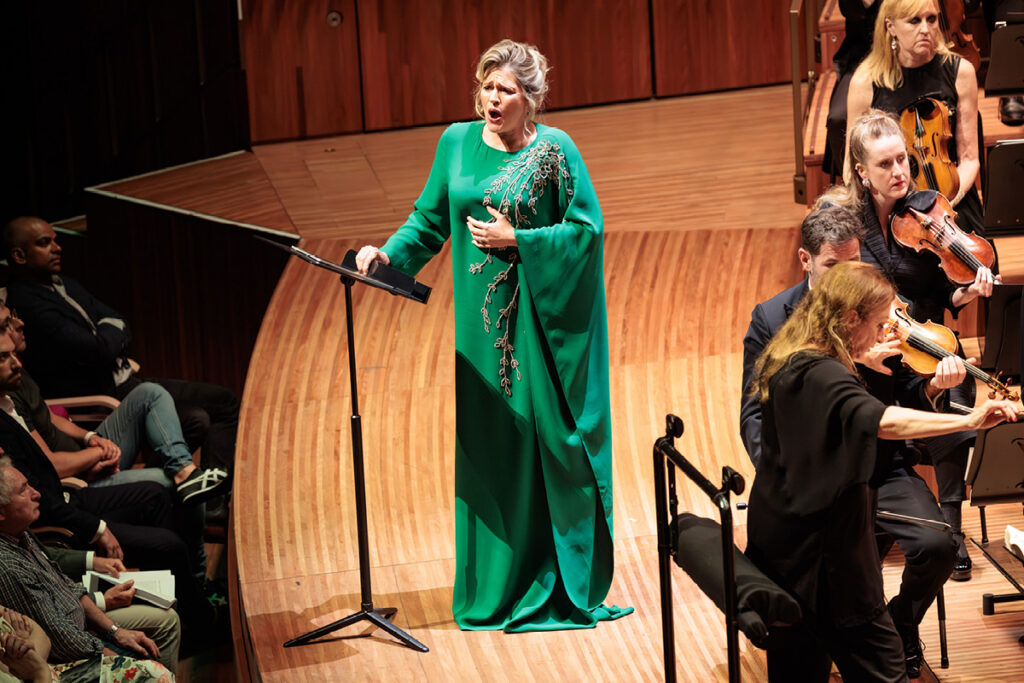
Conducting at Bayreuth is worlds removed from conducting one of Wagner’s epic music dramas in concert at the Sydney Opera House.
“I’d compare it to the difference between acting for film and acting on stage,” offers Young.
“The objective is the same – I’m trying to recreate the Bayreuth sound – but physically they’re entirely different experiences. At Bayreuth you conduct sitting down. Here, I’ll be standing. They’ve actually built me a special podium with a padded rail at the back so I can perch on it when necessary. We first used it for Siegfried, and it will certainly be coming out again.”
Young became famous for wearing vertiginous stilettos on the podium. Asked if she’ll wear heels for Götterdämmerung, she says, “Little ones. Not during rehearsals – those are definitely trainers – but for performances, yes.”
“Birgit Nilsson always said that what she needed most to sing Isolde was a good pair of shoes.’ She was absolutely right.”
The layout of the musicians in the pit at Bayreuth is intriguing. As Young explains, “The first violins sit on your right instead of your left. The second violins are on the opposite side. The violas are split across the width of the pit, the cellos likewise. The double basses are divided four and four, and the six harps are arranged three on each side.”
“We’re actually going to do the same thing in Sydney with the harps. I’ve never tried that on a concert platform before.”
“The brass at Bayreuth are positioned almost two storeys below the conductor, hidden beneath the stage. Their sound rises through the covered pit and blends before it reaches the audience. Here, the brass are physically much higher. So, the entire acoustic perspective is reversed. The challenge is to create the same aural perspective despite a completely different physical environment. That demands countless tiny adjustments of timing, balance and colour.”
The Perfect Opera
When it came to discussions about how to follow the Ring, Young says there were lots of suggestions such as Wagner’s Tristan und Isolde and Parsifal.
“But I thought, ‘No, we’ve travelled that road.’”
Instead, she settled on Richard Strauss’s Salome, which she believes is “completely connected” to the Ring and which she considers “a perfectly cut jewel.”
“It lasts about 100 minutes. It’s shorter than Act I of Götterdämmerung. When it’s over, you don’t wish it were a minute longer or a minute shorter. There isn’t a note you could remove or another note you would want Strauss to have written. It’s simply perfect.”
Young conducted her first Salome in Vienna in 1995 with no orchestral rehearsal whatsoever. “I literally walked into the pit and conducted the performance. And I haven’t stopped conducting it since,” she says.
“My very first experience of the opera, though, was actually with Opera Australia. It was performed in the Concert Hall at the Sydney Opera House not long after the building opened. I must have been 13 or 14. I remember almost nothing about the production except this enormous cistern on stage with Salome [played by Marilyn Richardson] perched on top of it – and, of course, that extraordinary orchestra.”
“Then, in 1982, I found myself playing in the orchestra for Opera Australia when Marilyn sang it [again]. We’ve remained friends ever since.”
“I’m still in love with the score [and] I’m still discovering new things in it. Of course, my understanding of the work is now infinitely deeper than it was back then. I’ve studied Strauss’s revised French version, which he prepared for a lighter soprano. That’s fascinating because Oscar Wilde originally wrote the play in French.”
“In fact, my first encounter with Salome was through Wilde. I went through the play in French laboriously, dictionary in hand, when I was about 13 because I was completely obsessed with Oscar Wilde. Only afterwards did I discover that Strauss’s opera is a German translation of Wilde’s French text.”
“Anyway, the point is that after 40 years I know every note of this score.”
“Opera was my first love. If I’m Chief Conductor of the Sydney Symphony, I think audiences should occasionally experience what I do best.”
Young has cast Irish soprano Sinead Campbell Wallace – whom she has known for 25 years – as Salome. “She’s only been singing the role for a couple of years, so it’s tremendously exciting to introduce someone who is still relatively new to it.”
Gerhard Siegel and Wolfgang Koch, who starred in Siegfried last year, will play Herod and Jochanaan respectively.
“Gerhard was an extraordinary Mime, and he’ll make a magnificent Herod,” says Young. “Wolfgang simply is Jochanaan. He sang his first Jochanaan with me in Hamburg. I love the way all these threads keep coming together.”
“The remainder of the cast is drawn largely from Australia and New Zealand, which makes me enormously happy.”
Young will be conducting the full orchestration. “The reduced version is performed all over the world because many pits simply can’t accommodate Strauss’s original scoring,” she says. “I’ve conducted the reduced version myself, although I confess I’ve quietly restored a few things – putting the heckelphone back, adding another harp, restoring the fourth trumpet.”
“The standard reduction has only four horns instead of eight. There are no Wagner tubas. It’s dramatically scaled back. Sydney is ready to hear the score exactly as Strauss wrote it.”
“People ask, ‘How can you perform Salome in concert? What about the Dance of the Seven Veils?’ Just wait until you watch our orchestra play it. You won’t need anything else.”
“Something audiences discovered during the Ring Cycle was that watching the orchestra perform can itself become an extraordinary visual experience. People worried they would miss the staging. Instead, they became fascinated by seeing the musicians creating these vast sound worlds in front of them. I think exactly the same thing will happen with Salome.”
Young is firmly convinced that the end of the Sydney Symphony season is the right place for one major opera in concert.
“Not more than one – we’re a symphony orchestra, and that’s our primary responsibility – but playing opera is one of the greatest things an orchestra can do,” she argues.
“The musicians don’t always realise it immediately, but everything they’ve learned from Wagner feeds directly into Brahms, Bruckner and Strauss. As we return to those composers, all the experience they’ve accumulated through the Ring will suddenly begin to illuminate the symphonic repertoire.”
“The same is true of Mahler. Everything we’ve explored in Mahler now feeds naturally into Strauss. We’ve been steadily building the orchestra’s Strauss repertoire over the past five years, so this all feels like a logical progression.”
“I don’t know whether we’ll always finish the season with an opera, but I certainly want to end each year with a major vocal work. If it’s not an opera, perhaps it’ll be a large-scale oratorio. It feels exactly right. The ballet season is on, Opera Australia isn’t presenting opera in Sydney at that time, and there’s an audience in Sydney that’s hungry for this repertoire.”
“Opera was my first love. If I’m Chief Conductor of the Sydney Symphony, I think audiences should occasionally experience what I do best.”
Simone Young conducts Götterdämmerung in concert with the Sydney Symphony Orchestra at the Sydney Opera House on 19 & 22 November; and Salome on 12 & 13 November, 2027.




Comments
Log in to start the conversation.