

As the epicentre of Wagnerian culture, Bayreuth has long relied on re-examination, reinvention and bold ideas to keep Richard Wagner’s legacy alive.
This year marks another milestone, with a landmark production of his third opera, Rienzi – one of three works excluded from the canon of 10 operas regularly performed at the purpose-built Festspielhaus – included in the program’s 150th anniversary celebrations.
Co-directed and designed by Alexandra Szemerédy and Magdolna Parditka, it is a glowing achievement in Bayreuth’s evolving history for what is intended to be its only appearance.
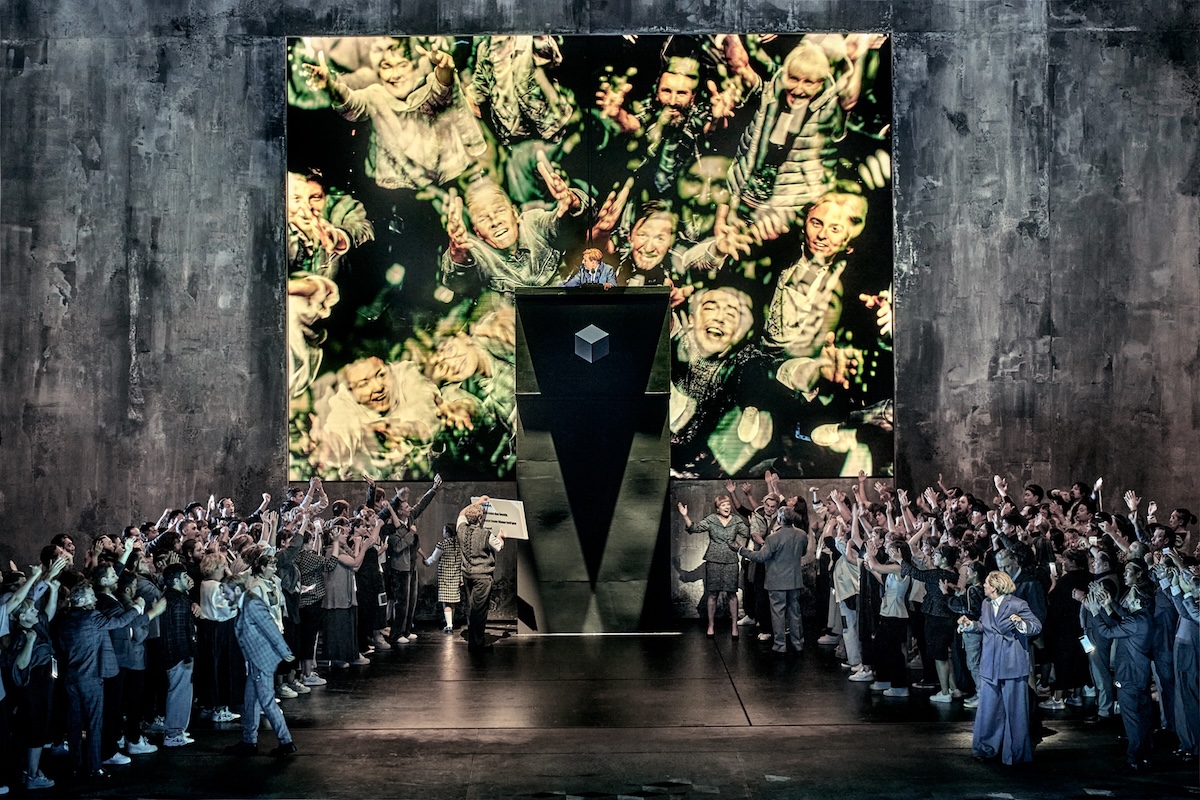
Rienzi. Photo © Enrico Nawrath / Bayreuther Festspiele
Completed in 1840, around the same time as The Flying Dutchman, Rienzi, despite its early success, was later regarded by Wagner as a youthful work unfit to represent his artistic ideals.
Indeed, it has its flaws, primarily in its dramatic pacing and abundance of compositional ideas that sometimes struggle to cohere, particularly across the first two of its five acts. Nevertheless, the score – clocking in at almost four hours in this edition – bursts with exhilarating intensity, with the massive Bayreuth Festival Chorus often taking centre stage in an array of roles alongside the requisite grand spectacle.
In the tradition of Meyerbeer and Halévy, Rienzi is a grand opera about political leadership, mass movements and factional divisions, foreshadowing many of the themes Wagner would later develop in his mature works.
The opera is based on the story of the 14th-century Roman tribune Cola Rienzi, who defeats the corrupt, feuding nobility and unites the people. But public opinion turns against him as Rienzi’s relentless pursuit of power alienates those around him, leading to his fall and ultimate death at the hands of rebellious citizens.
Personal tension emerges through Rienzi’s seemingly co-dependent bond with his sister Irene, whose relationship with the nobleman Adriano (a pants role) ultimately draws him into pledging support for Rienzi. In the historical narrative on which the opera is based, none of them survives.

Jennifer Holloway, Gabriela Scherer and Andreas Schager in Rienzi. Photo © Enrico Nawrath/Bayreuther Festspiele
For the Festspielhaus stage, Szemerédy and Parditka – barring a couple of questionable choices – bring judicious conceptual clarity without overcrowding the epic nature of the work. During the overture, a backstory plays out across three diagonally set cubic rooms in which Rienzi and Irene share a secret intimate relationship as their much younger brother – an invention in this production – suffers convulsions before later dying. It is a jarring image against Wagner’s symphonic music, but within these opening minutes what emerges of Rienzi is his industrious nature, his devotion to family and the first signs of a volatile temperament.
One might conclude that the young boy is this sibling pair’s son (a reference to Siegfried, son of Siegmund and Sieglinde, comes to mind), if not for the program notes. Regardless, the sexual nature of Rienzi and Irene’s affair feels like a gratuitous bid for shock value that diminishes the potential of a family relationship that could have proved sufficiently compelling on its own.
Far more interesting is the dynamic established between Irene and Adriano, in which Adriano could easily be interpreted as a woman whose lesbian relationship with Irene becomes highly believable.
As the first act opens, the cubic form rises into a four-level structure of concrete, glass and metal on an oppressive scale, forming part of what is eventually revealed, via Leonard Koch’s video work, to be a sprawling, overcrowded metropolis. It is a futuristic, shadowy digital world under Bernd Gallasch’s lighting design, in which screen use is manic and public surveillance omnipresent, feeling only a theatrical step removed from the direction in which democratic societies appear to be heading.
Almost the entirety of the first act is treated as a political campaign in which Orsini and Colonna compete for power before Rienzi enters the contest. It unfolds as a live-televised political spectacle, with onstage camerawork capturing every developing moment as journalists report from the Capitol.
Gabriela Scherer, Jennifer Holloway and Andreas Schager in Rienzi. Photo © Enrico Nawrath/Bayreuther Festspiele
With Rienzi victorious, a lavish entertainment for political guests takes the form of Wagnerian spectacle. In the middle of Act 2, where the original score calls for a ballet depicting The Rape of Lucretia, a smorgasbord of Bayreuth’s Wagner canon — including a comic, slapstick version of The Ring – is staged within a recreated Festspielhaus.
References to the festival experience abound, from patrons emerging from extended periods of sitting in a rush for bratwurst and champagne to joining the long toilet queues. At close to 20 minutes, it is a show within a show: light relief that nevertheless points to the enduring appeal of Wagner’s work, even in satire.
Musically, Acts 3 to 5 are much more tightly constructed and dramatically buoyant. Less attention is given to the role of the Church, but messianic elements are extended to Rienzi’s charismatic leadership, at least until his attempted assassination.
From there, Rienzi is engulfed by a personal psychological battle that is not always entirely clear but nevertheless charts his decline. The projection of the biblical passage from Matthew 24:1–33, as circumstances deteriorate, clearly signals a warning against false messiahs – or those who rule through deception.
As the finale approaches, Rienzi is seen climbing a stairway to the heavens, confronting a shadowy figure in a scene whose meaning remains elusive, while Irene and Adriano appear to be spared. Perhaps it is the directors’ way of suggesting that his downfall is entirely of his own making. Importantly, nothing suggests that Rome will be any better off. The cycle simply continues.
Rienzi. Photo © Enrico Nawrath / Bayreuther Festspiele
Helming the musical forces, conductor Nathalie Stutzmann brought vitality and melodic shape to the sumptuous score without ever overwhelming the cast, guiding the performance with assurance.
The title role is a punishing assignment, with a vast amount of vocal writing and a demanding tessitura that Austrian Heldentenor Andreas Schager surmounts with formidable authority. Sustaining remarkable vocal strength to the very end, he is particularly striking in his seemingly impossible fusion of head and chest voice, producing a sound of both calculated control and emotional intensity.
Swiss soprano Gabriela Scherer provides remarkable support at his side as Irene – a loyal but increasingly tested figure amid political upheaval – singing with smooth vocal precision, elegant phrasing and dramatic gusto when required.
American soprano Jennifer Holloway, who began her career as a mezzo-soprano, is outstanding as Adriano, her performance gathering intensity as tensions mount to create a formidable portrayal of Adriano’s emotional struggle in the face of Irene’s disturbing attachment to her brother.
Outside this central trio, the remaining cast perform with excellence, particularly German bass Andreas Bauer Kanabas, who exudes the aura of a mafioso boss as Colonna, while German baritone Michael Nagy is a picture of sly suavity as Orsini.
It was surprising that such a history-making event did not break Bayreuth convention by providing overhead surtitles, given the relative unfamiliarity of the work. Then again, leaving the audience slightly in the dark over textual nuances arguably served the directors’ interpretation.
Regardless, should this indeed remain Bayreuth’s only Rienzi, it will have been given a production worthy of the occasion.
Rienzi is performed at the Bayreuth Festival, Germany until 26 August.

Comments
Log in to start the conversation.