

The opera Eugene Onegin, a story of love, regret and tragedy composed by Pyotr Ilyich Tchaikovsky, is based on Alexander Pushkin’s 1833 verse novel of the same name. Pushkin is said to be Russia’s Shakespeare, not least for the fact that he shared The Bard’s inclination to insert – even in the direst tragedies – a bit of comic relief.
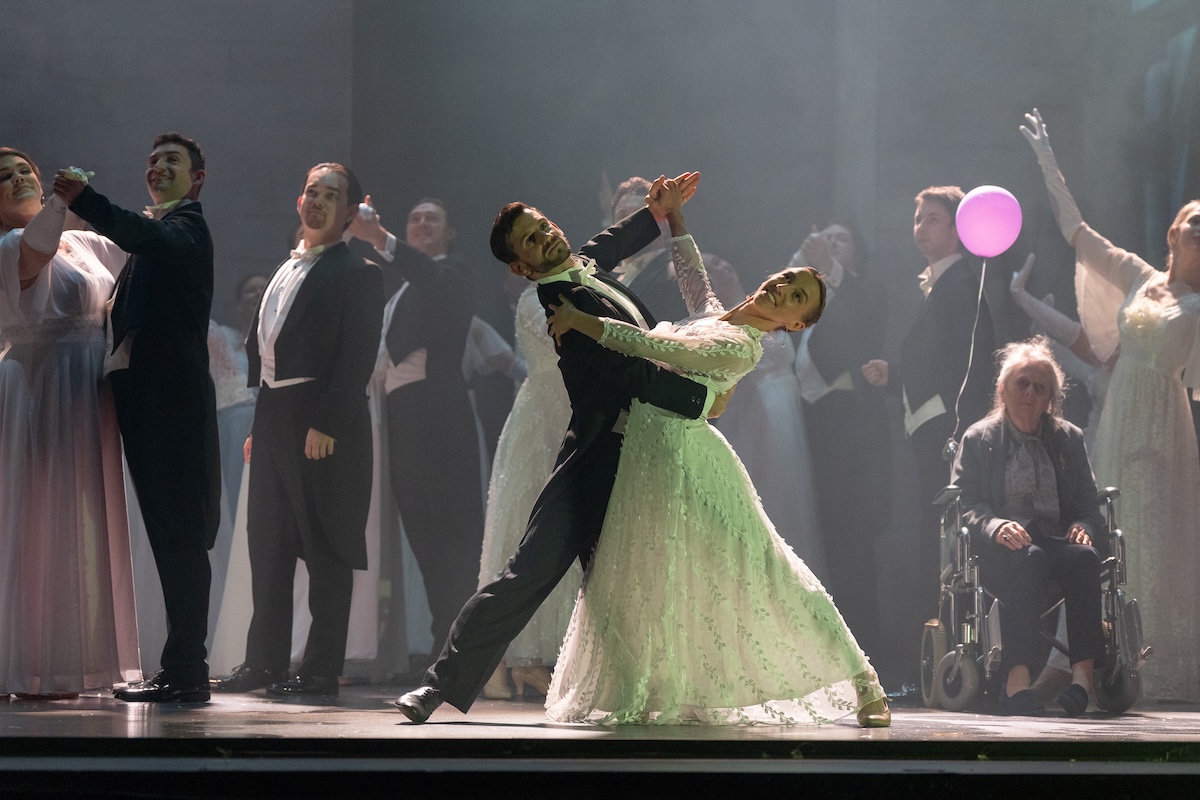
West Australian Opera’s Eugene Onegin. Photo © West Beach Studio
There is much agony in this opera but less ecstasy – even when our heroine, the rural-raised Tatyana (Eleanor Lyons), has become, like Cinderella, a loved and respected princess. The image that comes to mind when, at a ball, she approaches guests to make small talk is of the inconsequential (and probably bored) wives of world rulers put to such work on state occasions (particularly Melania). This ball is where Onegin (Samuel Dundas), back after a long absence from his Grand Tour, realises he was a fool for rejecting Tatyana’s outpourings of love in her country home. And, moreover, if he hadn’t, the tragedy that followed would not have occurred.
There are pivotal and gorgeous vocal moments in this Northern Ireland Opera production, which premiered in Belfast in 2024 and was directed by Cameron Menzies. However, perhaps because of the introduction of a much older Tatyana as a vehicle to reveal her story and memories, it seems ages to get to the substance of the tragedy. She sits in a wheelchair with an attendant, or stands and moves to watch or assist with the action, but adds little to the events.

Paul O’Neill and Ashlyn Tymms in West Australian Opera’s Eugene Onegin. Photo © West Beach Studio
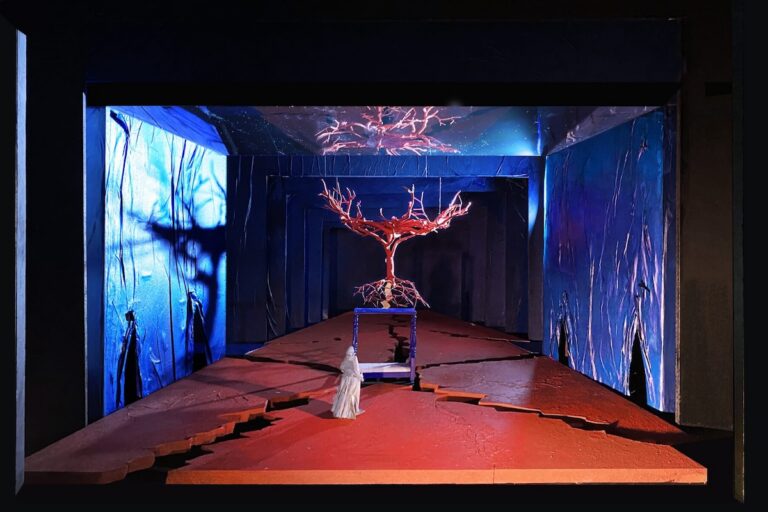
Set designer Niall McKeever encases the stage with three huge walls and a high ceiling. Its lighting (Kevin Treacy) and projection design (Neill O’Driscoll) change its venue from farmhouse to ballroom, bedroom to garden. It’s not an engaging space in itself but is enlivened by workers who arrive in large masks to celebrate the harvest, giving the chorus an opportunity to shine and dancers to perform in soft-coloured dresses or dinner suits.
The farm workers look rather sinister with their large pitchforks – harbingers, perhaps, of the tragedy to come – but here was the opportunity for some comic interlude.
Onegin is a wealthy, idle young man who arrives with his friend Lensky (Paul O’Neill) to meet Lensky’s beloved Olga (Ashlyn Tymms) and her sister Tatyana, and messes up the lives of all of them.
Despite his rather wooden acting style, Dundas’ voice is masterful, whether sighing over his boredom with life or lecturing Tatyana for her indiscretion. A touch more charisma might have made Tatyana’s obsession with him at first sight a little more believable.

Eleanor Lyons as Tatyana in West Australian Opera’s Eugene Onegin. Photo © West Beach Studio
Lyons is superbly luminous. She sings with convincing and fierce intensity in the famous “Letter Scene”, where, roaming the room in her beautiful light-yellow-cream silk dressing gown, she tries to convince herself that writing a letter to Onegin to let him know of her undying love is the right thing to do.
Her plight is overshadowed by the duel instigated between Onegin and Lensky due to Onegin’s flirtation with the young and mischievous Olga. It causes one of the highlights of this opera: the pre-duel scene when O’Neill, graceful and elegant, sings Kuda, Kuda, vy udalilis, the famous aria regretting the loss of the golden days of his youth. The following duet between him and Onegin, where the hint of a stand-down is so agonisingly close but unrealised, gives an intense torment to its tear-stained delivery.
It is in these moments and the climactic finale that there is no doubt about what brings you back to savour the force and depth of art in the operatic tradition. Who can watch the proud Onegin in a grovelling display at the feet of Tatyana and hear her confess she still loves him but will do her moral duty and reject his pleas? Dundas and Lyons are superb, their voices echoing Tchaikovsky’s music at its best in moments of angst and the realisation that what’s done is done.
Despite the slow start, the powerful pathos and passion of Tchaikovsky’s score, so beautifully played with its profusion of wind, string and brass instruments by the West Australian Symphony Orchestra and so deftly conducted by Christopher van Tuinen, give the opera its emotional depth, enhanced even more by the West Australian Opera Chorus.
___________________________________________________________________________
West Australian Opera presents Eugene Onegin at His Majesty’s Theatre, Perth until 15 August.

Comments
Log in to start the conversation.