The winter spirits seemed restless as Selby and Friends opened the second tour of the 2026 season in the intimate confines of the National Gallery’s James Fairfax Theatre. The box of concert programmes had somehow gone astray. Violinist Natalie Chee’s paper score was not cooperating. At one stage a stand lamp went flying across the stage.
Despite these challenges, three master musicians remained relaxed and unfazed in executing a rich and emotional program with grace and aplomb. Kathryn Selby (piano) was joined by collaborators Chee (violin) and Richard Narroway (cello), and the three of them delivered some truly superb music.
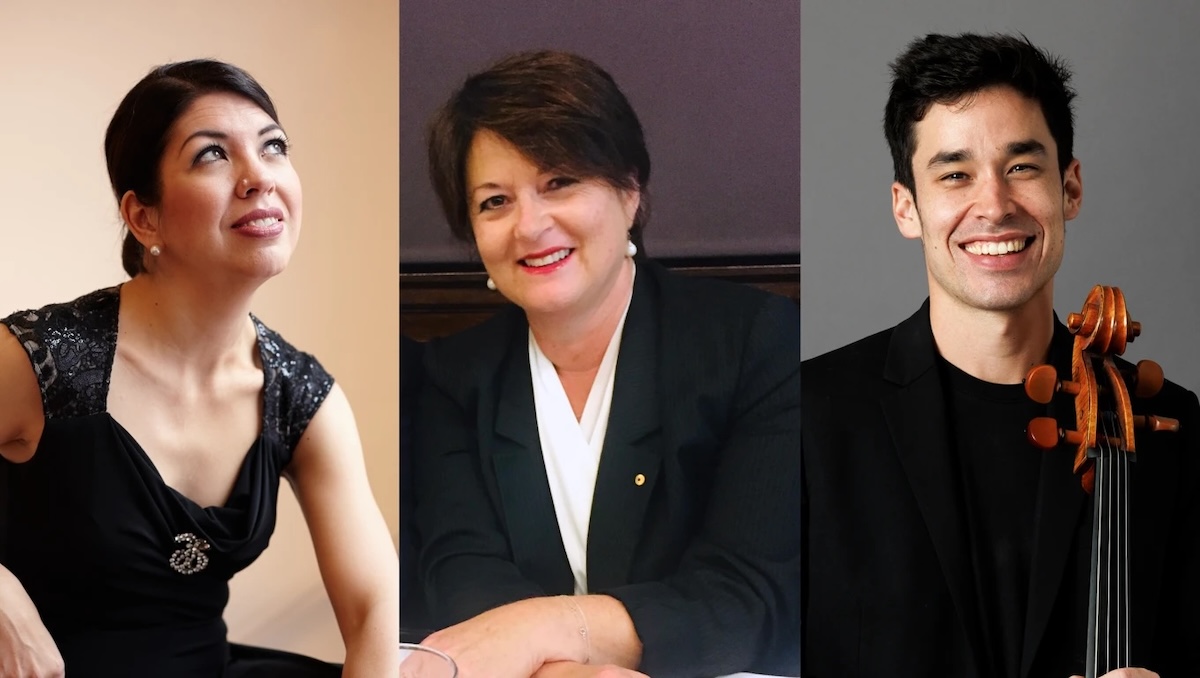
Natalie Chee, Kathryn Selby and Richard Narroway. Photo supplied
An enthralling yet sobering set of eight very short Australian works by women composers reflecting on Australian bushfire experiences opened the concert. Each work in the Fire Dances suite (all under three minutes long) was captivating, but they were especially effective as a collection: from meditative birdsong in Nat Bartch’s Haze for Days, to hammering violence in the piano over-woven with long dissonant notes from the strings in Olivia Bettina Davies’ Haze, contrasts were extreme.
Maria Grenfell’s Wall of Flames employed creative percussion from the cello to evoke the drama, whereas Elena Kats-Chernin’s In the Embers’ Path conjures imagery from a gorgeous cello solo. Cathy Applegate’s Cycads After Fire is written in a more traditional, peaceful pastoral style, before handing to Isabella Gerometta’s very avant-garde Will-O-Wisp to conclude the series.
Two works by Robert Schumann followed, the first showcasing Natalie Chee (Violin Sonata in A minor) coaxing a warm, mellow, viola-like tone from her instrument. While Schumann himself strangely didn’t rate this piece especially highly, its rhythms and contrasts run like the gripping narration to a story. Selby and Chee traded the melody with an assertive ease to a confident and satisfying finish.
Schumann’s Three Romances arranged for cello and piano were originally written for piano and oboe as a Christmas gift to Schumann’s equally brilliant wife Clara. Narroway ended the first, Nicht Schnell (not fast): Moderato with utter delicacy and understatement. The cello’s introspection in the second was rich and meditative, while the third (also marked Moderato) was played in a finely textured, thoughtful interpretation with completely synchronised push and pull between piano and cello.
Finally, Felix Mendelssohn’s Piano Trio in C minor brought the three players together once more, displaying their joint flair for changing moods – restless and passionate in the Allegro; pleading and romantic in the Andante; enthralled and transported in the Scherzo and then fast, furious and driving in the Finale. Selby was consistently sensitive and responsive on the piano, supporting Chee’s restrained use of vibrato on the violin and then Narroway’s freer expression in the challenging third movement.
While there may have been a slight disagreement with how to express the climaxes in the Finale, this was somehow in character in the context of this untroubled, superb trio where no individual dominated.
Selby & Friends presents Romance to Reckoning at City Recital Hall, Sydney on 21 July, the Primrose Potter Salon, Melbourne on 22 July, and Concordia College Chapel, Adelaide on 26 July.

Comments
Log in to start the conversation.